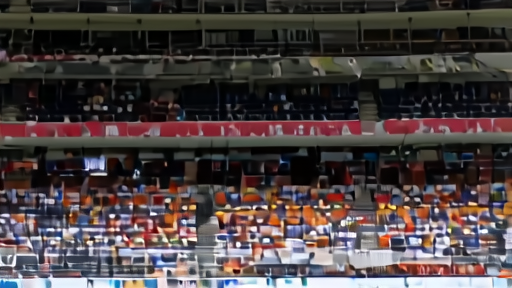
FIFA's official attendance for the World Cup's opening six matches left just 1,574 seats unfilled, according to an analysis by The Athletic — a near-perfect house. [1] The cameras disagreed. Broadcasts from Santa Clara, Guadalajara and Toronto showed whole sections of empty plastic. The gap between those two pictures is not a rounding error. It is a definition, and FIFA has now told everyone which one it uses.
The paper's June 15 edition argued that an audience number means nothing until it carries a method label that tells you what is being counted. FIFA has supplied the label. "Official attendance figures reflect the number of tickets scanned and spectators present within the stadium footprint, rather than visual assessments of seating occupancy at any given moment during the match," the governing body said in a statement posted to X. [1] Read that twice. The count is tickets scanned at the gate and bodies inside the building's perimeter — not bottoms in seats.
That distinction does all the work. A fan who scans in, then spends the half on the concourse buying a beer, is present within the footprint and absent from the seat the camera is filming. FIFA leaned on exactly that after South Korea beat Czechia. "Several ticketed fans could be seen standing in concourses rather than staying in their assigned seats throughout the match," it said. [1] The claim is not disprovable from a wide shot. It is also not verifiable from one.
Hold the specific numbers against the specific pictures. Qatar's 1-1 draw with Switzerland in Santa Clara on June 13 was reported at 67,966, just shy of the venue's 68,827 capacity, while visible blocks sat empty. [1][2] South Korea's win over Czechia in Zapopan drew an announced 44,985 in a 45,664-seat stadium. [2] Canada's 1-1 draw with Bosnia and Herzegovina featured the same noticeable gaps under the same near-full figures. [1] Each number is "scanned tickets within the footprint." None is "seats occupied at kickoff." Both can be true at once, which is precisely why the label matters more than the figure.
FIFA wants the larger frame. Before the tournament opened on June 11, President Gianni Infantino said the body had "sold until today over 6 million tickets" and called demand "unprecedented, by a factor of 10 or more." [1] The organization promised "new benchmarks for attendance and global engagement." Sold, scanned, and seated are three different verbs, and a victory lap that quietly swaps one for another is selling smoke as currency.
The resale data complicates the demand story further. The day before the tournament began, figures published on TicketData.com showed roughly 25,000 tickets sold directly by FIFA and more than 170,000 listed on the resale marketplace. [1] FIFA has said additional tickets will keep being released throughout the tournament, with thousands still available for upcoming fixtures including Switzerland versus Canada on June 24. [1] An event drawing unprecedented demand by a factor of ten does not usually arrive with six figures of inventory still circulating on resale.
This is where the timeline and the wire diverge, and the divergence is the point. On X, the empty-seat clips became "FIFA lied" and "they priced out the real fans, then counted ghosts." The statistician Nate Silver put the suspicion plainly: FIFA's position, he wrote, amounts to "don't believe your eyes, instead trust an organization that benefits from inflating the number." Al Kass relayed the official defense verbatim — the scanned-footprint line — letting the two readings sit side by side. Mainstream coverage from Newsweek, carried by Yahoo, did the same: dueling pictures, FIFA's explanation, no verdict. [1][2]
The paper's verdict is narrower and, we think, more useful. "Record attendance" is not a lie and not a fact. It is a measurement choice, and the choice has a name FIFA finally said aloud. Scanned tickets within the footprint is a legitimate metric — turnstile counts are how most leagues report — but it is not the metric a television viewer thinks she is being given when she sees a quarter of an upper tier empty and a caption reading 67,966. The honest scoreboard would carry two lines: tickets scanned, and seats occupied. FIFA publishes the first and lets the audience assume the second.
Empty seats at a World Cup are old news; the concern surfaced in Brazil in 2014 and Qatar in 2022, usually blamed on no-shows. [1] What is new is that FIFA has written its definition down. The number is real. The question is what it counts. Until the broadcast caption says so, every "record" deserves the asterisk the method requires.
-- AMARA OKONKWO, Lagos