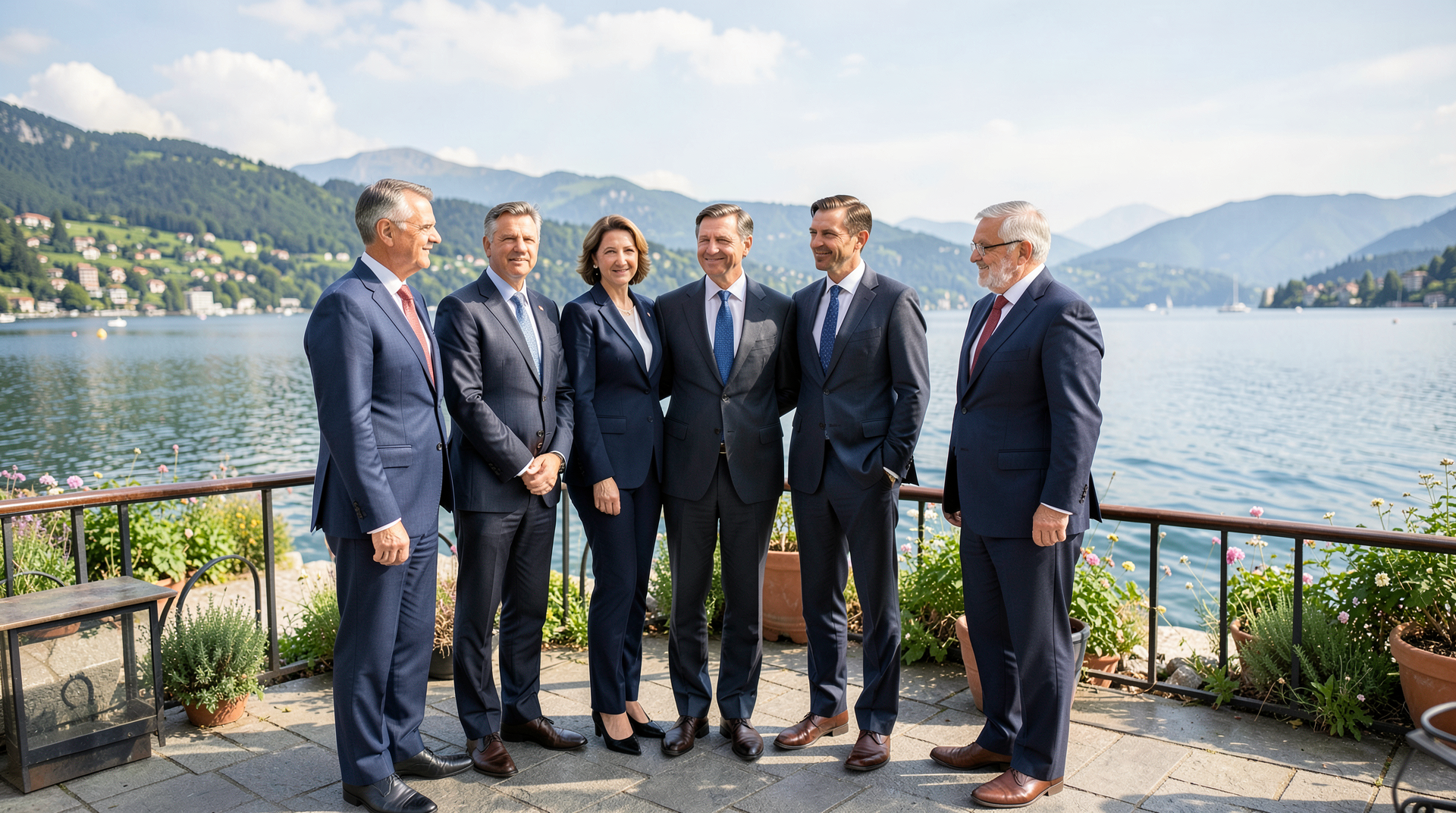
Trump opened the G7 summit at Evian-les-Bains on Monday by hailing his Iran memorandum as a breakthrough for global security, surrounded by allies who spent the spring criticizing the war that produced it. [1] The victory lap and the alliance's actual position are not the same document — and only one of them is being posted.
The paper noted June 15 that a G7 victory claim is not a common allied implementation line. A day at Evian sharpened the point. The leaders Trump never consulted before going to war — French President Emmanuel Macron, British Prime Minister Keir Starmer, German Chancellor Friedrich Merz, and Italian Prime Minister Giorgia Meloni — remain, in the Associated Press's word, "sharply critical" of how he managed the roughly 15-week conflict. [2] Trump has answered their lack of support with a threat, floating the drawdown of U.S. troops in all four countries, every one of them a NATO member. [2] This is the chemistry the official feed crops out: a host who threatens to withdraw forces from his guests' soil between sessions.
The reframing was sharpest from Brussels. The European Commission's Ursula von der Leyen met Trump, congratulated him, and then specified the terms of her congratulations on X: "We both agree that it should mean a definitive end to Iran's nuclear programme." It is a courteous sentence and a harder demand than the memorandum contains. As the paper has reported, the deal defers the nuclear file to a 60-day negotiation with no written enrichment cap; "a definitive end" is an end-state, not a deferral. The congratulation and the condition point in different directions.
Trump's own description of the deal at the summit was characteristically absolute — "fair," "good," and a guarantee that Iran "can't have a nuclear weapon" or "they get blown up," he told reporters. [3] The allies are not contradicting him in the room. They are restating the goal in language the document does not meet, which is a more durable form of dissent than a press-conference quarrel.
What the summit has not produced is the thing that would convert the victory claim into an alliance position: a common G7 statement on how the Iran agreement is to be implemented. There is a congratulatory post from the Commission president, sharp private criticism from four heads of government, and a standing American threat to pull troops from their countries. There is no joint implementation line. The allies are applauding an outcome and quietly demanding a different one — and on the evidence at Evian, the applause is for the cameras and the demand is for the record.
-- HENDRIK VAN DER BERG, Brussels