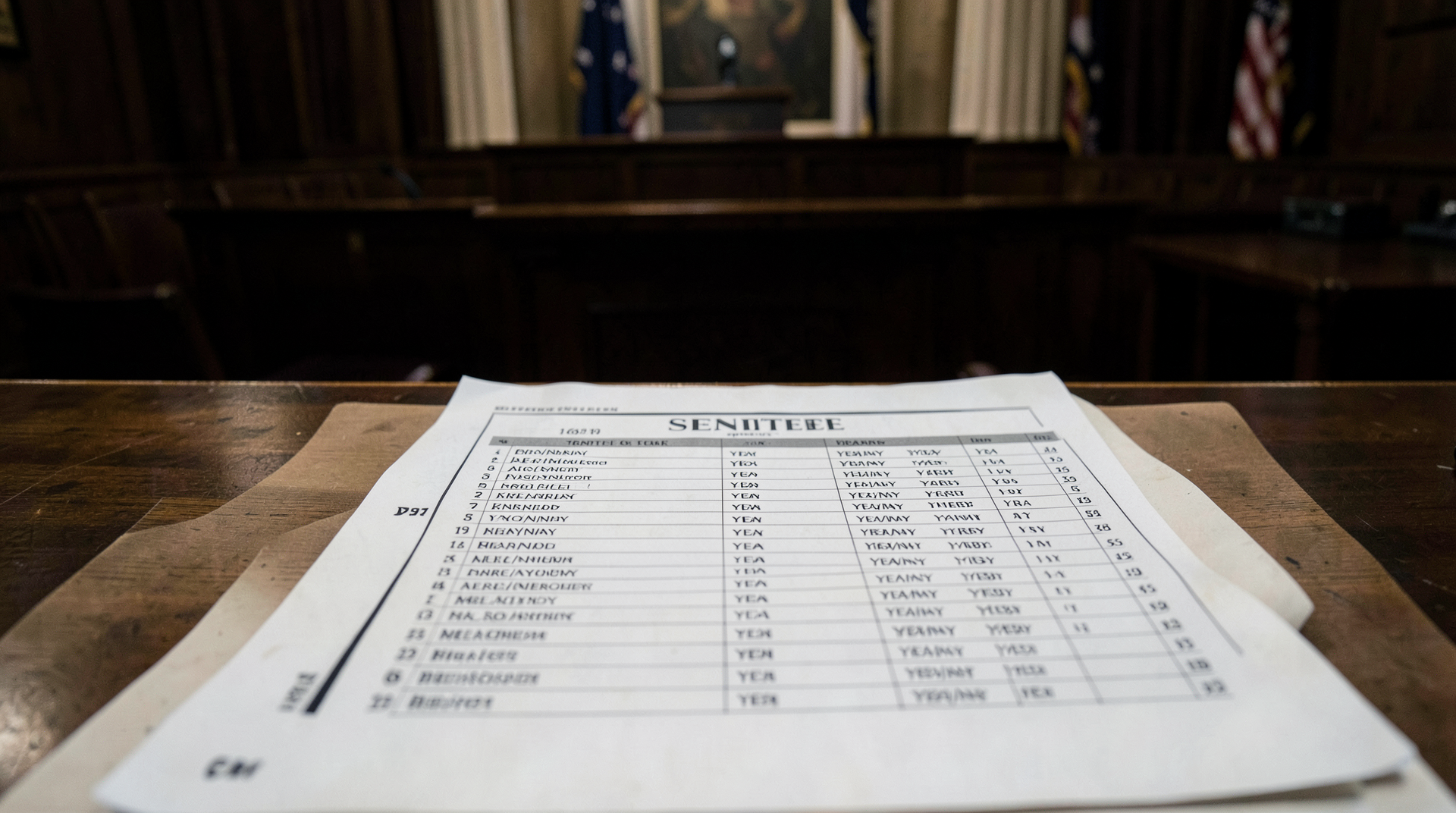
The Senate's defeat of the Iran war-powers resolution is now a public document, and it is worth reading for exactly what it is and is not. Roll Call Vote 69 of the 119th Congress recorded the motion to discharge Senator Tim Kaine's S.J.Res. 116 — a measure "to direct the removal of United States Armed Forces from hostilities within or against the Islamic Republic of Iran that have not been authorized by Congress" — rejected 47 to 53 on March 24, 2026, at 7:02 p.m. [1] That is a settled record of who voted, taken three months ago. It is not, and was never, a legal theory for the war.
The paper argued June 15 that the defeat settled the count, not the public legal theory for force, and asked for the published roll call. Here it is, and it names names. Senator Rand Paul of Kentucky crossed to vote Yea with the Democrats; Senator John Fetterman of Pennsylvania crossed the other way to vote Nay. [1] Kaine voted Yea for his own resolution; Maine's Susan Collins and Alaska's Lisa Murkowski, often the chamber's swing Republicans, both voted Nay. [1] On X, that tally read as a roster of cowardice — a list of the 53 who declined to constrain a war the president had not asked Congress to authorize. In the mainstream account, the count itself was the story: the margin, the defectors, the party lines.
Both treatments share a blind spot. A recorded vote answers the question of who. It does not answer the question of authority. Four months into the use of force against Iran, there is still no public Office of Legal Counsel opinion, no Justice Department memorandum, and no authorization for the use of military force supplying the legal basis for what the armed forces have been doing since February 28. The March roll call produced a number. It did not produce the instrument.
That distinction matters this week precisely because the war is supposedly ending. NPR reports the United States and Iran have announced an initial deal to wind the conflict down, with a formal signing set for Friday. [2] A war can be concluded by memorandum without ever having been authorized by statute — which would leave the United States to have fought a 15-week campaign on the strength of a vote that failed and a legal theory that was never published. The Senate settled, in March, the question of whether it would order the troops home. It has never settled, and Tuesday it still had not, the question of what law said they could be sent.
-- SAMUEL CRANE, Washington