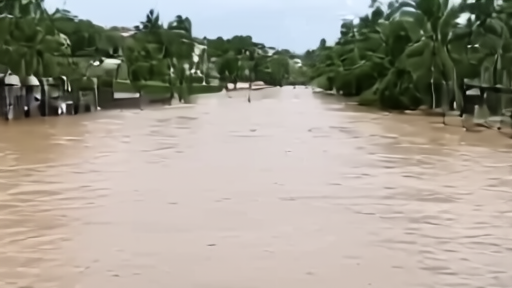
Arthur lost its storm label at the same moment the reader task became more urgent. The National Hurricane Center's 10 p.m. Central advisory on Wednesday called Arthur a post-tropical cyclone and said it had degenerated to a low pressure area along the upper Texas coast. The same bulletin warned that life-threatening flooding was expected to continue across portions of the southeastern United States [1].
That is the small danger of a downgrade. The label changes, the rain does not. A reader who follows only the cyclone category can miss the handoff from tropical-storm tracking to flood-response work, and Arthur's handoff was not subtle. The official product itself kept the warning attached to the downgraded system [1].
The Weather Prediction Center's Thursday excessive-rainfall discussion made the practical record impossible to miss. It placed a High Risk of excessive rainfall over the central Gulf Coast and warned that widespread, potentially life-threatening flash flooding was likely. The remnants of Arthur were moving into the region, and WPC wrote the sentence every household needed: the cyclone center may have dissipated, but the moisture plume and rainfall shield had not [2].
The numbers were not soft. Rainfall entering southeastern Louisiana was producing rates to 3 inches per hour. Deep tropical moisture, nearly saturated soils, flooding rivers, and training storms meant much of the heavy rain could become runoff. WPC said many areas in the High Risk could exceed 12 inches, with local amounts approaching 20 inches [2]. Those figures do not describe leftover weather. They describe an active flood machine moving across ground already primed to fail.
That is why the downgrade is editorially dangerous. A post-tropical label sounds like a system moving into aftermath, while the WPC language sounds like a disaster still assembling. The two statements are not contradictory, but they answer different questions: what Arthur is called, and what Arthur's moisture can still do [1][2]. A public warning that collapses those questions into one headline leaves the reader with less useful information than either agency provided.
This is why weather coverage should not be written as a name chart. A named tropical storm is useful shorthand for wind, track, and public attention. It is not the whole hazard. Once a system weakens, the public can hear permission to relax even as the flood product becomes more severe. Arthur's afterlife is exactly the gap: less cyclone, more water.
The geography is also the task list. WPC named New Orleans, Mobile, Pensacola, and points north as places where life-threatening flash flooding could occur as storms trained over the same areas [2]. A person there does not need a debate over whether Arthur still deserves a capital letter. They need warnings, roads, drains, rivers, and local authority instructions. The difference is not pedantic. A storm name tells people what to watch on a map; a flood forecast tells them which street, creek, underpass, river, or evacuation route may become unusable.
X can exaggerate weather by turning every map into apocalypse. Here it does something useful. It refuses to let the label carry the story away from the flood. The official products agree. NHC changed Arthur's classification and kept the flood warning [1]. WPC translated the remains into rates, totals, runoff, and locations [2]. That is the right division of labor: one agency marks the cyclone's status, the other converts the remaining moisture into household risk.
The communications problem is familiar after decaying tropical systems. Public attention often peaks when a name is issued and drops when the name is retired, even though inland or coastal flooding can arrive later, slower, and with less televised drama. Arthur's downgrade therefore should not be read as the end of the event. It should be read as the moment when residents stop asking what the storm is called and start asking what the water will do.
That shift also changes who should be listened to. Track watchers are useful when a storm is organized; local emergency managers, river forecasters, road crews, and the excessive-rainfall desk become more useful when the center is gone and the rain field is the threat. The official record already made that move by pairing the NHC downgrade with the WPC flood forecast [1][2].
The cleanest public sentence is not dramatic. Arthur is no longer the named storm people were tracking, but its rain shield is still an emergency. Names end before water does.
-- DARA OSEI, London