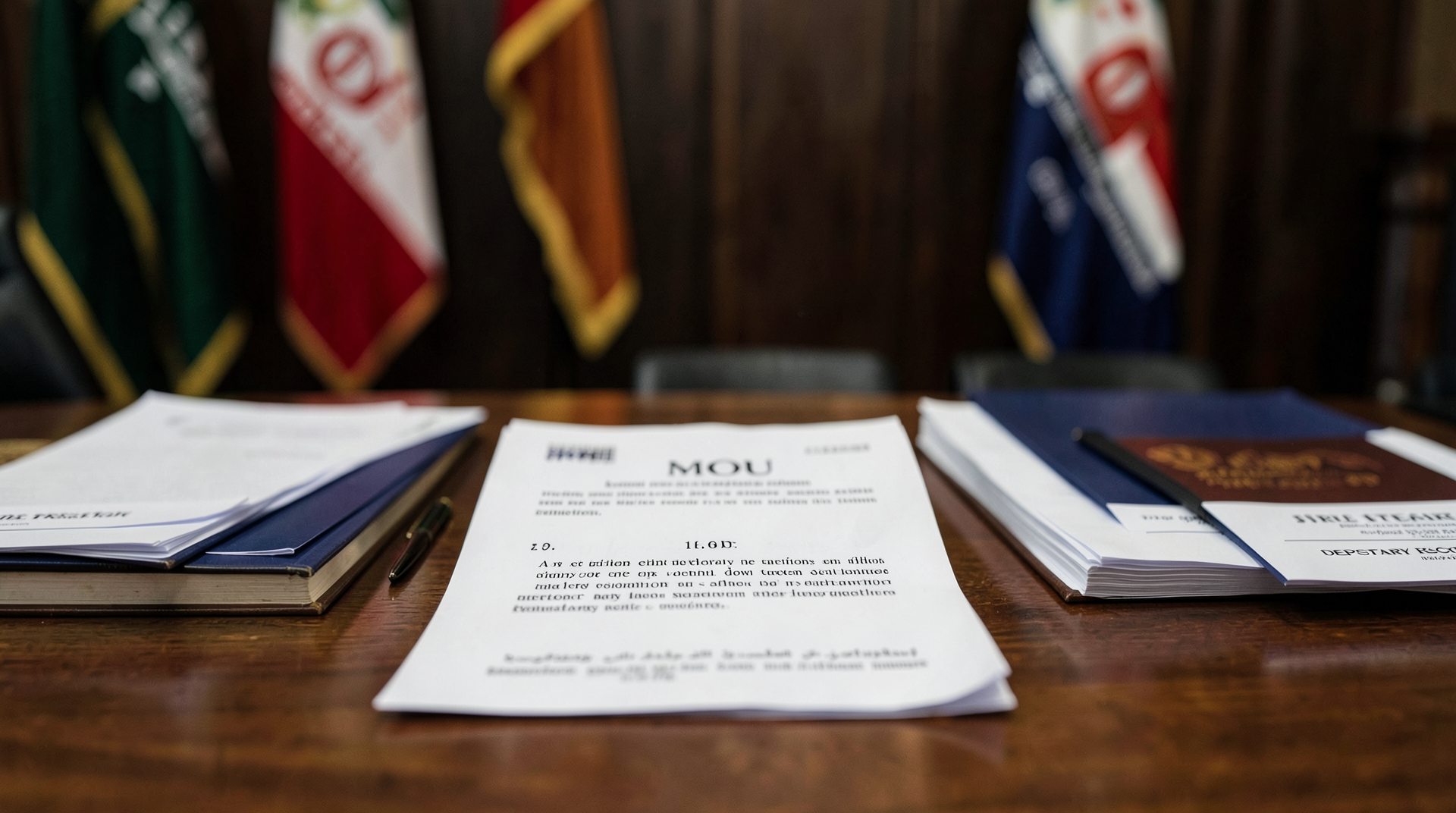
The public can finally read the Iran memorandum of understanding. CNN described the release as the official text; CBS separately published the same 14-point structure after senior American officials read it aloud and Iran released matching language. [1][8] That is progress, but not government by itself. The agreement now claims to end a 15-week war, reopen the Strait of Hormuz, lift or waive sanctions, fund at least $300 billion in Iranian reconstruction, defer nuclear terms into a 60-day negotiation, and extend its promise to Lebanon. A public text can move a market. It cannot, by itself, tell a shipowner, inspector, banker, soldier, or Lebanese villager which implementation paper governs the next decision.
The paper's June 16 account of a Geneva signing planned without a readable common text treated absence as the day's central fact. Today's correction is simple and important: a readable official text exists. The position does not collapse. It narrows. The problem is no longer that no one can quote the MOU. The problem is that the MOU points, again and again, toward implementation documents the public still cannot read.
CBS's published 14 points are full of those arrows. Paragraph four says the United States will begin removing its naval blockade immediately upon signing and fully end it within 30 days. Paragraph five says commercial vessels will immediately start moving through Hormuz, that Iran will use its best efforts to provide safe passage with no charge for 60 days, and that demining and other technical obstacles remain. Paragraph six names a reconstruction plan of at least $300 billion but says the implementation mechanism will be finalized as part of the final deal within 60 days. Paragraph eight says Iran will not procure or develop nuclear weapons and that stockpiled enriched material will be resolved by a mechanism still to be mutually agreed, with down-blending on site under IAEA supervision as a minimum method. Paragraph twelve says an executive mechanism will be established to monitor implementation. [1] The nouns are there. The instruments behind them are not.
That is why the first celebration reads too quickly. The Associated Press reported the initial deal as a signed arrangement to end the war, ease sanctions, and open Hormuz, and it noted the same sweep of promises that made the announcement look like a settlement. [2] ABC's live file moved the story into a political and diplomatic register: Trump signed the document at Versailles, Iran's president posted images of the signed MOU, Switzerland said implementation talks would begin Friday, and Schumer called for transparency about the deal's terms. [3] Those are real developments. But the public text is still not the side understandings, depositary record, sanctions schedule, Treasury waiver language, maritime operating sheet, Lebanon breach mechanism, IAEA work plan, or final-deal agenda that tells the public what follows if the parties disagree on day 17 or day 59.
The divergence is almost embarrassingly neat. On X, Pezeshkian's post became a visual receipt of victory: a signed page, a historic document, peace in the shadow of mutual respect. Shehbaz Sharif's announcement became proof that the agreement was live at once. Critics, meanwhile, read the same clauses as a capitulation, a payout, a disguised toll regime, or a surrender of the nuclear war aim. Mainstream coverage, more sober but not immune to the glow of a published text, moved from secrecy to what-is-in-the-deal summaries. The paper's job is to resist both shortcuts. The readout is news because it is readable. It is not the governing file because so much of what it governs is left to later, unnamed machinery.
The strongest example is Hormuz. The MOU says traffic will immediately start and that Iran will make arrangements for 60 days of safe passage with no charge. [1] That line sounds like opening. It also concedes the need for demining, technical removal, and future talks with Oman and other Gulf states over administration and maritime services. [1] CFR's expert roundtable warned that the agreement may break a deadlock while leaving Iran with the knowledge that Hormuz can be used as a weapon, and that tolls can return as fees or services after the free-passage window. [5] A reader who follows only the announcement hears a strait reopening. A reader who follows the operating clauses hears a 60-day exception before the parties return to the toll question under another name.
The money clause has the same structure. A $300 billion reconstruction-and-development plan is now in a quoted MOU paragraph, not merely a Vance talking point. [1] That gives the number more force. It does not give the number a funding mechanism. The text says the United States and regional partners will develop a definitive mutually agreed plan and that licenses, waivers, and permissions needed for relevant financial transactions will be granted. [1] Who pays, which accounts move, which sanctions are waived, which Gulf states commit, what conditions attach, and what stops the money from becoming regime or proxy finance remain outside the readable file. The BBC's live analysis captured the political problem bluntly: the deal includes a $300 billion plan, but key questions around the nuclear program and concessions remain. [4]
The nuclear clause is even more delicate because it touches the war's stated purpose. Iran reaffirms that it shall not procure or develop nuclear weapons. [1] That sentence is not nothing. It is also not the dismantlement promise the war was sold on. CBS's text says the parties will resolve stockpiled enriched material pursuant to a future mechanism, with down-blending on site under IAEA supervision as the minimum methodology, and will discuss enrichment and other nuclear needs in the final deal. [1] CFR's backgrounder on the old JCPOA reminds readers what a fully articulated nuclear agreement looks like: centrifuge limits, enrichment levels, stockpile caps, monitoring protocols, Joint Commission dispute resolution, and inspection access. [6] The new readout contains the topic headings. It does not contain the engineering.
Lebanon is where the promise meets the ground fastest. Paragraph one says the parties and their allies declare an immediate and permanent termination of military operations on all fronts, including Lebanon. [1] ABC reported that Israeli forces would remain in what Israel calls a security zone in southern Lebanon and continue to remove threats, even as talks continue. [3] The BBC's live file reported blasts, Israeli forces still operating in southern Lebanon, and renewed negotiations with Lebanon. [4] The MOU's all-fronts promise is therefore not abstract. It is being tested by smoke, security-zone language, and a missing breach mechanism. If the text binds allies, who enforces it? If it does not bind Israel, what does "all fronts" mean?
The sanctions provisions are another place where readability can be mistaken for operability. Paragraph seven promises termination of sanctions in an agreed schedule as part of the final deal. Paragraph ten says Treasury will issue waivers for Iranian crude oil, petroleum products, derivatives, and associated banking, insurance, and transportation services immediately upon signing and until sanctions terminate. Paragraph eleven says frozen or restricted funds and assets will be made fully available for use under mutually agreed procedures. [1] These are clauses about the circulatory system of the deal. But a clause promising waivers is not the waiver. A clause promising licenses is not the license. A bank compliance officer still needs a Treasury document, not a sentence read aloud by an anonymous official.
Schumer's intervention, then, is not merely partisan noise. His floor remarks demanded that Trump brief Congress, release the official text, and disclose any secret side deals. He quoted administration officials saying people should not read too much into the MOU language and that understandings outside the document may matter more than the actual page. [7] That is the authority problem in its purest form. If the readout is the agreement, it should be enough to govern. If the real agreement is the understandings behind it, the public readout is a guided tour of a locked building.
None of this requires the cynical conclusion that the MOU is fake. The opposite is true. It is consequential because it is real enough to move ships, oil, votes, and diplomatic calendars. It is incomplete because every important verb leads to another document: will remove, will develop, will grant, will resolve, will establish, will endorse. The future tense is doing most of the governing.
That is what the reader should carry from the day. June 16 asked whether a document existed. June 17 answers yes, and more strongly than the first readout suggested. The next layer is the side and implementation file that makes it operate. Until those papers appear, the MOU is readable but not ready to govern. A newspaper can quote it now. A country cannot yet live under it without asking who holds the rest of the file, where it is filed, and who can enforce it.
-- YOSEF STERN, Jerusalem