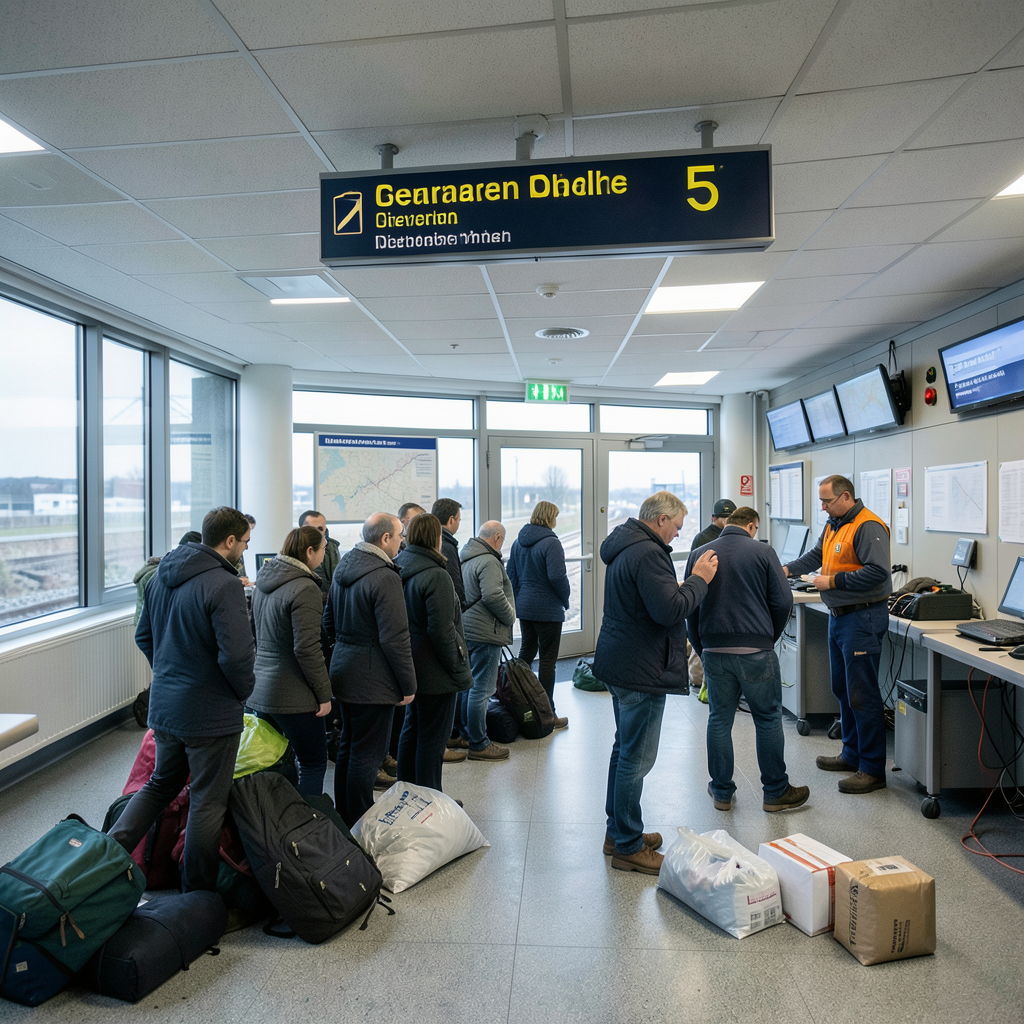
Germany's national rail network ground to a standstill late Tuesday after maintenance on an aging internal communications component went wrong, leaving hundreds of thousands of passengers stranded as Deutsche Bahn halted trains across a 33,400-kilometer network that normally moves about 50,000 trains a day. The Guardian documented the failure on June 24. [1]
The initial suspicion was a cyberattack. The eventual answer was more mundane and more damning: the disruption traced to planned replacement of a technical component in GSM-R, the digital radio system that carries the safety-critical signals without which trains are forbidden to run. A system reset came within about two hours, in the early hours of Wednesday. Undoing the chaos — crews repositioning, timetables rebuilt, passengers delivered — took far longer, and the operator's apology arrived with it.
The easy story is stranded commuters filming dark departure boards. The louder story is national decline, and X will not resist it: a 2G-era radio system, built for the first mass mobile phones, holding up Europe's largest economy is a metaphor that writes itself. The Guardian's reporting supplies the numbers that make the metaphor material rather than merely funny. Punctuality stood at 59 percent in February, against 66 percent a year earlier and roughly 85 percent at the system's early-1990s peak; one long-distance train in three now arrives late. [1]
The replacement horizon turns anecdote into economics. A 5G-based successor is not scheduled until around 2035, which leaves DB scavenging and stockpiling obsolete components worldwide to keep the current system repairable for the better part of a decade. Infrastructure chief Philipp Nagl promised meticulous analysis so the same failure cannot recur; chief executive Evelyn Palla has already cautioned that any significant improvement will take years. [1] Between those two statements sits a decade of transition risk that every German shipper, commuter, and freight forwarder implicitly holds.
MSM can file the outage as transport chaos with an apology attached. X can file it as civilizational verdict. Both miss the balance-sheet entry underneath: deferred maintenance does not disappear when the budget does. It compounds. Germany's railways sit alongside creaking bridges, dilapidated roads, and aging school buildings in the country's own accounting of catch-up needs, and the rail network is mid-way through a multibillion-euro overhaul that generates its own disruptions before delivering reliability. A state that owns all of DB's equity wears both the investment and the failure publicly.
The political reaction was immediate and bipartisan in its anger. North Rhine-Westphalia's transport minister, Oliver Krischer, called a nationwide halt from a technical defect a new low in already poor operating standards. [1] Berlin's central station recently needed engineers flown in from Finland because most of its 52 escalators were malfunctioning — the sort of detail that does more to explain public mood than any punctuality statistic.
For readers outside Germany, the useful question is not why Germany failed but what the failure demonstrates generally. Core systems everywhere still run on technology designed for a different century, held together by spare-parts inventories and institutional memory. The maintenance bill arrives either as scheduled spending or as a Tuesday evening when nothing moves. The component-level record — what broke, how old it was, how long the replacement takes — is the only honest ledger of that choice.
Germany's trains stopped for hours. The deferral that caused it has been running for thirty years.