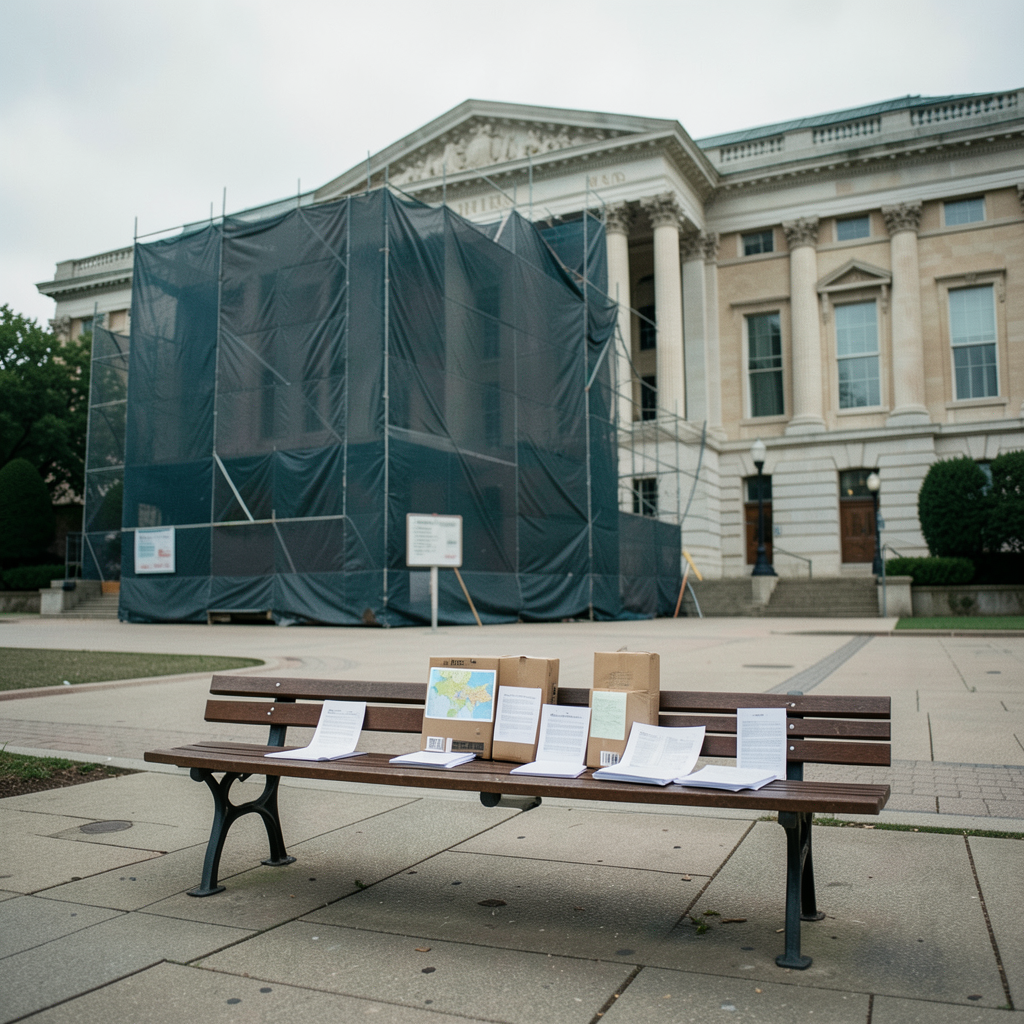
A federal judge ordered the administration on June 24 to report by July 31 on the purpose and status of the tarp and scaffolding covering the Kennedy Center facade, converting a Washington spectacle into a written assignment with a deadline. The Guardian documented the order. [1]
The culture-war version of the story is irresistible, and everyone took their shot. Workers stripped Donald Trump's name from the building in a predawn operation earlier this month, after Judge Christopher Cooper ruled that the December renaming was unlawful — a 94-page opinion resting on the center's organic statute, which reserves the name to Congress alone. Days later, a semi-permanent tarp went up across the facade where John F. Kennedy's name had been restored to view. Representative Joyce Beatty, a board member and plaintiff in the underlying suit, called the covering an act of petty defiance. Representative Jamie Raskin went further on X: "A literal coverup, to add to all the others. Nobody's fooled." [1]
X will let the image do all the work — a shrouded landmark as portrait of institutional pettiness. MSM can cover the spectacle as a naming fight's latest beat. The court did something less theatrical and more useful: it demanded paper. Cooper's order requires the government to explain what the tarp is for, how long it will remain, and how it relates to litigation over the building's name and management. [1]
That demand matters because visual politics can be simultaneously true and incomplete. A tarp may be a symbol of defiance; Beatty's lawyers told the D.C. Circuit it appears designed to frustrate restoration of the status quo. It may also be, as facilities departments everywhere insist, protection for scaffolding during facade work. Those explanations conflict, and the entire dispute has arrived at the point where someone must pick one, sign it, and defend it under oath-adjacent pressure. A court order converts vibes into exhibits.
The procedural backdrop sharpens the stakes. Cooper last month blocked the administration's plan to close the center for two years of a $257 million renovation he called ill-informed and seemingly preordained, a decision the government has asked the appeals court to stay. The center's own general counsel, complying with the renaming ruling, ordered staff to purge Trump-era references from letterheads, templates, signage, and web pages by June 12. [1] Every one of those documents is discoverable, datable, and quotable. The tarp is the only piece of the dispute whose purpose nobody has yet put in writing.
There is a general lesson here worth keeping when the next symbol fight arrives, on the Kennedy Center's lawn or anywhere else. Monuments, banners, tarps, and flags are cheap to raise and cheaper to argue about. The administrative state moves slower but leaves records: work orders, contracts, memos, filings. When officials prefer imagery to documentation, the preference itself is information. When a judge compels documentation, the record becomes the story.
So the useful date on the calendar is not the next protest but July 31 — the deadline for a filing that must describe, in prose, why fabric hangs over a federal memorial. Whatever it says will either survive comparison with the construction paperwork or expose the gap between the two.
Culture fights become government records only when someone is forced to file the explanation. This one just crossed that line.