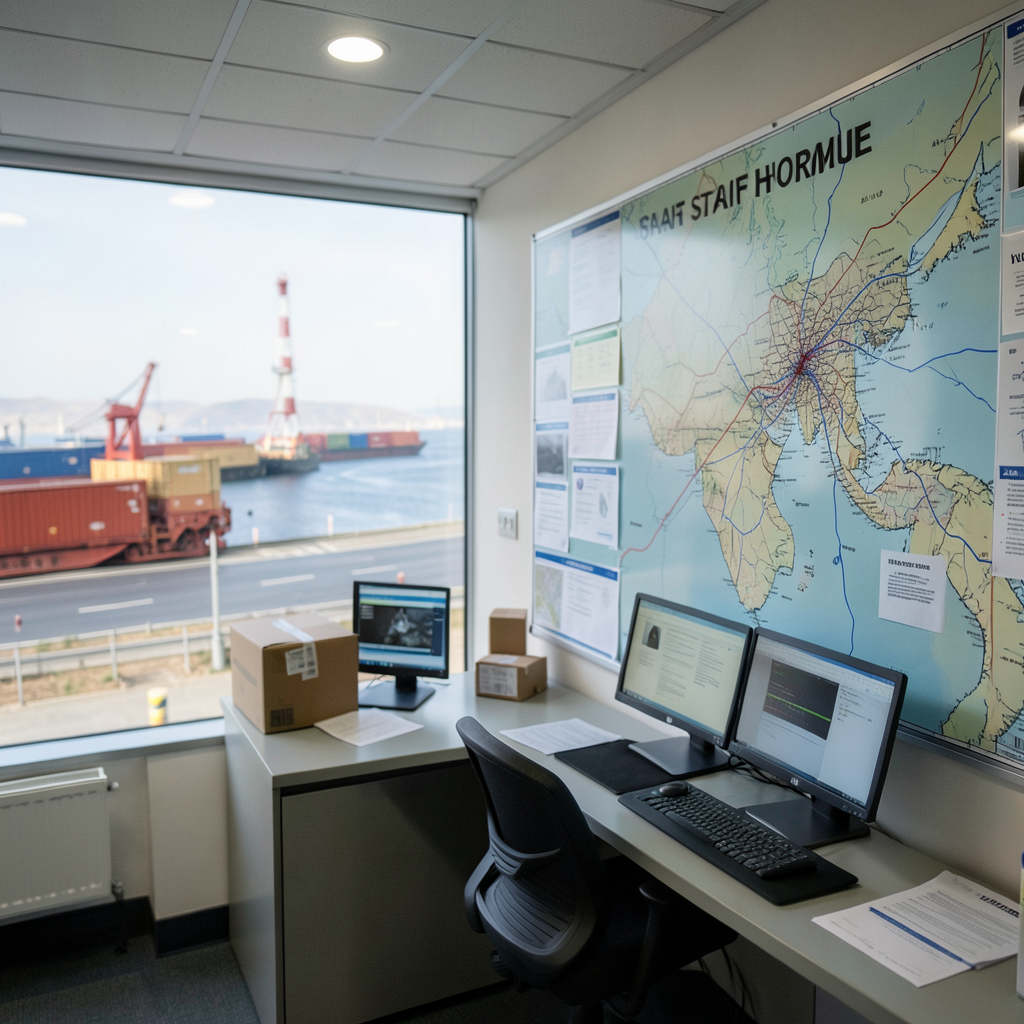
Marco Rubio said flatly that Iran will not be permitted to charge tolls or fees for vessels transiting the Strait of Hormuz under any final agreement with Washington, while Tehran kept open the claim that postwar transit might carry service charges once a 60-day negotiation window expires. Al Jazeera documented both positions on June 24. [1]
The paper's June 23 lead on Iran oil relief treated the American license as a valuation and restriction test. Hormuz is the same argument in shipping form. The mechanics so far: Iran's Persian Gulf Strait Authority announced it would suspend planned transit fees for the duration of the Swiss talks, explicitly reserving charges for afterward; Iran and Oman then issued a joint statement agreeing to study future administration of the route and possible fees, while maintaining their sovereignty claims over adjacent territorial waters. Rubio, opening a Gulf tour in Abu Dhabi, answered as a matter of principle — "It's an international waterway. No country is allowed to charge tolls or fees on an international waterway" — and predicted regional states would agree. [1]
Iran's chief negotiator, Mohammad Bagher Ghalibaf, supplied the counterframe: "Hormuz will never return" to its prewar status, whatever communication mechanisms the two sides agreed to establish on Monday. Both statements are true simultaneously, which is why the divergence matters. MSM can explain the law — transit passage through international straits is protected, and one-fifth of the world's exported oil and gas normally moves through this one. X will treat the same facts as either extortion or capitulation before a single operating term exists. The gap matters because traders and readers need different evidence than political argument requires.
That evidence has names. Route notices: whether carriers publish war-risk surcharges or remove them. Insurance terms: whether underwriters reprice Gulf coverage after the waiver period or treat fee language as background noise. Port circulars: whether any authority actually levies a charge, against which vessel, denominated in what currency, collected by whom. Traffic counts: whether tanker transits hold at normal levels through the negotiation window. If none of those instruments moves, the online fight is noise. If they do move, a diplomatic dispute has become an energy story with a price attached. [1]
Context sharpens the stakes. Iran effectively closed the waterway during the war, oil prices soared, and Washington answered with an April naval blockade on Iranian ports — leverage Tehran has not forgotten and cannot rebuild quickly. A toll regime would convert military disruption into recurring revenue and standing leverage; that is precisely why the United States rejects even the vocabulary of fees. Pakistan and Qatar, the mediation's sponsors, expect talks to resume Tuesday. Sixty days is long enough for every instrument above to print at least once.
Until something official appears — a circular, a rate, a notice to mariners — Rubio's rejection and Iran's reservation belong in the same sentence. They are two positions on a contract nobody has produced.
The diplomatic scaffolding around the dispute is worth tracking too, because it defines what "service fees" could legally attach to. The Swiss memorandum signed this week runs sixty days and covers sanctions relief, Iran's nuclear program, and the strait's future administration; Pakistan and Qatar brokered, Oman co-signs the shipping language, and talks are expected to resume Tuesday after the current pause. Each party enters with different instruments in hand — Washington with naval presence, Tehran with geography, Muscat with ports. Fee authority, if it ever emerges, will look like paperwork from one of those desks, which is exactly where readers should look first.
Watch the boring documents. Chokepoints change hands through paperwork.