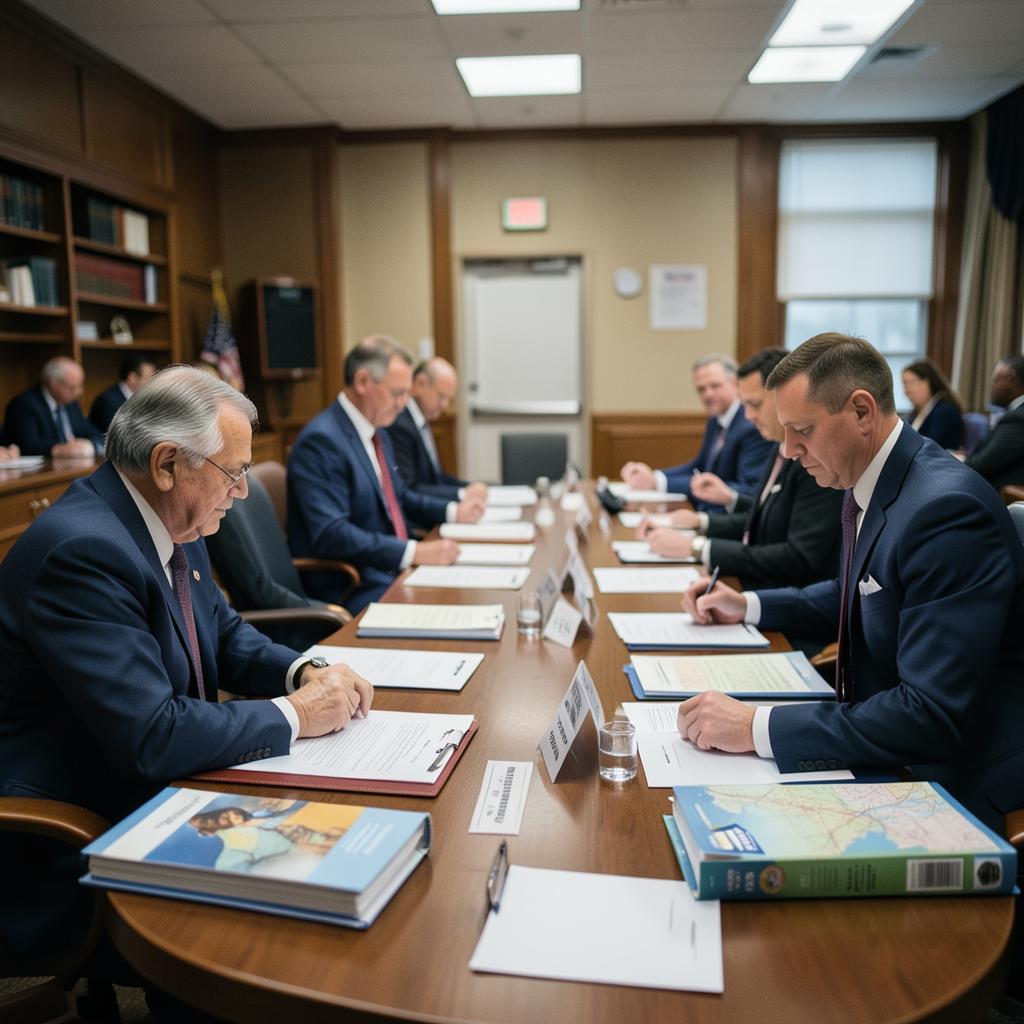
The Senate voted 50-48 on June 24 to approve an Iran War Powers resolution directing the president to remove U.S. forces from hostilities against Iran, with four Republicans crossing party lines — and within twenty-four hours, the White House asked Congress for $87.6 billion in additional spending, roughly $67 billion of it for defense needs tied to the same war. [1][2]
The paper's June 23 account of Iran's inspection contradiction argued that public instruments, not administration claims, should control how readers understand the war's governance. The same rule now applies to Congress itself. A War Powers vote is one instrument. An appropriations request is another. This week produced both back to back, and the distance between them — constitutional rebuke on Tuesday, invoice on Wednesday — is the most precise measurement available of where Washington actually stands on a war that began with U.S.-Israeli strikes on Tehran on February 28.
Start with the vote's structure, because its parts matter separately. This was the tenth attempt this Congress to restrain the war, and the first time both chambers have passed a resolution directing a president to remove armed forces from hostilities under the War Powers Act: the House cleared the identical measure 215-208 on June 3, and a May 20 Senate effort died as procedural maneuvering before reaching this floor. Four Republicans voted yes — Bill Cassidy of Louisiana, Lisa Murkowski of Alaska, Susan Collins of Maine, and Rand Paul of Kentucky. Mitch McConnell and Dave McCormick did not vote at all, a small abstention with large re-election arithmetic behind it. Every Democrat except John Fetterman supported the measure. Chuck Schumer framed the case in floor terms designed for history's clipboard: Trump promised maximum pressure and delivered "maximum confusion, maximum chaos, maximum cost," a foreign-policy blunder destined for the history books. [1]
The resolution's text is narrower than its headlines. It directs removal from hostilities absent "a declaration of war or a specific congressional authorization," while permitting a limited Middle East presence to counter imminent threats against the United States or its allies. What it cannot do, standing alone, is bind anyone. Constitutional lawyer Bruce Fein told Al Jazeera the war powers belong to Congress exclusively, but also predicted flatly how this ends in practice: "Trump will ignore the vote on the bogus fantasy of unconstitutionality. The courts will refrain from intervening." Precedent supports him. The 2001 and 2002 AUMFs remain in force; presidents of both parties have routed around the War Powers Act through them for decades, and the 2020 Soleimani strike proceeded under exactly such authority without a declaration of war. Senator James Risch warned before the vote that passage would hand Iranian negotiators a reason to walk out of the Switzerland talks, then dismissed the instrument entirely: "It's going to have no effect." Trump had already answered the underlying constitutional question himself, telling Axios there are "no limits" on his war powers. [1]
A reader who stops at the vote therefore concludes theater — which is precisely where X stopped, filing the day under rebellion or betrayal depending on the account. The money file complicates that conclusion. On Wednesday, Office of Management and Budget Director Russell Vought formally transmitted the $87.6 billion request, urging Speaker Mike Johnson to act "as soon as possible." Roughly $67 billion flows to the Pentagon for military personnel, readiness, and rebuilding munitions stocks — $21 billion earmarked for weapons alone, $17.3 billion for operational costs — with the remainder spread across other accounts. The ask is deliberately smaller than the $200 billion supplemental the Defense Department floated earlier in the year, sized for a political environment in which only 24 percent of Americans tell Reuters/Ipsos the war has been worth its cost, four Republican defectors face November electorates, and Democratic appropriators are promising resistance. Patty Murray called it an attempt to secure "tens of billions more for this disastrous war of choice" outside the normal process; Tom Cole and Ken Calvert countered that defense strength "must be maintained, not merely demonstrated." [2]
Then there is the lunch. Cassidy — who placed third in his own primary last month after Trump endorsed a rival — confronted the president at a closed-door Senate Republican gathering the day after his defection. Trump opened with a question, "Why would anybody vote for the War Powers Act?" Cassidy stood: was that rhetorical, or did he want the answer. Pressed, the senator laid out his condition — the administration promised a four-week operation that has lasted four months without achieving its stated objectives, and he would keep voting for war powers resolutions until Congress received a full briefing. Voices rose. Trump invoked the primary loss to demean him. Cassidy later told reporters he lost his temper — "it's the Irish in me" — matched the president's volume, then sat down deliberately to de-escalate, keeping his condition intact: brief me, or the votes continue. [3]
The same visit exposed how entangled the war fight has become with the rest of the Republican agenda. Trump cancelled a signing ceremony for a bipartisan housing bill passed overwhelmingly by both chambers, saying he would withhold his signature until Congress delivers the Save America Act voting restrictions — legislation with no path past the Senate filibuster. He has likewise conditioned FISA renewal, a surveillance tool that expired earlier this month, on the same package. A presidency holding popular bills hostage to unrelated demands, while shouting at senators who cite their own oversight duties, is not a governing posture that invites congressional generosity toward its funding requests. [3]
MSM coverage can keep these files apart — one constitutional, one fiscal, one personal. X prefers single nouns. But the files interlock, and the interlocks are where accountability lives. Cassidy's briefing demand converts symbolism into procedure: a classified session is checkable, schedulable, and refusable in ways a floor speech never is. Murray's opposition converts the appropriations calendar into the war's real authorization track — because the constitutional instrument failed, the fiscal one becomes the binding constraint. And the White House sequencing reveals what it believes about its own congress: it asked for the money one day after the rebuke, implying confidence that rebukes without riders are survivable.
Which returns the open question to Congress. If both chambers rebuke the war and then appropriate for it, the rebuke becomes a message without a mechanism — recorded dissent financing continued operations. If appropriators strip the war money, slow-walk the supplemental, or condition funds on the briefing Cassidy demanded, the June vote retroactively becomes the opening move of a real constraint. History counsels neither certainty nor cynicism: earlier war powers majorities evaporated before appropriation season arrived, but none arrived alongside a president publicly shouting at his own defectors inside the Capitol, or a poll showing three-quarters of the country judging the war a loss.
The next records are specific and near-dated: whether the briefing happens and what it covers, the markup language Vought's request receives in committee, any amendment stripping Iran hostilities funding, and the roll call on whatever vehicle finally carries the money. Each will be published. Each will be votable.
The day did not settle which Congress this is. It put both receipts — the rebuke and the invoice — on the same table, twenty-four hours apart, and dared the institution to reconcile them.