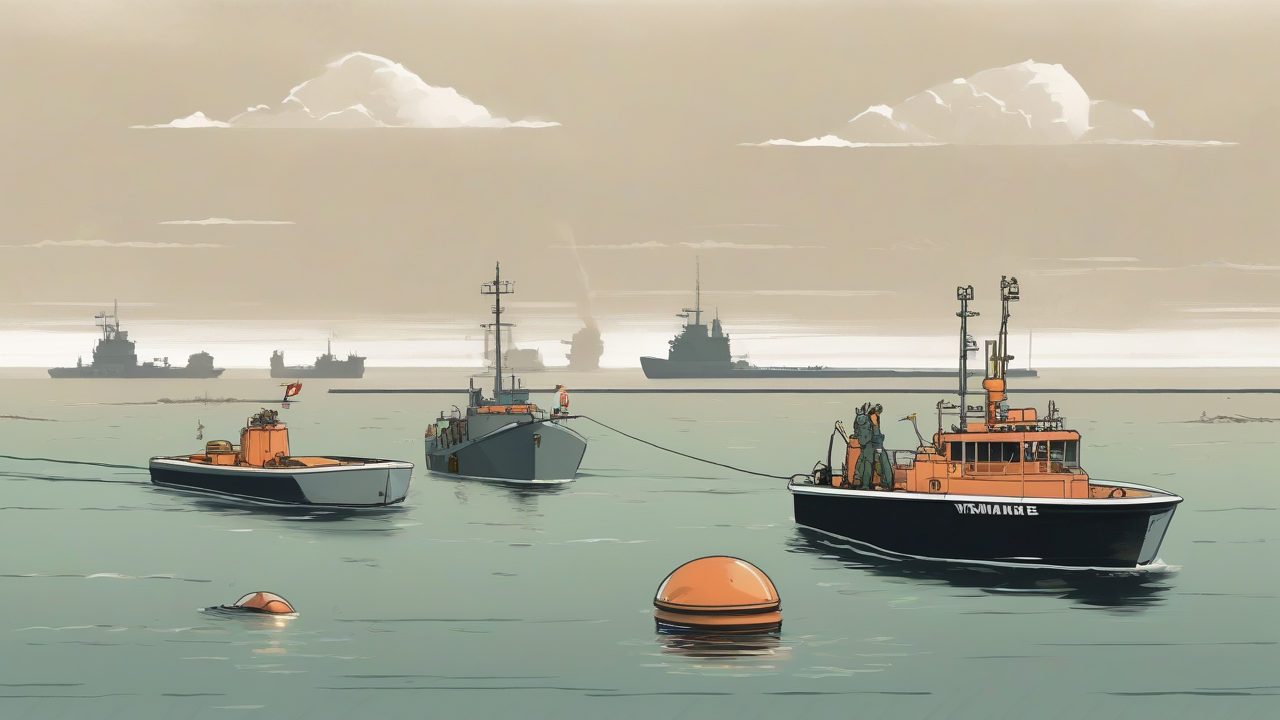
A strait is not open because diplomats say it is open. It is open when ships cross, insurers stop flinching, and someone can say who is allowed to remove the mines.
That was the paper's position yesterday in two forms: Washington had licensed Iranian oil before the tankers had ordinary passage, and U.S.-Iran talks in Doha mattered only if they settled who controls Hormuz rather than who asked for the meeting. Thursday hardens the test. The deminer, not the communique, has become the sovereign actor.
CBS reported that France and Oman agreed to collaborate with international partners on demining the Strait of Hormuz, while Iran's deputy foreign minister Kazem Gharibabadi said Iran alone would remove mines and would not allow any other country to participate. He called the situation "sensitive and complex" and warned France not to complicate it with provocations. CBS also cited the memorandum language appearing to assign the roughly 80 mines to Iranian demining within 30 days. [1]
That is not a technical disagreement. It is the political core of the reopening claim. If France and Oman can clear lanes, Iran loses part of the leverage it preserved after the war. If only Iran can clear them, every ship that passes through Hormuz does so under an Iranian timetable, with an Iranian definition of safety.
The traffic counts show why this matters. CBS cited Kpler data showing 29 commodity vessels crossed on Saturday and 12 on Sunday, down sharply from 70 crossings on Wednesday after the memorandum of understanding had briefly lifted traffic to its highest level since the start of the war. Vessels kept using several routes despite Iranian warnings against unapproved lanes, and MarineTraffic showed ships continued using a southern corridor through Omani waters for several hours after a vessel was struck before traffic appeared to slow. [1]
AP supplied the diplomatic surface. U.S. and Iranian negotiators met separately with Qatari and Pakistani mediators and agreed to continue discussions, with host Qatar reporting positive progress. The same AP file noted that a foreign container ship ran aground in the strait while using a route not approved by Iran, a report that appeared aimed at underlining Tehran's claim to control the waterway. [2]
The Guardian made the sovereignty dispute explicit. It reported that Iran is competing with Oman as decision-maker over the strait, resisting arrangements that would reduce its control over the route. Its account described a proposed southern route near Oman's shore that had to be abandoned after Iran attacked a ship using it, and framed Oman's legal work as an attempt to design management that meets international law while still securing Iran's support. [3]
This is the divergence in its cleanest form. Mainstream outlets correctly say talks continue. X argues humiliation, fake peace, or capitulation, depending on which flag the account has chosen. The operational fact is less theatrical: the strait's status is being decided by demining authority, vessel counts, and route permissions. A peace claim that cannot name the clearing crew is not yet a shipping fact.
One public tracker still describes the strait as closed, with commercial shipping suspended after a brief reopening, near-zero ships transiting against a normal roughly 60 a day, more than 150 stranded vessels, and major oil and LNG exposure. [4] The exact live count will move. The point is the same: the public record is still full of abnormality.
Hormuz has always been a geography lesson disguised as an oil story. It is narrow enough for a mine to become policy, busy enough for a vessel count to move markets, and sovereign enough for every buoy to become an argument. The new question is not whether Tehran, Muscat, Paris, Doha, or Washington prefers the word open. It is which of them can publish the dull records an ordinary shipper needs: safe-channel map, demining notice, routing protocol, insurer downgrade, port circular, and enough crossings to make Sunday look like commerce again.
Until those records exist, the word open is doing too much work. The ships know it. The mines know it. So does Iran.
-- YOSEF STERN, Jerusalem