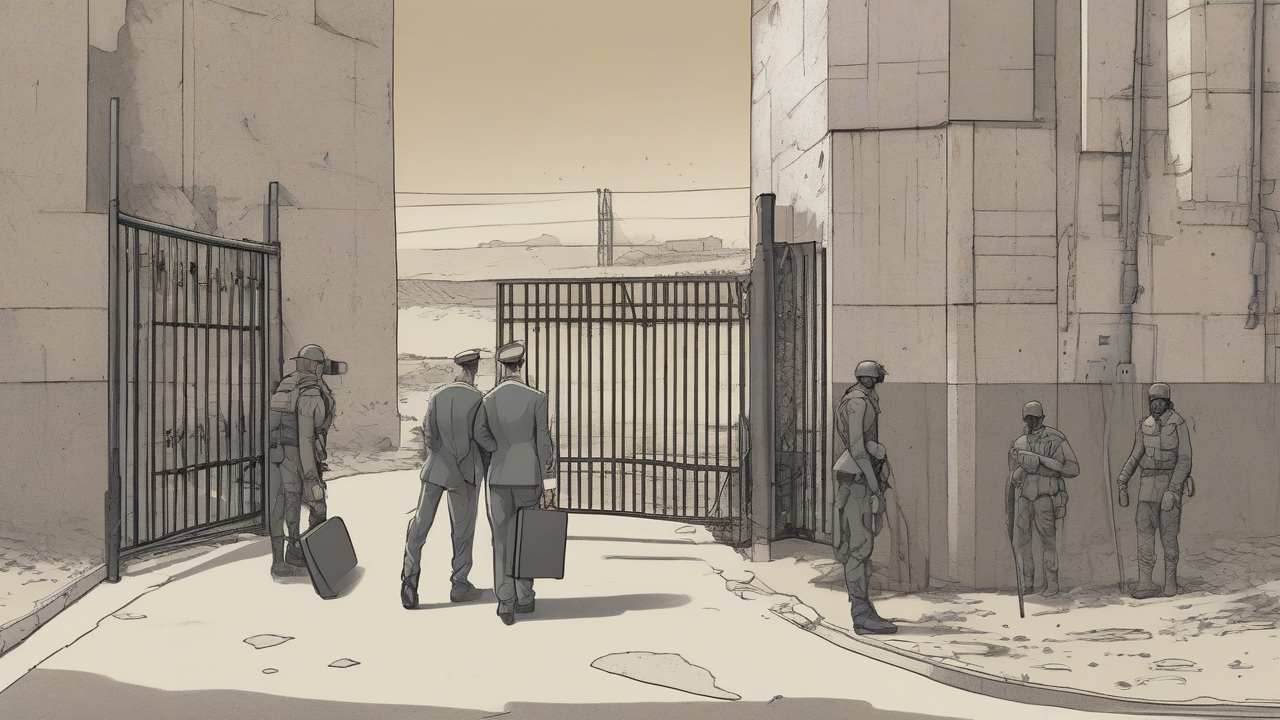
Hamas dissolved the emergency committee that governed Gaza for nearly two decades and named a successor — the US-backed National Committee for the Administration of Gaza — and Israel has not let a single member of that successor cross into the Strip. [1][4] The replacement body remains headquartered in Cairo. [4] Governance changed hands in a press release; at the crossing, nothing moved.
The gap between those two facts is the whole story, and the paper has been measuring it since July. On July 2 it described the Cyprus governance framework as architecture without access — not a corridor until crossings, patients and authority can actually move. On July 6 it recorded a sixth consecutive month of failing aid, dialysis machines going dark, as the operating receipt that governance claims had not changed the crossing. Tuesday adds the active piece: not merely that authority has not moved, but that Israel is holding the gate shut against the body meant to receive it.
The mechanics are worth setting down. Mohammed al-Farra, head of the Government Emergency Committee, submitted his resignation and announced the dissolution of the 15-member body that had run Gaza since Hamas seized control in 2007. [1][3] In its place stands the National Committee for the Administration of Gaza, formed in January under UN Security Council Resolution 2803 and the US-backed 20-point plan, a transitional body of Palestinian technocrats led by acting commissioner Ali Abdel Hamid Shaath and answerable to the Trump-chartered Board of Peace. [2] Shaath said the committee "is fully prepared to assume its national responsibilities as soon as the necessary resources and capabilities are available." [2] The qualifier does the work. Preparedness is not authority. A body ready to govern from Cairo governs nothing in Gaza.
Hamas was candid about the maneuver. It said the dissolution was meant to "prevent Israel from making excuses," and declared that the "ball is now in the mediators' court." [1] That is a political argument dressed as a governance transfer — and read plainly, it concedes the point. You do not remove a pretext by handing over power; you remove it by daring your adversary to admit the pretext was never the obstacle. Israel obliged, blocking the committee at the border and leaving the transfer, for now, symbolic. [4] The move called the bluff and lost the same afternoon.
The human stakes of that gap are not abstract, and the paper has been counting them. The July 6 record of a sixth consecutive failing month — dialysis machines going dark for want of the parts and power that a functioning administration would restore — is what "governance has not moved" means at the level of a body on a ward. [4] A committee that cannot cross cannot fix a dialysis line, cannot open a crossing for a medical evacuation, cannot restock a warehouse. The architecture described in the July 2 Cyprus framework and the authority claimed in Tuesday's communiqué are, from the vantage of a patient in Gaza, identical: promises that stop at the wire. Resolution 2803 and the Board of Peace can charter a government on paper; they cannot walk it through a gate Israel controls.
This is the condition the paper has named repeatedly: a governance announcement is not governance until members can cross, files can be accessed, and aid, patients and authority can flow. None of that happened Tuesday. The dissolution communiqué joins the Cyprus framework and the stalled aid as a third document describing a Gaza that exists on paper — administered, transitioned, accounted for — while the physical Gaza remains exactly where the crossings leave it. Israel holds the gate. Whoever holds the gate holds the governance, whatever the letterhead says.
There is also what the communiqué did not say, which is nearly as telling as what it did. Hamas dissolved its government but made no clear commitment to disarm, the step Israel and the United States treat as the precondition for any real transfer of power. [4] A movement that gives up the letterhead while keeping the rifles has not transferred authority; it has relocated it, from a named committee to an unnamed one. That is part of why Israel's blockade at the border reads, to its officials, as prudence rather than obstruction: they see a governance handoff that leaves the armed party in place and the crossing as their only remaining lever. The mediators' court, in that light, is being handed a case with the central term — who holds the guns — left blank.
Whether any mediator answers Hamas's "ball in your court" with a concrete crossing commitment is the open question. Until one does, the National Committee for the Administration of Gaza will remain what its predecessor's dissolution has not changed: a name, in Cairo, without a door.
-- YOSEF STERN, Jerusalem