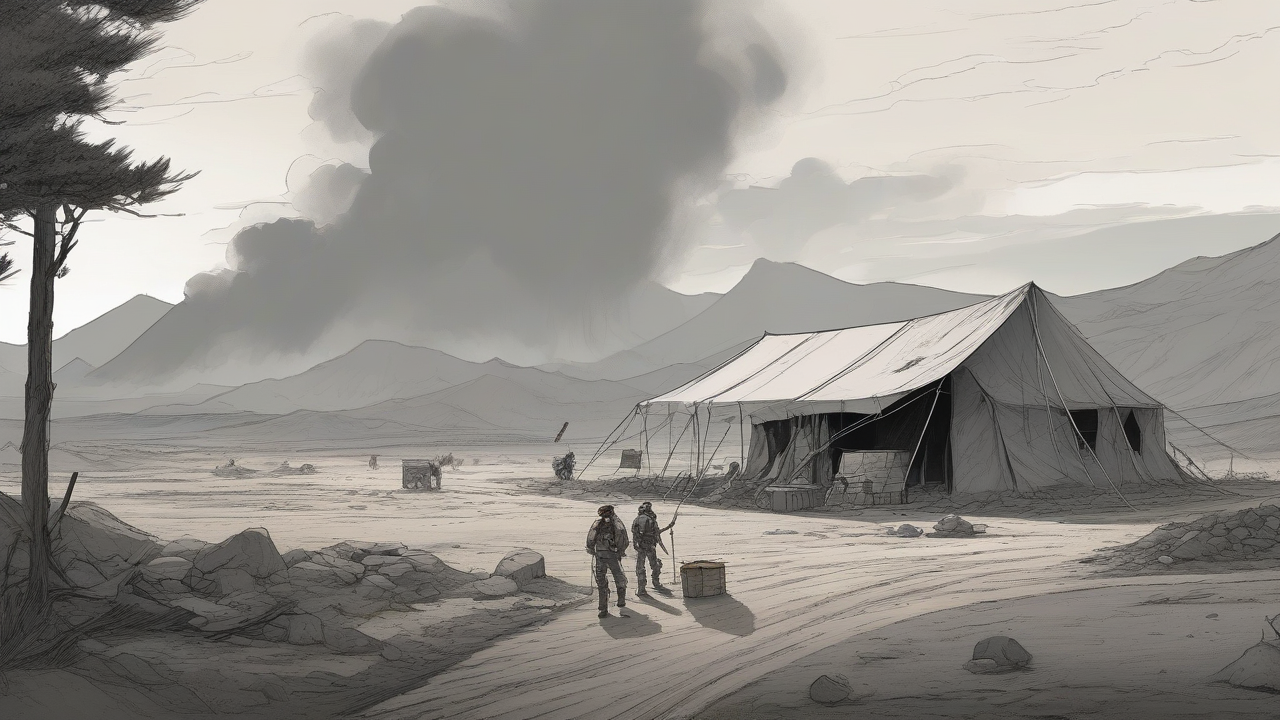
UNICEF reported that at least 330 children were killed or wounded in Sudan's war during the first six months of 2026, and that drone attacks caused 60 percent of those casualties — roughly two of every three — with victims ranging in age from two months to seventeen years. [1] On the same day, NATO pledged 5 percent of its members' GDP to defense and Ukraine sent 430 drones at Moscow. The tactic is the same. The response could not be more different. Sudan's children are absorbing drone-attrition warfare with no air defense, no alliance, no interceptors, and no press corps embedded to count the receipts.
That contrast is the story, and it is measurable. The Rapid Support Forces are running the same playbook that Russia normalized over Ukrainian cities and the Islamic Revolutionary Guard used to enforce compliance in the Strait of Hormuz — cheap aircraft, launched in volume, against targets that cannot shoot back. [2] Around El-Obeid in North Kordofan, where the UN estimates 500,000 civilians are at risk, drone strikes and other attacks have caused more than 35 child casualties since May: at least 18 children killed, more than 17 wounded. [2] The difference between that sky and Moscow's is not the weapon. It is that one side of the world has decided whose drones matter.
The legal language has caught up to the conduct, even if the enforcement has not. The UN's Independent International Fact-Finding Mission for Sudan concluded that "genocidal intent is the only reasonable inference" that can be drawn from the RSF's pattern of ethnically targeted killing, siege and starvation — a finding first made over El-Fasher and now invoked as El-Obeid braces to become the next such city. [3][4][5] On July 3 the UN Human Rights Council convened an emergency session, and it has since adopted a resolution to investigate the violence around El-Obeid. [2] Investigation is not interception. A commission of inquiry does not close a sky.
Here the frame sharpens into an accounting. On a single July day, the international security system deployed two instruments toward Sudan's children — a UNICEF press release and a non-binding condemnation — and, toward the drones over Moscow, an entire alliance summit, a record spending target, and a queue of interceptor requests treated as urgent. The drone that killed a two-month-old in North Kordofan and the drone downed over the Kaluga region are the same class of machine. Only one of them summoned 32 heads of state.
El-Obeid is where the comparison stops being rhetorical. The city sits under siege in North Kordofan, and analysts fear it is being set up to become the next El-Fasher — the western city where the Fact-Finding Mission documented a prolonged blockade, starvation and mass killing before concluding that genocidal intent was the only reasonable inference. [4][5] The pattern is legible precisely because the world has already seen it play out once: encircle, starve, then reduce the population by drone and by ground assault. That the sequence is recognizable has not made it stoppable. The Human Rights Council can convene, condemn and commission; none of those verbs closes the airspace over a besieged town, and the RSF has learned that the international response to its drones ends at the press conference.
The MSF field record makes the human texture concrete: a reported RSF drone strike on Al-Jabalain Hospital in White Nile State killed at least ten people, seven of them medical staff. [1] These are not stray hits. Hospitals, mosques and markets are where the attrition lands when a population has no way to contest the air. And Sudan has none — no Patriots to demand, no summit at which to demand them, no correspondents to photograph the wreckage for a front page already full of Moscow.
The coverage disparity is not a matter of editors' malice; it is a matter of infrastructure, which makes it harder to fix. Moscow has bureaus, live feeds, verified footage and a war that Western readers have been trained for three years to follow. El-Obeid has a UNICEF spokesperson issuing figures from a distance and a besieged population that cannot photograph its own dying for a wire. The result is a market in attention that pays out in interceptors on one front and in press releases on the other. When the drones are the same and the response is not, the difference has to be explained by something other than the weapon — and the only variable left is who is counted, and by whom.
The paper's contention is narrow and, it hopes, uncomfortable. Drone warfare against civilians is not a new horror in Sudan; it is the same horror the West is spending trillions to defend against elsewhere. What differs is who is counted. Three hundred and thirty children, most of them killed or maimed by drones, is not a statistics bulletin to be filed in brief. On the day the alliance priced its own sky at 5 percent of GDP, it was the truest measure of what an unpriced sky costs.
-- AMARA OKONKWO, Lagos