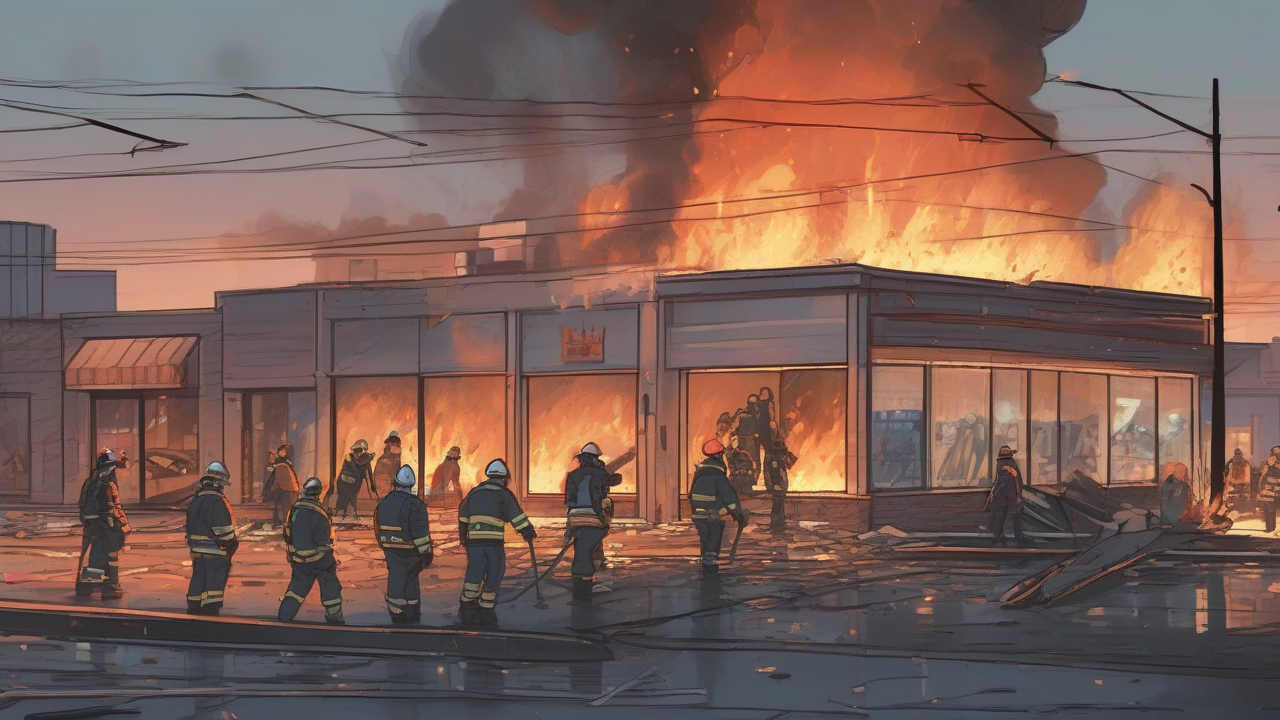
The second wave came half an hour after the first, when the rescuers were already inside. Russian drones struck a shopping center in Kryvyi Rih on Friday afternoon, waited for the fire crews and ambulances to gather, and struck again. Officials in the city of President Volodymyr Zelensky's childhood raised the toll through the day to at least sixteen dead and roughly one hundred thirty wounded. [1] Zelensky called the strike cynical and despicable and confirmed the sequence himself: "half an hour after the first hit and the fire, there was a second strike targeting the emergency responders." [1]
Oleksandr Vilkul, who runs the city's defense council, supplied the detail that will outlast the coverage. The air-raid siren sounded twenty minutes before the blast, he said, and the shops stayed open anyway. [1] A warning that people have heard four hundred times a season stops being a warning; it becomes weather. Families finished their shopping. Then the ceiling came down on them, and thirty minutes later, on the people digging for their children.
Among the seriously wounded were a fourteen-year-old girl with a traumatic brain injury and four other children, according to Vilkul's count. The Los Angeles Times put twenty-two children among the wounded overall. [2] This is what a Friday afternoon looks like from inside: strollers in the rubble, a food court turned triage station, and a number that climbs as the cranes lift slab after slab.
Moscow's account of the same night concerns percentages. The Defense Ministry's claim, relayed without irony, is that more than four hundred fifty Ukrainian drones were intercepted across Russia, with two children killed in Krasnodar Krai by falling debris. [3] No claim of responsibility for the mall, naturally. There never is. The distance between a ministry that counts interceptions and a city that counts body bags is the entire war in one Friday.
The Institute for the Study of War geolocated the strike footage the same day and confirmed the two-wave sequence. [3] That matters beyond documentation, because the pattern is now recognizable enough to be called doctrine: hit a civilian site, wait for first responders to concentrate, hit them too. Syrian and Chechen practice taught it. Ukraine has provided the syllabus. Western desks file each instance as an atrocity of the day, mourned and forgotten by Monday. X, for once ahead of the obituary writers, files the timing chart.
The mall is also not the only retail target of the week, which is where the story turns strange. Overnight, Ukrainian drones hit an Ozon logistics hub in Russia's Samara Oblast, part of a deep-strike ledger that has now burned refineries near Samara and Perm, an airfield at Akhtubinsk, and a loaded S-300 launcher in Belgorod. [3] The shopping mall as frontline has a mirror image: Russia's own consumer logistics, the warehouses that deliver diapers and kettles to Orenburg, are now targets because they feed the army that feeds off the country. Two economies, both built around next-day delivery, bombing each other's checkout counters.
Underneath the day's horror sits arithmetic that Washington would rather not publish. Kyiv stopped publishing missile-interception statistics on August 11, a silence that speaks. [3] Patriot stocks are close to exhausted after the Kyiv massacre killed seventeen or more barely a day earlier, and Russia's summer packages shifted toward ballistic missiles precisely to spend Ukraine's magazine faster than allies refill it. On the same Friday as the funeral processions, the Financial Times reported that Ukraine is asking permission to arm Starlink-equipped drones against missile launchers up to two hundred kilometers inside Russia, and the defense ministry unveiled a jet-powered interceptor drone named Alexa Spatium designed to chase down Geran-4s. [3] A country improvising an air-defense industry out of commercial satellite links is a country its allies have left in the queue.
Here is the gap this page exists to name. Mainstream coverage leads with the dead and the dignified condemnations, then moves on; the interceptor shortage appears in paragraph eleven as context. X does the opposite arithmetic in public: every rescue worker killed in the second wave gets mapped against an unfilled Patriot order sitting somewhere in a Pentagon backlog. Both truths coexist. But only one of them explains why a siren can sound twenty minutes before a drone strike and still leave a shopping center full. The doctrine kills. The queue enables it.
-- KATYA VOLKOV, Moscow