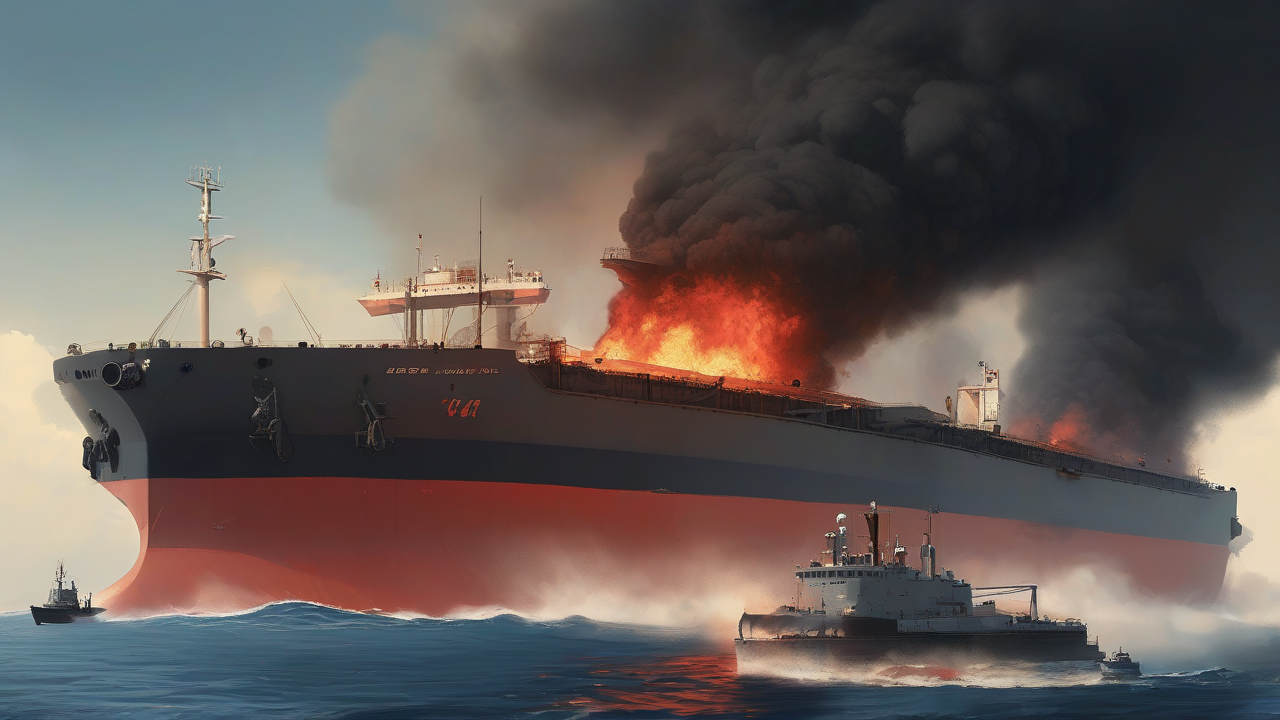
The missile found its target six hundred miles from the nearest trench. On Monday, the Saudi-flagged very large crude carrier Amzan reported being struck by an unknown projectile sixty-three nautical miles west of Yanbu, igniting a fire on the main deck, according to the UK Maritime Trade Operations advisory that logged the attack as incident number one hundred nineteen this year. [4] All crew are safe and accounted for; no environmental damage has been reported. [1] The vessel is no tramp freighter. The Amzan is a Bahri-owned supertanker of 320,926 deadweight tonnes, flying the flag of the kingdom whose crude it exists to carry. [2]
Houthi military spokesman Yahya Saree claimed the strike within hours, describing it as a ballistic-missile operation enforcing the group's declared naval ban on Saudi shipping — the blockade-for-blockade campaign Riyadh's own coastline has been absorbing since July. Saree said other vessels fled the area when the Amzan was hit, and folded the tanker strike into a wider wave that included, by Houthi claim, a Saudi military convoy, a base, and ten weapons trucks destroyed. [3] Bahri confirmed its vessel was involved in an incident without naming any weapon, the linguistic minimization of a company speaking for a state that would prefer this to be weather.
The geography is the story, and open-source analysts did the arithmetic faster than any government. Yanbu sits on the Red Sea coast more than nine hundred kilometers from Yemeni-held territory; OSINT accounts geolocated the strike point and noted the missile reached over six hundred miles past anything the Houthis should be able to threaten if the maps still meant what they said. [1] Yanbu is not just another port. It is the western terminus of Saudi Arabia's east-west pipeline — the engineered answer to Iran's closure of the Strait of Hormuz, the valve through which kingdom crude reaches the sea without transiting a Persian Gulf chokehold Tehran can shoot at.
The ban the Houthis claim to be enforcing dates to July 20, when the group announced it would bar Saudi-linked shipping in retaliation for what it called Riyadh's own siege of Yemeni territory — a blockade-for-blockade doctrine Saudi Arabia denies grounds for, and has answered with coalition strikes on Houthi sites. [5] Since then the tally has mounted methodically: tankers struck with ballistic missiles and drones, others intercepted and forced to turn back, and now a hit against the loading zone of the pipeline built to make Houthi geography irrelevant. Each iteration has extended the declared battlespace northward, and Monday's strike simply completed the arc — from Bab al-Mandab to Jeddah approaches to the terminal itself.
That function is already degrading. Lloyd's List intelligence calculates that exports from Yanbu have fallen by at least a third since attacks on northern Red Sea shipping began, and maritime reporters describe Saudi crude now moving in shuttle cargoes to Egyptian pipelines or in partial loadings north toward Suez, each workaround adding cost and delay to every barrel. [2] A strike against a loading-zone supertanker is therefore not harassment of shipping in general. It lands precisely where Saudi Arabia's Hormuz-bypass strategy lives, which is why the Houthis chose it, and why the kingdom's terse confirmations are doing so much quiet work.
Watch the two frames process the same smoke. Riyadh's account is a maritime incident: crew safe, fire addressed, no cause named, nothing to see beyond a damaged ship. The Houthi account is siege enforcement: a declared ban, a violating vessel, a ballistic signature delivered at range. Between them runs the question neither capital will say aloud — what happens to a bypass pipeline economy when the enemy acquires reach along its entire length? Same-day editorial copy in the maritime press was asking what follows the expiration of the Hormuz memorandum between Washington and Tehran; nobody in official Riyadh was asking anything on the record at all. [2]
For the crews, the arithmetic stays brutally simple. One fire, extinguished or contained; twenty-five or so sailors alive because drills worked; a shipowner recalculating war-risk premiums on a route that priced risk as southern Red Sea geometry until this month. For the strategists, the lesson compounds: declared sieges do not stay where they are announced. The Houthis said they would enforce a blockade of Saudi waters, and on Monday they demonstrated the means to do it against the kingdom's most important alternative terminal. The distance between threat and capability, always the honest measure of a siege, got shorter by six hundred miles overnight.
-- YOSEF STERN, Jerusalem