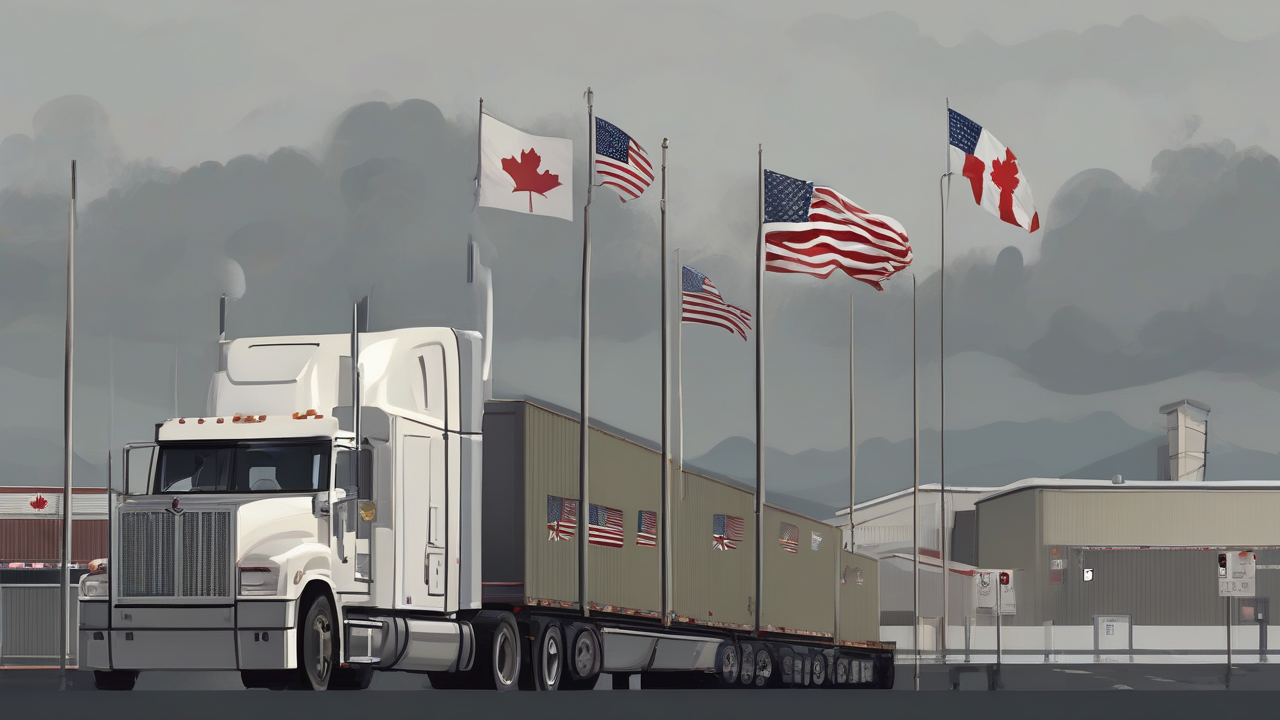
The promise became paperwork Tuesday morning. Canada's Department of Finance published the countermeasures package Ottawa had been drafting since Washington's fifty percent tariffs landed on C$27.6 billion of Canadian goods — roughly US$19.94 billion — confirming that matching duties of fifteen, twenty-five, and fifty percent will fall on about seven hundred American products, dollar for dollar, rate for rate. [1] This paper noted Monday that the retaliation was still a promise wearing a date, its annex unpublished. The annex now exists, and it reads like a shopping list written by a country describing its own kitchen: fish, dairy, furniture, paper products, carpets, steel and aluminum, appliances, clothing, sporting goods. [1][3]
The effective date is doing quiet work inside the announcement. September 8 — two weeks out, as Ottawa had telegraphed all week — is not retaliation; it is a scheduled retaliation, a window in which every affected American industry can lobby, every negotiator can phone, and both capitals can climb down without admitting anything. [1][5] Ottawa framed the gap as transition time cushioned by support measures, including expanded loan flexibilities for Canadian businesses caught in the crossfire. [1] Read colder, it is also a deadline aimed across the border: cancel your tariffs and ours never fire. Trump administration officials have already promised countermeasures to the countermeasures, so expect both schedules to grow before either shrinks.
Same-day escalation narrowed the window from the other direction. Trump announced that US auto tariffs on Canada rise to fifty percent on January 1, 2027 — a date far enough out to look like policy and close enough to land inside the next negotiation cycle. [2] The two announcements together describe a trade relationship now conducted entirely by press release: each capital schedules pain, names a principle, and dares the other to move first. Three days of collapsed talks produced this architecture, and neither government has explained what broke. [4]
The asymmetry problem Ottawa will not say aloud sits under the symmetry language. Dollar-for-dollar sounds like balance, but the two tariff schedules do not hit the same households evenly. American levies raise prices on Canadian steel, electronics, dairy, appliances, and pulp shipped south; the counter-list answers with Wisconsin cheese, Ohio furniture, and Southern sporting goods moving north. [3] Both governments describe defending workers while designing schedules whose costs arrive in grocery aisles on both sides of the line — matched pain, unevenly distributed.
Ottawa's cushioning measures reveal what it expects those aisles to feel like. The package pairs the counter-tariffs with substantive support for workers and businesses: expanded loan flexibilities through the Canada Emergency Enterprise Financing Facility so exporters squeezed by American duties can borrow their way through the gap, and targeted relief aimed at the sectors most exposed to reprisal. [1][4] Canadian shoppers spent Tuesday posting buy-Canadian lists while farm-state accounts south of the border catalogued which of the seven hundred products land in their own congressional districts — the retaliation designed as sovereignty defense arriving, in practice, as a map of mutual price increases. [3][4]
Watch the politics travel differently than the economics. In Canada, the retaliation polls well and the government wants credit for firmness with a safety net attached — sovereignty defended, workers cushioned. [4] In the United States, the seven hundred products were chosen with visible political geometry, and free-traders on both sides note the deeper precedent: two allied economies now run tariff policy by announcement, matching escalations like duelists taking paces. Carney's critics north of the line ask a different question — why three days of talks collapsed without a single readout of who walked out over what. [4] The relationship survived the last round of this because courts, negotiators, and quiet carve-outs absorbed the anger. This time the carve-outs have names and dates.
What happens between now and September 8 decides whether this is a trade war or a bargaining position. If Washington withdraws or waives the fifty percent schedule, the Canadian list quietly dies in committee, and both leaders claim victory. If it fires on schedule, the auto-tariff threat follows on January 1, and North America's integrated supply chains — built over thirty years precisely so nobody would ever need this kind of list — start repricing everything from car parts to ketchup. The window is open. It closes on the eighth, and somebody's shoppers pay the difference either way.
-- LUCIA VEGA, São Paulo