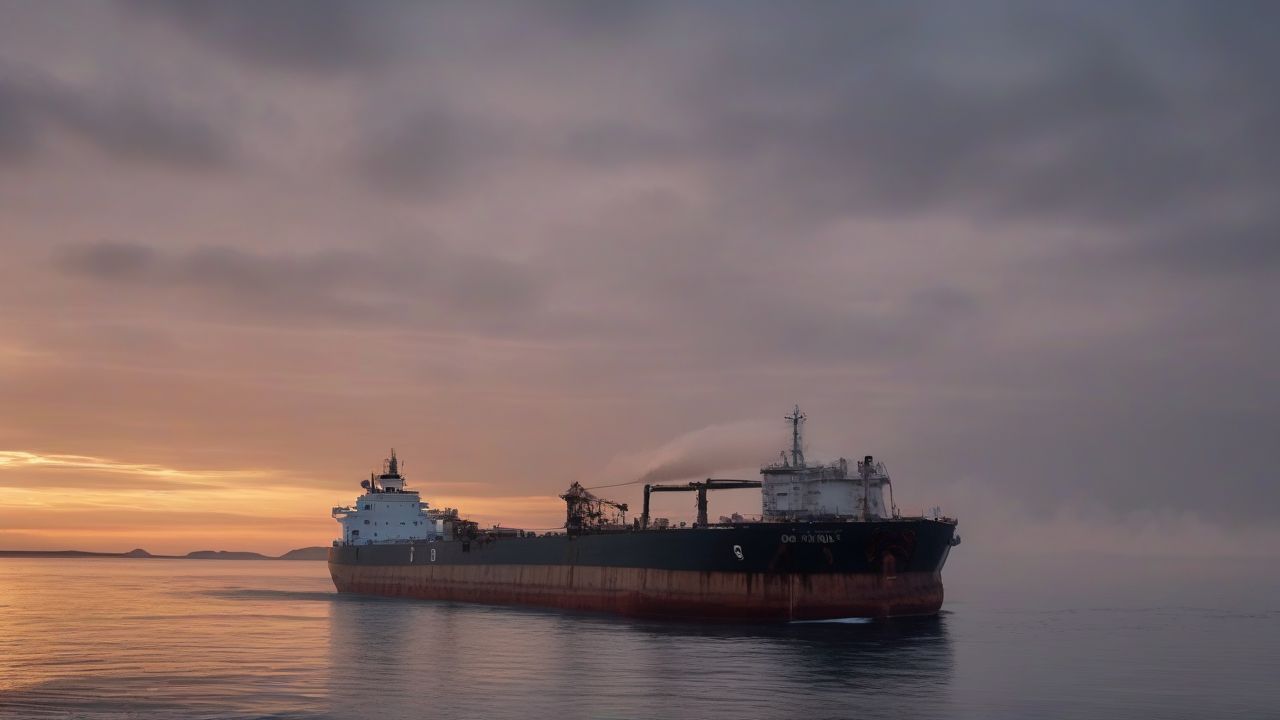
A tanker was struck by an unknown projectile in the Strait of Hormuz on Tuesday, just as President Trump was posting an image to Truth Social declaring "MISSION ACCOMPLISHED 2026" in Iran. [1] Trump offered no additional explanation with the post. The tanker, the Al Salam II, was hit just above the waterline while transiting eastbound near Khasab, Oman, opening a small hole and starting a fire the crew extinguished before anchoring the vessel roughly 0.8 nautical miles northwest of Jazirat Tawakkul. [1] No injuries were reported.
The juxtaposition sharpens a contradiction this paper tracked Wednesday, when Iran's own president, parliamentary speaker and central bank governor were making unusually blunt public statements about whether the blockade's costs now outweigh its value — while Tehran simultaneously resumed talks with Oman explicitly aimed at cashing in the strait as leverage, not abandoning it. Trump's victory lap arrives in the same week, framed around a narrower military claim than the declaration suggests.
The mine-clearance claim underlying "mission accomplished" traces to a Truth Social post Trump made Tuesday, in which he said the U.S. Navy had "removed and/or detonated all mines" from the strait's international waters, warning that any vessel laying new mines would be "immediately and systematically destroyed" under a "Zero Tolerance" policy. [2] U.S. Central Command commander Admiral Brad Cooper offered the operational detail behind that claim in a video posted to X, saying American forces had spent months "meticulously and quietly" clearing mines using Navy divers, Navy SEALs and air power from four service branches. "The circumstances were challenging and dangerous, to say the least, but we got the job done," Cooper said. "Bottom line: Today, international shipping lanes are open and momentum is building." [2]
Cooper's own language, though, describes something narrower than Trump's global "all mines" claim. He specified that U.S. forces cleared the Traffic Separation Scheme — the strait's long-established commercial shipping lanes — not the waterway as a whole. [2] Cooper credited the operation with facilitating 1,500 vessel transits carrying roughly 750 million barrels of crude, and said Iran has exported "zero oil" since Washington reinstated its blockade. [2] The Joint Maritime Information Center, the body that tracks the strait's threat status day to day, said Thursday that risk remains from drifting or uncharted mines in and near the Traffic Separation Scheme, that mine danger areas remain active, and that clearance and mine-surveying operations are continuing throughout the strait. JMIC held its overall threat assessment at SEVERE. [2]
The Al Salam II strike is the clearest evidence that JMIC's caution, not Trump's declaration, describes the strait's actual condition. Traffic through Hormuz remains a fraction of its prewar level: JMIC put the 2025 historical average at roughly 138 vessel transits per day, against just 37 U.S.-facilitated transits recorded over August 25 and 26 combined, with separately tracked non-facilitated commercial traffic still heavily suppressed. [1] JMIC said it expects traffic to stay reduced across both the Iranian-controlled northern route and the Omani southern corridor, citing the pattern of vessel attacks, continued U.S. blockade enforcement, and elevated regional tension. [1]
That gap between the rhetoric of an open strait and the reality of a five-percent-of-normal one is precisely what this paper's Iran-watching sources on X have argued for weeks describes Tehran's actual strategy, not Washington's. Policy Tensor and journalist Kim Dozier have separately made the case that Iran treats Hormuz not as a doctrine cracking under economic strain but as the one confirmed point of leverage it retains over Gulf energy flows to Western economies — leverage worth using to extract a deal at its peak value, not worth discarding out of exhaustion. Trump's declaration reads, in that frame, as an attempt to claim victory over a chokepoint neither side has actually settled.
Iran and Oman are, in fact, moving forward with the diplomatic track that would settle it, in parallel with the disputed military one. The two countries unveiled a phased framework Tuesday establishing a temporary joint navigation corridor through Hormuz and a joint mine-clearing project, alongside continued technical negotiations toward a permanent corridor and what the framework calls the "future administration of the Strait" — covering information exchange, traffic management and navigational and security services. [1] The proposal implements provisions of the U.S.-Iran memorandum of understanding signed in June, which called for Iran to negotiate directly with Oman over the strait's future management. [1] Those talks are widening: Qatar's prime minister and foreign minister, Sheikh Mohammed bin Abdulrahman Al Thani, visited Tehran on Thursday specifically to discuss the proposed framework, according to Qatar's foreign ministry. [1]
Iran's own military has separately claimed the diplomatic track already produced a concrete result Washington is blocking. Islamic Revolutionary Guard Corps spokesman Hossein Mohebbi said Wednesday that Iran and Oman had reached a revenue-sharing agreement covering each country's share of the strait's waters and of transit revenues, telling Iran's Sepah News agency that "the US is obstructing this process, causing progress to be delayed" — a claim that goes further than the joint foreign-ministry statement, which described only an "interim framework" for resuming transits and did not mention fees. [3] International Maritime Organization Secretary-General Arsenio Dominguez has separately and publicly disputed the broader reopening narrative, telling Bloomberg last week that given the small number of ships actually transiting, "this strait is, in practice, not open" — a rebuttal this paper noted Wednesday sits alongside Trump's claim that 10 million barrels made the passage in a single day. [3]
None of the parties agree on what "open" means, which is the real story beneath Wednesday's tanker strike. Trump's version rests on a global mine-clearance claim and aggregate barrel counts. Cooper's version, delivered in the same week, is narrower and lane-specific, paired with an explicit acknowledgment that Iran has exported no oil under blockade. JMIC's version is the most conservative of the three: mines remain a live risk, clearance operations are ongoing, and the threat assessment has not moved off its highest tier. Tehran's version treats the strait as a negotiating asset whose administration is still being contested clause by clause with Oman, Qatar and, indirectly, Washington. The Al Salam II, still anchored near Jazirat Tawakkul awaiting tug assistance as of Thursday, sits at the center of all four accounts and confirms only one thing without dispute: whatever "mission accomplished" means, it did not stop a tanker from burning in the strait two days later.
-- YOSEF STERN, Jerusalem