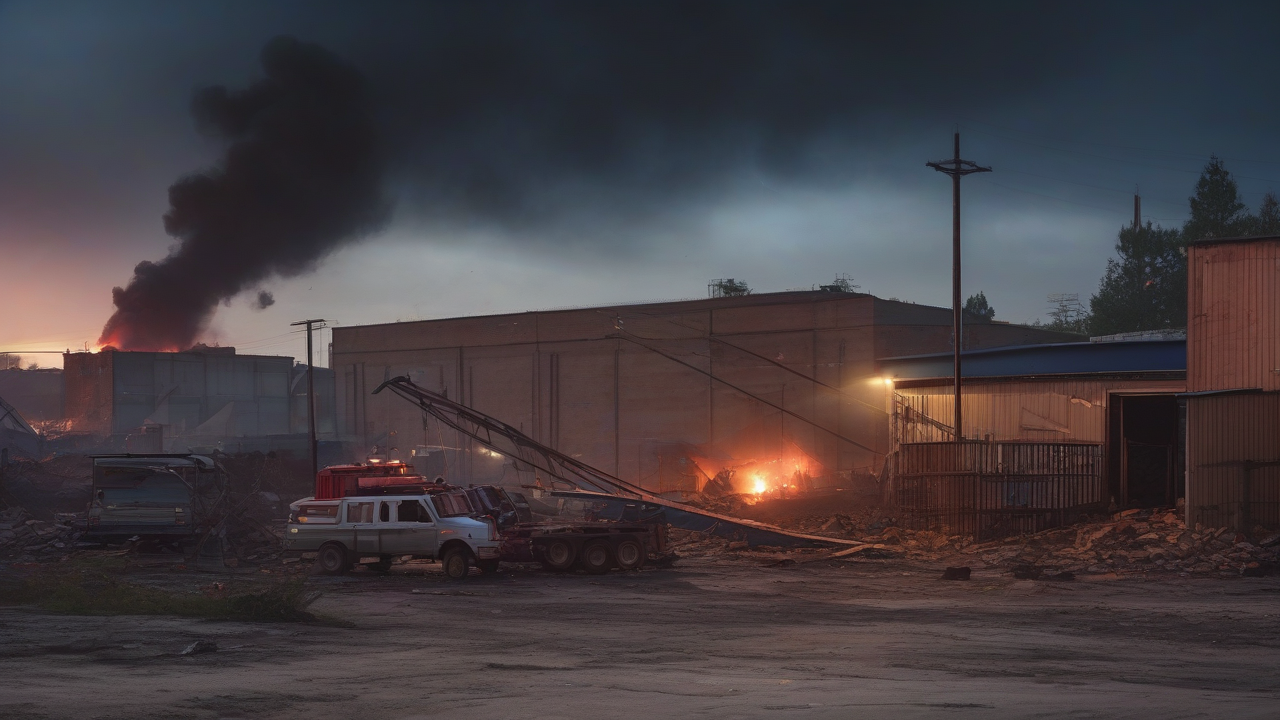
A Russian drone strike on a warehouse west of Kyiv killed at least 37 people on Saturday, one of the deadliest single attacks on Ukraine this year — and Ukrainian President Volodymyr Zelensky's own account of what happened complicates the story MSM headlines are telling. [1] The strike hit a warehouse in the village of Myla, in the Bucha district, that Russia's Defense Ministry said was storing components and launch boosters for long-range drones. [1] The resulting detonation and fire swept through an adjacent elderly and disabled care home and damaged at least 50 residential buildings. Regional military administration head Tymur Tkachenko said 34 of the 37 dead were residents of that care facility. [1]
Zelensky did not confine his statement to condemning Russia. He described a "terrible situation" and called it "terrible negligence on the part of those who stored explosives right next to people." [1] Ukrainian law forbids storing ammunition near civilian homes, he noted, and criminal proceedings have already been opened. "Those who allowed this to happen must be held accountable for their decisions," Zelensky said. [1] It is an unusual admission for a wartime leader to volunteer in the same breath as reporting a mass-casualty enemy strike, and it is the detail that separates Saturday's coverage from a straightforward atrocity story: the deaths resulted from a Russian weapon detonating explosives that Ukrainian officials had placed beside a care home in violation of their own law.
Ukrainian Prime Minister Serhii Koretskyi drew an explicit line to a near-identical incident less than two months earlier. An attack on the Kyiv suburb of Vyshneve in early July hit an ammunition depot, killing 22 people and triggering large detonations and fires through nearby homes — the same pattern of civilian housing built beside a legitimate military target. [1] "Unfortunately, we can already see that the terrible tragedy in Vyshneve did not become a lesson," Koretskyi said. "In the fifth year of a full-scale invasion, making the same mistakes is criminal negligence. And all those guilty, without exception, must be severely punished so that such situations do not happen again." [1] Zelensky separately announced that two officials at state-owned companies, including Ukroboronprom, the country's largest arms producer, had illegally allowed weapons storage at the Vyshneve site and would be held accountable. [1] Whether the Myla warehouse involved the same institutional failure — a state arms apparatus repeatedly choosing convenient storage sites over compliance with its own safety law — is the open question Saturday's statement did not answer.
The strike landed amid what Ukrainian officials describe as the most sustained bombardment of Kyiv in months. Russian air raids on the capital entered their third consecutive day Saturday, part of a pattern officials say is designed to exhaust Ukrainian air defenses through sheer volume of drone and missile launches rather than any single decisive strike. [1] Russia's Defense Ministry said it also struck the ports of Mykolaiv and Izmail on the same day, along with a logistics center storing components for Ukraine's Flamingo cruise missiles in the Kyiv region — claims that would, if accurate, support Moscow's framing of Saturday's attacks as targeting legitimate military infrastructure rather than civilians. [1] That framing has not been independently assessed, and it does not address why explosive components were stored adjacent to a residential care facility in the first place.
Elsewhere in the country, Russian strikes on the southern Kherson region killed two people and wounded 27 more Saturday, including a child, regional administration head Oleksandr Prokudin said. [1] Prokudin had warned earlier in the week that Russia intensified attacks on critical infrastructure in the roughly 70-percent-occupied region and urged tens of thousands of residents to relocate ahead of a possible winter without power or heat. [1]
Ukraine's own long-range campaign continued in parallel. Zelensky said in his Friday evening address that Kyiv hopes to raise its long-range strikes on Russian territory — which he calls "sanctions" — to 1,000 drone launches a day. "Right now, we average over 300 of our long-range sanctions," he said. "There must be more. We have a very specific goal, and we will achieve it." [1] Russia's Defense Ministry said it destroyed 313 Ukrainian drones overnight into Saturday, and a Russian regional governor reported 11 people wounded, including four children, in a Ukrainian drone attack on Rostov region. [1]
Deputy head of Ukraine's presidential office Pavlo Palisa told journalists Friday, in comments embargoed until Saturday, that Russia has significantly expanded its use of jet-powered drones and that their numbers will keep climbing as Moscow registers their battlefield effectiveness. "Means of attack always outpace means of defense," Palisa said. "We will certainly need to adapt. It will take time." He added that Ukraine's currently available interceptor drones — the theoretical answer to jet-powered threats — "have not yet demonstrated the expected effectiveness," though the country is working on solutions. [1]
The tactical picture Palisa described helps explain why officials keep describing the current bombardment in terms of volume rather than any single breakthrough weapon. Ukrainian officials say Russia methodically builds up missile and drone stocks between major attacks, then launches them in concentrated waves every few days specifically to overwhelm air-defense systems that can intercept individual threats but struggle against saturation. Saturday's third consecutive day of raids on Kyiv fits that described pattern, and it is the backdrop against which the Myla warehouse — whatever its precise inventory — became a target Russia's Defense Ministry judged worth striking directly rather than as collateral damage from a wider barrage. [1]
That distinction is part of what makes Zelensky's negligence framing land differently than a typical wartime casualty report. If Russia deliberately targeted a known drone-component depot, as its own Defense Ministry claims, then the deaths of 34 care-home residents were not an accident of imprecise weaponry — they were the foreseeable consequence of a storage decision Ukrainian officials could have avoided under their own law. Whether Saturday's criminal proceedings ultimately identify who made that decision, and whether it mirrors the Vyshneve failure closely enough to implicate the same institutional actors, will determine whether Kyiv's account of Saturday reads as accountability in practice or as a promise repeated for the second time in two months.
The Kherson strikes Saturday, killing two and wounding 27 in a region already about 70 percent under Russian control, underscore how the war's daily toll now extends well beyond any single headline attack. Prokudin's warning earlier in the week — urging tens of thousands of residents to relocate ahead of a winter without reliable power or heat — describes a slower, quieter form of the same infrastructure targeting that produced Saturday's larger tragedy in Bucha district. Both are consequences of the same broader strategy Ukrainian officials describe: sustained pressure across multiple fronts simultaneously, calculated to strain air defenses, energy infrastructure and now, in Myla's case, whatever storage decisions Ukraine's own institutions made under that pressure.
Saturday's death toll makes Myla one of the war's costliest single strikes in 2026, but the number that will likely determine the story's second act is not the count of Russian munitions but the accountability process Zelensky himself opened. Criminal proceedings are underway. Whether they identify a specific chain of decisions — who chose the Myla site, who signed off on it, whether anyone flagged the same risk after Vyshneve in July — will decide whether Saturday reads, in the end, as a story about Russian aggression alone or about a state repeating an error it had already promised, in writing, not to repeat.
-- KATYA VOLKOV, Moscow