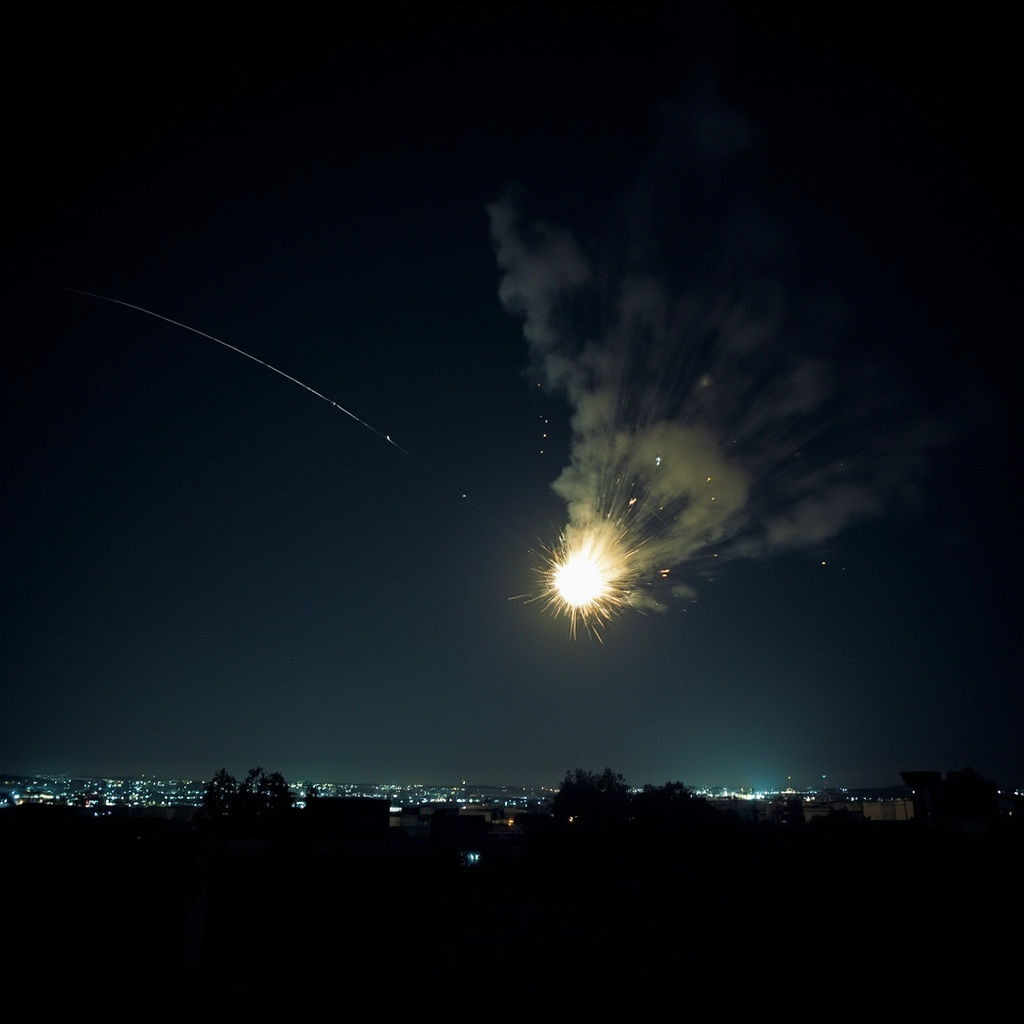
On Saturday evening, an Israeli Arrow 3 interceptor climbed through the upper atmosphere, crossed the Karman line into space, and destroyed an incoming Iranian ballistic missile before it could begin its descent toward Dimona. Verified footage published by JNS shows the intercept at exoatmospheric altitude — a bright flare against the darkness, followed by a debris trail that dissipated over the Negev. [1]
This paper reported on Sunday that the IDF had confirmed Arrow 3 was never fired during the Arad-Dimona strikes that wounded 175 people, raising questions about whether the system was being conserved or had failed. Saturday's intercept answers the operational question: Arrow 3 works. It was subsequently activated after the initial barrage. The strategic question — whether Israel has enough of them — remains unanswered, and the emerging evidence suggests it does not.
On March 14, Israel warned the United States that its supply of ballistic missile interceptors was "running critically low," according to reporting by Semafor and the Middle East Monitor. The warning was delivered as the conflict with Iran entered its third week and the volume of incoming ballistic missiles showed no sign of diminishing. [2][3]
The Intercept
Arrow 3 is designed to do precisely what it did Saturday: destroy ballistic missiles outside the Earth's atmosphere, at altitudes above 100 kilometers, before warheads can separate or deploy countermeasures. Jointly developed by Israel Aerospace Industries and Boeing at a cost exceeding $3 billion, the system represents the outermost layer of Israel's multi-tier missile defense architecture. Arrow 2 handles endoatmospheric interceptions. David's Sling covers medium-range threats. Iron Dome addresses short-range rockets. [1]
The footage shows what analysts describe as a "hit-to-kill" engagement — the interceptor physically colliding with the incoming missile rather than detonating a proximity warhead. This is the preferred engagement mode for Arrow 3 because it ensures complete destruction of the warhead before atmospheric re-entry. The debris from Saturday's intercept fell outside Israeli territory. [1]
The Arithmetic Has Not Changed
The successful intercept does not alter the attritional calculus this paper described on Sunday. Each Arrow 3 interceptor costs between $2 million and $3 million. Iran's ballistic missiles cost a fraction of that. Israel entered the war with a finite stockpile estimated by analysts at well under 200 Arrow-series interceptors combined. After 24 days of sustained Iranian barrages — hundreds of ballistic missiles — every successful intercept depletes a reserve that cannot be replenished at anything approaching the rate of expenditure. [2][3]
The Economist reported on March 17 that the question of interceptor sufficiency had become "the central anxiety of Israeli defense planning." The IDF denied reports of a shortage on March 16 through the New York Times, stating it had "sufficient reserves for the current operational tempo." But the gap between that denial and the warning delivered to Washington two days earlier is notable. Telling the press you have enough while telling your patron you do not is a negotiating posture, not a strategic assessment. [3][4]
Arrow 4 and the Resupply Question
Israel and the United States are co-developing Arrow 4, the next-generation interceptor intended to address hypersonic and maneuvering warheads that the current system struggles to track. Arrow 4 is years from deployment. It does not help with the current war. [4]
What would help is emergency resupply from existing American stockpiles. Defense Ministry Director General Amir Baram flew to Washington in the second week of the conflict to request precisely that. No confirmation of additional U.S. shipments has been made public. The silence is itself informative. If the resupply had been approved and delivered, Jerusalem would have every incentive to say so. The fact that it has not suggests either the shipments have not arrived, the quantities are insufficient to announce, or Washington is conditioning the transfer on political concessions it does not wish to publicize. [2]
Saturday's Arrow 3 intercept was a technical triumph. The system performed exactly as designed, under combat conditions, against a live warhead aimed at Israel's most sensitive facility. The footage will enter the promotional reels of every defense contractor involved. But one successful intercept against a single missile does not constitute a defense posture. It constitutes a data point. The question is not whether Arrow 3 can destroy an Iranian missile in space. The question is whether Israel has enough of them to keep doing it — and the evidence, from Jerusalem's own warnings to Washington, suggests the answer is shrinking by the day.
-- YOSEF STERN, Jerusalem