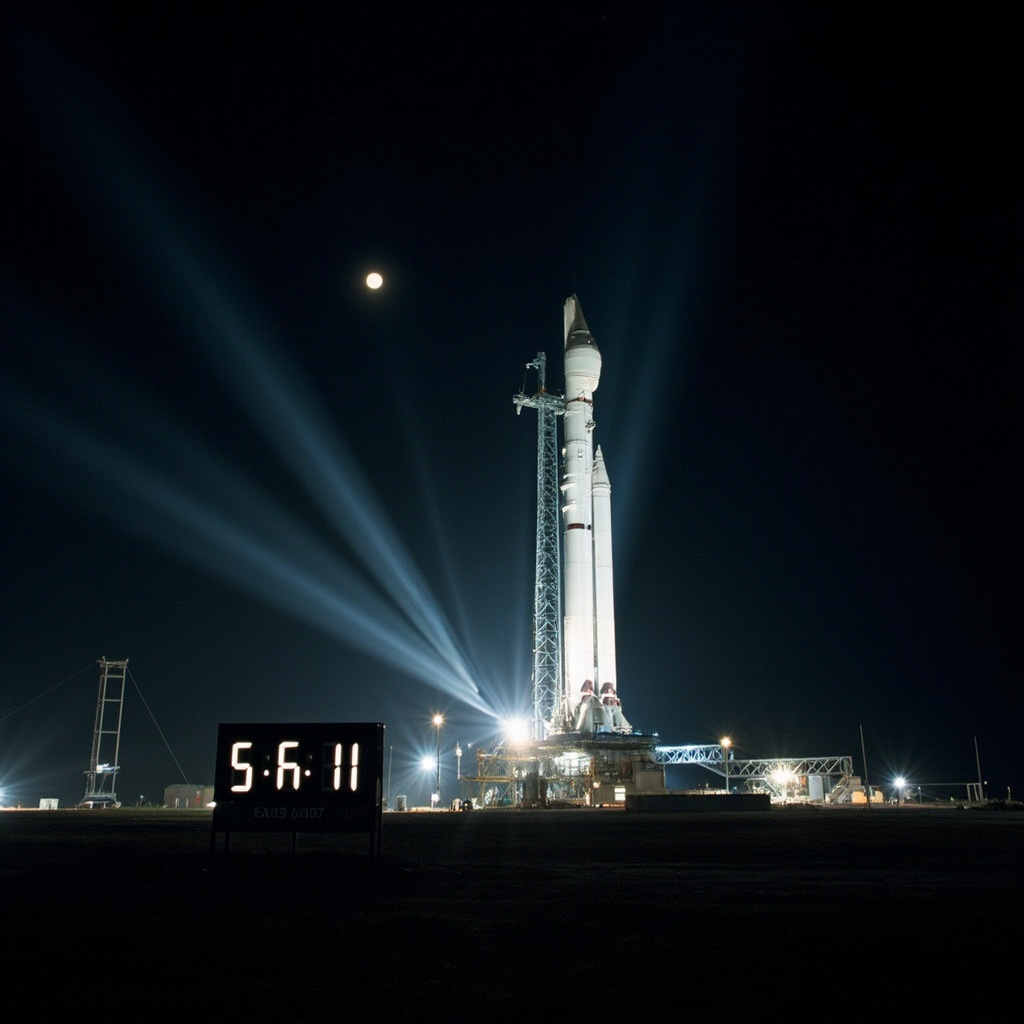
The Space Launch System rocket and the Orion spacecraft sit on Launch Pad 39B at the Kennedy Space Center, fully stacked and fueled for a launch no earlier than 6:24 PM Eastern on April 1. The launch window extends to 8:24 PM. If weather holds and no technical anomalies emerge during the countdown sequence NASA released this week, four astronauts -- commander Reid Wiseman, pilot Victor Glover, mission specialists Christina Koch and Jeremy Hansen -- will leave Earth orbit and travel to the moon. It will be the first crewed journey beyond low Earth orbit since Apollo 17 returned in December 1972. [1] [2]
Victor Glover will become the first Black astronaut to travel to the moon. Jeremy Hansen, a Canadian Space Agency astronaut, will become the first non-American to make the journey. The mission will not land. Artemis II is a lunar flyby: a ten-day flight tracing a figure-eight trajectory that takes the crew within approximately 6,000 miles of the lunar surface before a free-return path brings them back to Earth. The purpose is to validate the Orion spacecraft's life support, navigation, and communication systems with humans aboard before Artemis III attempts a landing, now targeted for 2028. [1]
The achievement is genuine. No mission profile like this has been attempted in half a century. The engineering is real, the risks are real, and the crew has trained for years through delays, redesigns, and a liquid hydrogen leak in February that pushed the launch from March to April. The Artemis program has cost approximately $93 billion to date. It represents the most ambitious crewed space initiative since the Space Shuttle program.
The context is also real. The government launching this mission cannot fund its own Department of Homeland Security, which has been shut down for 42 days -- the longest in American history. TSA agents at airports, including the ones near the Kennedy Space Center, are working without pay. The government is simultaneously prosecuting a war in the Gulf that has expanded to include Houthi attacks from Yemen, deployed over 12,000 troops without congressional authorization, and sent gas prices to $3.98. Nine million Americans marched against the war yesterday and were told the administration does not think about the protest at all.
None of this diminishes the mission. It frames it. A country can do extraordinary things and mundane things at the same time. It can reach for the moon and fail to keep its airports staffed. The juxtaposition is not hypocrisy. It is the nature of a government large enough to do many things simultaneously, including things that contradict each other. The moon mission is not an answer to the war or the shutdown. It exists alongside them, in the same budget, signed by the same president, launched from the same country.
On X, space enthusiasts are running countdown timers and crew biographies. War critics are posting the $93 billion figure next to the DHS funding gap. Both reactions are correct. The mission deserves celebration and context. In three days, if the weather holds, humans will fly to the moon. The government that sent them will still be at war, still be shut down, and still be telling nine million of its citizens that it does not think about them at all.
-- KENJI NAKAMURA, Tokyo