TL;DR
Thousands displaced by Israeli strikes shelter in tents on Beirut's corniche while luxury high-rises and nightclubs operate steps away.
MSM Perspective
The NYT reports thousands now sheltering along Beirut's Mediterranean promenade as Israeli strikes enter their third week on the capital.
X Perspective
Lebanese displaced are posting videos of children sleeping in rain on the corniche while music from nearby clubs plays in the background.
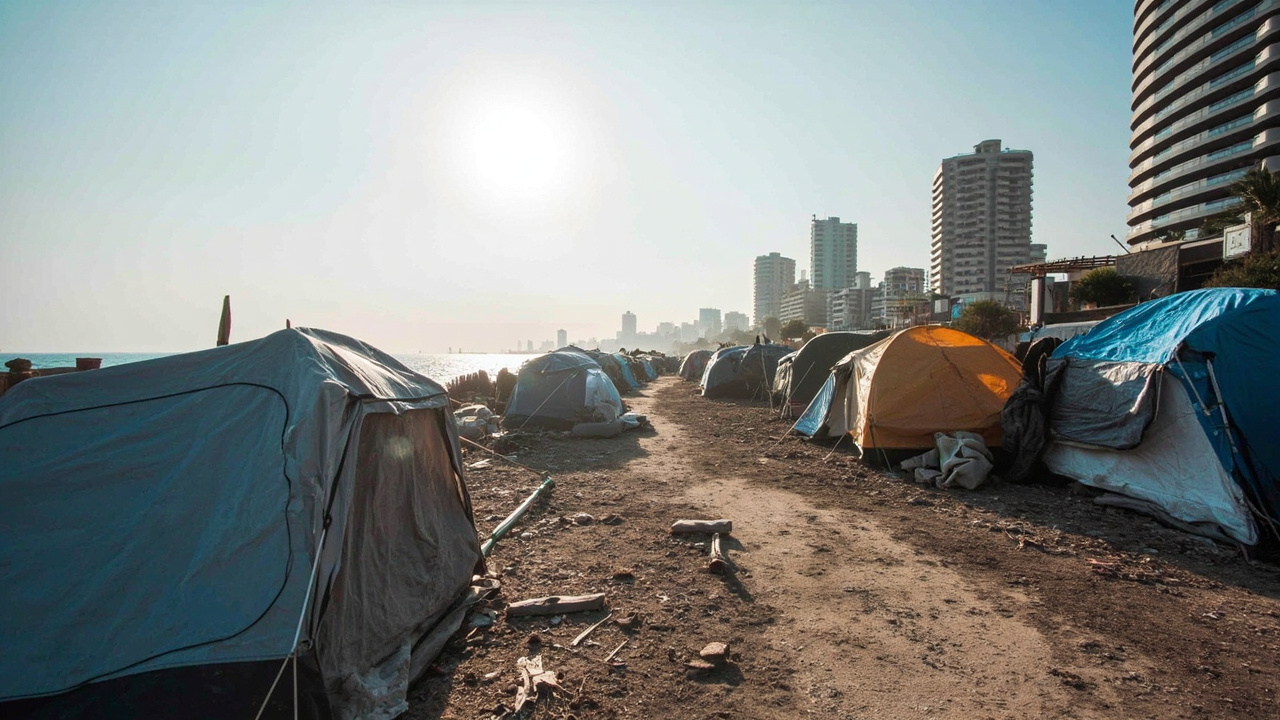
The tents begin at the Manara lighthouse and stretch east along the corniche for nearly two kilometers, a shantytown of blue tarpaulins and bedsheets rigged to parking meters and palm trees, and if you stand at the right angle you can see, beyond the flapping plastic, the glass facade of a building where a one-bedroom apartment sells for $1.2 million. This is Beirut in the third week of its newest war — a city where displacement and wealth occupy not merely the same country, or the same district, but the same block [1].
On Saturday, the New York Times published a dispatch from this stretch of Mediterranean waterfront that has become, in the lexicon of humanitarian crisis, an "informal settlement." The language is precise and also absurd. There is nothing informal about a family of seven sleeping under a tarpaulin in March rain while the Rolex boutique on Zeitounay Bay remains open for business 400 meters away [1].
I have covered Beirut across three wars. Each one produces this particular vertigo — the coexistence of catastrophe and normalcy that is not a failure of the city's character but its defining feature. Lebanon does not shut down during wars. It fractures. The rich retreat to the mountains or to their reinforced underground parking garages. The poor end up on the corniche.
The numbers this time are staggering. Over one million people have been displaced within Lebanon since Israeli strikes resumed in early March, according to the United Nations. At least 1,029 Lebanese have been killed. The strikes on Beirut's southern suburbs — Dahieh, the Hezbollah stronghold — have pushed entire neighborhoods northward into the city center, where they have no homes, no relatives, and no shelter other than what they can improvise from materials scavenged from construction sites [2].
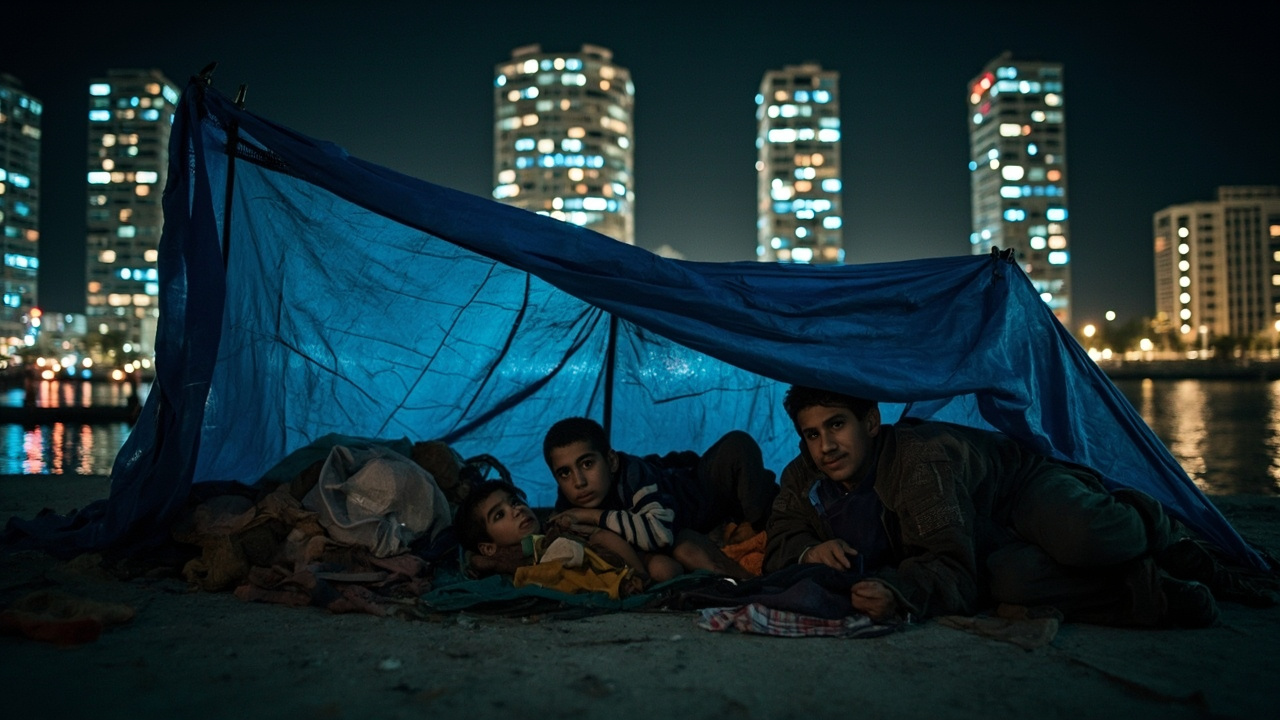
"We haven't slept," Huda, a 34-year-old mother of three from Haret Hreik, told L'Orient Le Jour. She has been on the corniche for nine days. Her tent is a construction-site tarpaulin stretched over a length of rope tied between two lampposts. Her youngest child, a boy of four, sleeps in a stroller that she found abandoned near the St. George Yacht Club. "When it rains, we hold the plastic over the children. The adults just get wet" [3].
The rain came twice last week. Heavy, cold, Mediterranean rain that turns the corniche's stone walkway into a shallow river. Photographs published by the ICRC showed toddlers standing barefoot in puddles, their clothes soaked, their mothers wringing out blankets that would not dry before nightfall. Thirty meters away, behind a construction hoarding, a nightclub was advertising its Saturday DJ set on Instagram [4].
The third week of the war brought heavier strikes. Israeli jets hit targets in Dahieh that the IDF described as Hezbollah command nodes. The explosions, residents say, were louder than anything in the 2006 war. The shock waves carried across the city, rattling windows in Achrafieh and Hamra, neighborhoods that had considered themselves relatively safe. Each escalation sends a new wave of families toward the sea [2].
A volunteer from the Lebanese Red Cross, who asked not to be named because he was not authorized to speak to press, described the sanitation situation as "pre-crisis." There are no toilets. Families use the public bathrooms at the adjacent Sporting Club — a private beach club that has, to its credit, opened its facilities without charge — but the bathrooms were built for summer bathers, not for a thousand displaced families. There is one working tap for drinking water per 200 meters of corniche. The children are developing skin rashes. Respiratory infections are spreading [4].
And yet. The children play. They run along the waterfront in the gaps between the tents, kicking a deflated football, and their laughter carries the specific, unbearable sound of children who do not yet understand that the world has failed them. A girl of perhaps eight was photographed by Reuters last Tuesday holding a helium balloon — pink, heart-shaped — that someone had given her. The ICRC used the image for a fundraising appeal. The balloon has since deflated [4].
The juxtaposition is structural. Lebanon is a country of 5.5 million people where the top 10 percent control more than 70 percent of national wealth. The waterfront exists because money exists. The tents exist because the state does not — not in any functional sense. The Lebanese government has been in caretaker mode for years. It has no budget for this [2].
What remains is private charity and international agencies, overwhelmed. The World Food Programme is distributing meals, but the logistics of feeding thousands along a two-kilometer strip of urban waterfront differ from feeding a camp in a field. There is no perimeter, no registration system. The population fluctuates with each night's bombing [3].
At sunset, the corniche fills with a different kind of crowd: joggers, couples, families from the undamaged neighborhoods who come to walk the promenade as they have always done. They walk past the tents. Some stop to offer food or water. Most keep walking. This is not cruelty. It is the survival mechanism of a city that has learned, through repetition, to absorb the unabsorbable.
Huda's four-year-old son, the one in the stroller, has a name: Karim. He has brown eyes and a cough. He does not know that the building he lived in no longer exists. He does not know that the Rolex boutique down the road sells watches for more than his father earned in a decade. He knows that the sea is loud at night, and that his mother holds the plastic over him when it rains.
This is what war looks like when it arrives in a city that was never designed to accommodate it and never learned to refuse it.
-- YOSEF STERN, Jerusalem
Sources & X Posts
News Sources