TL;DR
J. Michael Bishop, who shared the 1989 Nobel Prize for discovering that cancer genes originate from our own normal cells, died March 20 at 90.
MSM Perspective
The New York Times obituary calls Bishop's discovery 'the conceptual foundation on which all modern cancer biology rests.'
X Perspective
Science X is sharing the oncogene discovery story as a reminder that basic research — not drug development — produces paradigm shifts.
For most of the twentieth century, cancer was understood as an invasion. Something got into you — a virus, a chemical, a piece of radiation — and it corrupted your cells from the outside. The enemy was foreign. The body was the victim. The metaphor was war, and if you could only find the invader and kill it, the body would be saved [1].
J. Michael Bishop, who died on March 20 at the age of 90 from pneumonia at his home in San Francisco, proved that this understanding was almost entirely wrong. Cancer does not come from outside. Cancer comes from within. The genes that cause it — oncogenes — are corrupted versions of genes the cell has carried all along, genes that in their normal state perform essential functions: regulating growth, directing division, telling a cell when to live and when to die. The villain was not a stranger. The villain was the cell's own machinery, broken [1].
This discovery, made with Harold Varmus in the mid-1970s at the University of California, San Francisco, earned them the 1989 Nobel Prize in Physiology or Medicine. Before Bishop and Varmus, cancer research was a vast and scattered enterprise — thousands of scientists studying thousands of carcinogens, each a separate cause requiring a separate solution. After them, cancer research had a unifying theory: all roads lead to the same genes [2].
The Son of a Minister
John Michael Bishop was born on February 22, 1936, in York, Pennsylvania. His father was a Lutheran minister. His mother was a schoolteacher. Neither parent had attended college. He attended Gettysburg College, a Lutheran liberal arts school, where he studied chemistry and experienced what he described as a gradual seduction by the molecular [1].
He went to Harvard Medical School not to become a doctor but because, in 1957, a bright young man interested in biochemistry and unable to afford a PhD program could get someone else to pay for his education if he agreed to learn anatomy along the way. At Harvard, his mentor Elmer Pfefferkorn studied how viruses replicate inside cells, and Bishop was transfixed — a particle so simple it was barely alive, yet capable of hijacking the most complex machinery in biology. A clinical rotation in oncology showed him patients dying of cancers that medicine could describe but not explain. "I knew what the tumors looked like under a microscope," he wrote in his memoir, "How to Win the Nobel Prize." "I had no idea why they were there" [1].
He chose the mystery over the clinic. In 1968 he joined UCSF and began studying Rous sarcoma virus, a chicken virus that had fascinated virologists since Peyton Rous first described it in 1911.
The Experiment That Changed Everything
Rous sarcoma virus carried a gene called src that could transform normal cells into cancer cells. The universal assumption was that src was a viral gene — a weapon unique to the pathogen.
Bishop and Varmus asked the obvious question nobody had asked: Is src actually a viral gene? Or did the virus steal it from somewhere?
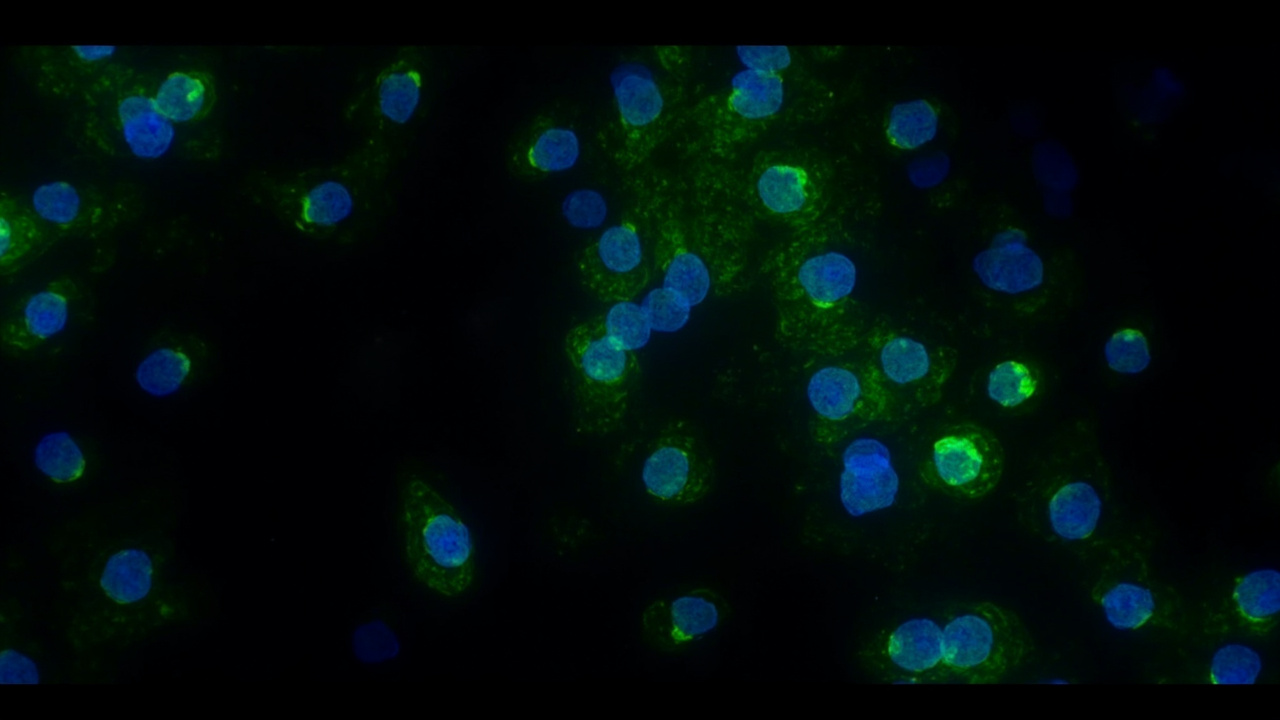
They built a molecular probe — a radioactively labeled strand of DNA complementary to src. If src was unique to the virus, the probe would bind only to viral DNA. If it had a cousin in normal cells, the probe would bind there too.
It bound there too. Not just in chicken cells. In quail cells, duck cells, mouse cells, human cells. The gene that caused cancer in chickens existed, in slightly different form, in the normal DNA of every vertebrate species they tested. It was not a viral weapon. It was a cellular gene — a proto-oncogene — that the virus had captured and mutated into a form that drives uncontrolled growth [2].
The implications were staggering. Every cell in every human body carried proto-oncogenes — genes that, when functioning properly, regulated growth and division, but that could be broken by mutation into oncogenes. Every cigarette, every radiation exposure, every inherited mutation — they all converge on the same cellular switches. Different keys, same lock [2].
What It Meant
This insight made modern cancer therapy possible. If you know which genes drive a cancer, you can design drugs that target the proteins those genes produce. Imatinib (Gleevec) for chronic myeloid leukemia, trastuzumab (Herceptin) for HER2-positive breast cancer, vemurafenib for BRAF-mutant melanoma — the entire field of targeted cancer therapy flows from a probe in a UCSF laboratory that lit up where it was not supposed to [2].
Bishop led UCSF as chancellor from 1998 to 2009. He wrote with grace and wit. His memoir contains a passage about the moment of discovery: "The probe found its target in normal cells. I stared at the autoradiograph for a very long time. I understood immediately that this changed everything. And I understood, with equal clarity, that I would spend the rest of my career explaining why."
He spent 50 years explaining why. The explanation changed medicine.
He is survived by his wife, Kathryn Bishop, and two sons.
-- KENJI NAKAMURA, San Francisco
Sources & X Posts
News Sources