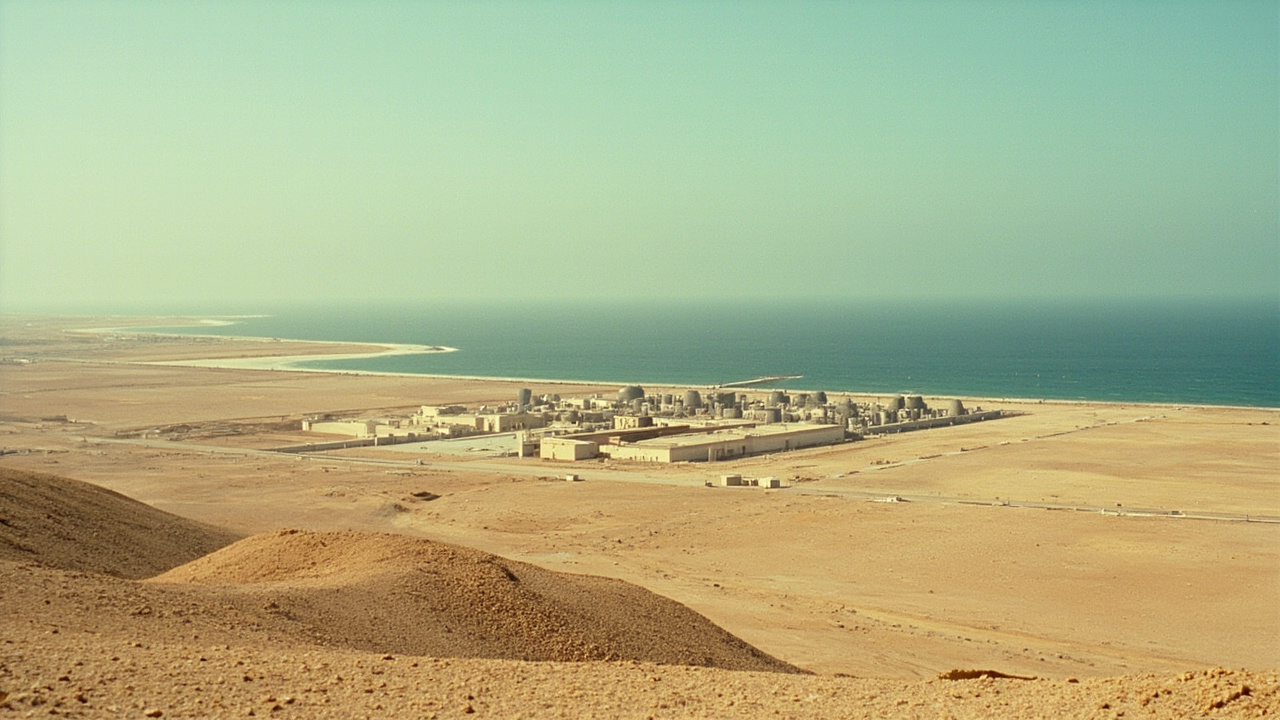
At approximately 8:30 a.m. local time on Saturday, a projectile struck near the perimeter of Iran's Bushehr Nuclear Power Plant, killing one member of the facility's physical protection division and damaging an auxiliary building. [1] It was the fourth attack on the Bushehr complex since the war began — following incidents on March 17, March 24 (two strikes), and now April 4. [1] The plant's main reactor was not damaged. Operations at the site were not disrupted. No increase in radiation levels was reported. [2]
The International Atomic Energy Agency confirmed the strike. The agency's statement noted that it had been informed by Iran and that "no increase in radiation levels was reported." [2] IAEA Director General Rafael Grossi reiterated his call for "military restraint" around nuclear installations. [3] The language was measured. The pattern is not. The IAEA has now issued statements about strikes on or near Bushehr, Natanz, and Isfahan — the three pillars of Iran's civilian and military nuclear programs — multiple times since February 28.
The dead man was a security guard. His name has not been released. He was hit by projectile fragments while stationed at the plant's physical protection perimeter — the outer fence line that separates the nuclear installation from the surrounding area. [1] Shrapnel and blast wave from the impact damaged one of the plant's auxiliary buildings, a support structure separate from the reactor and its primary containment. [1] Iranian authorities said the damage was "limited to a nearby auxiliary structure" and that "there were no signs of radiation risk or disruption to power generation." [4]
Israeli Army Radio claimed the intended target was a "petrochemical facility," a characterization that drew immediate skepticism from nuclear policy analysts who noted there are no petrochemical facilities in the vicinity of the Bushehr reactor. [5] The claim appeared designed to provide legal and rhetorical distance from the act of striking a nuclear power plant — an act that the IAEA has described as crossing "the reddest line" of nuclear safety. [3]
The Bushehr plant, Iran's only operational nuclear power reactor, is a Russian-built 1,000-megawatt pressurized water reactor that began generating electricity in 2011 after decades of construction delays. [6] It sits on the Persian Gulf coast in Bushehr province and is operated under IAEA safeguards, with Russian fuel supply and spent fuel repatriation agreements. Russia's Foreign Ministry had previously warned that any strike on the Bushehr facility "would inevitably lead to irreversible humanitarian and environmental consequences." [7]
Four strikes in 18 days. One guard dead. An auxiliary building damaged. The reactor intact — for now. The margin between "near the perimeter" and "direct hit on the containment structure" is not a strategic buffer. It is a function of accuracy, weather, and chance. Every projectile that lands inside the Bushehr fence line is a roll of the dice with a 1,000-megawatt reactor on the Persian Gulf coast.
Iran's Atomic Energy Organization issued a statement warning that attacks on nuclear facilities "constitute a clear violation of international rules and obligations" and could have "dangerous and irreversible consequences for regional safety." [1] The statement has been issued, in nearly identical language, after each of the four incidents. It has not deterred the fifth.