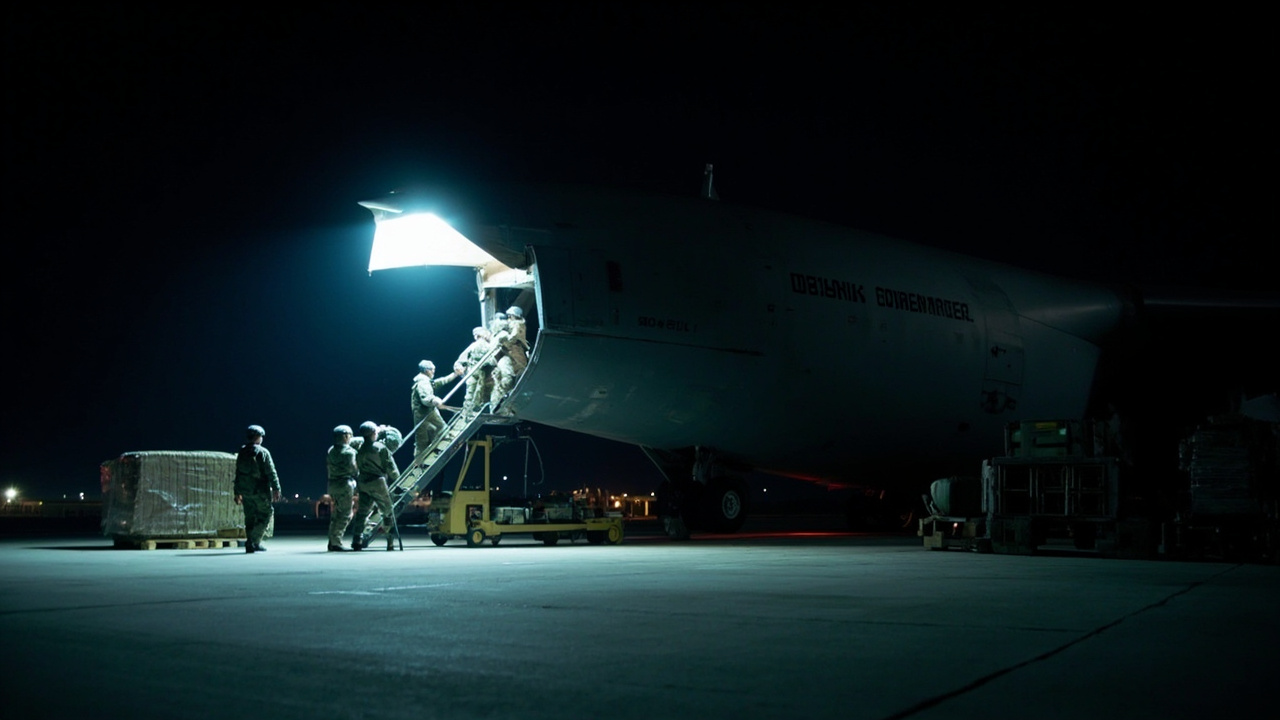
The Pentagon ordered approximately 2,000 soldiers from the 82nd Airborne Division to deploy to the Middle East on Monday, the New York Times reported in a live update that also named, for the first time in a major American outlet, a specific ground objective: Kharg Island, Iran's primary oil export terminal [1]. The order transforms what had been described as deliberation into action and introduces a target that has no analogue in the air campaign.
Yesterday this paper reported the Pentagon was weighing deployment of up to 3,000 paratroopers while 5,000 Marines steamed toward the Gulf aboard the USS Boxer Amphibious Ready Group. That story documented cancelled training exercises, C-17 transport flights tracked out of Fort Bragg, and a combined ground force approaching 8,000 without congressional authorization. The distinction it drew — that Marines are expeditionary by posture, but the 82nd Airborne deploys for combat — still holds. What changed overnight is the verb. "Weighing" became "ordered."
Fox News reported that Major General Brandon Tegtmeier, commander of the 82nd Airborne Division, and his command element were ordered to deploy [2]. A division commander does not move to a theater for consultations. Tegtmeier's presence means a headquarters capable of commanding brigade-level operations is being established forward, and the infrastructure to receive thousands of additional troops is being built. Army Recognition characterized the headquarters deployment as signaling "immediate combat readiness" [3].
The division being ordered eastward is the instrument designed for exactly this moment. The 82nd jumped into Sicily in 1943 and Normandy on D-Day, fought through Market Garden and the Bulge, seized Port-au-Prince in 1994, and led the security effort at Hamid Karzai International Airport during the 2021 Kabul evacuation. Its home is Fort Liberty, North Carolina — renamed from Fort Bragg in 2023 — where a brigade combat team sits on eighteen-hour recall as the Army's Immediate Response Force at all times. That posture explains both the speed of this deployment and its ambiguity: an IRF brigade can be anywhere in days for any purpose, which makes it ideal for signaling and dangerous for planning, because signals have a way of becoming garrisons.
The Kharg Island Detail
Buried in the Times' live coverage was a sentence that defense analysts had been discussing for weeks but that no major Western outlet had previously published as a named operational scenario: the seizure of Kharg Island is one contingency under consideration [1]. The deployment, the Times reported, gives President Trump "more military options" following the 15-point proposal sent to Iran — a proposal Tehran has not accepted and that several Iranian officials have publicly rejected.
Kharg Island handles roughly 90 percent of Iran's crude oil exports. It sits 25 kilometers off Iran's southern coast in the Persian Gulf, connected to the mainland by an undersea pipeline. Seizing it would not require an invasion of the Iranian mainland, but it would require an amphibious or airborne assault on a fortified island within range of Iranian anti-ship missiles, coastal artillery, and whatever remains of Iran's air defenses after four weeks of strikes. A retired general had already called publicly for exactly this operation [4]. The Times' mention moves the idea from the op-ed pages to the planning documents.
The comparison planners will reach for is the seizure of Iraq's Al Basrah oil terminal in March 2003, when Royal Marines and Navy SEALs took the platform in hours against negligible resistance. Kharg is a different proposition: garrisoned, fortified across two wars' worth of lessons, backed by missile batteries on the mainland it sits twenty-five kilometers from, and approachable only through waters Iran spent decades seeding with mining doctrine. The 2003 terminal was taken by surprise and handed to engineers within weeks. Kharg would have to be fought for and then held — resupplied by sea through an engagement zone, against an adversary whose doctrine is built entirely around making occupation expensive.
Anadolu Agency, which had previously tracked C-17 flights from Fort Bragg to Gulf staging areas, reported Monday that the flight-tracking data now showed a pattern consistent with full brigade mobilization rather than the advance-party movements detected last week [5]. The distinction matters: advance parties establish logistics. Full mobilization means the fighting force is moving.
The Numbers
Ynetnews reported Monday that contingency plans include deploying approximately 3,000 troops from the 82nd Airborne, with Kharg Island explicitly named as a target [6]. The current order covers 2,000. The gap between what was ordered and what is planned suggests the deployment is being staged — an initial force to establish the headquarters and logistics footprint, with the remainder to follow on order. This is standard practice for the 82nd's Immediate Response Force, which maintains a brigade combat team on 18-hour recall at all times.
Al Jazeera reported the deployment as "thousands of soldiers" being sent to the Middle East, adding to a military buildup it described as already the largest American force concentration in the region since the 2003 invasion of Iraq [7]. When combined with the Marines aboard the Boxer ARG — expected to arrive in the Gulf by Friday — and the 31st Marine Expeditionary Unit already in theater, total American ground combat strength in the region will approach 10,000.
That number does not include the naval personnel aboard the carrier strike groups operating in the Arabian Sea, the air crews running sorties from bases in Qatar, Bahrain, and Diego Garcia, or the special operations forces whose presence is never officially confirmed and never officially denied. The ground troops are the politically significant force because ground troops take ground, hold ground, and — in the lexicon the administration has studiously avoided — fight ground wars.
What the Administration Is Not Saying
The 15-point proposal sent to Iran was, by the administration's framing, a diplomatic off-ramp. Tehran's public rejection of it was reported across multiple outlets last week. What the 82nd Airborne's deployment reveals is that the off-ramp had a deadline, and the deadline produced not a pause but an escalation. The paratroopers are not being sent to the Gulf to wait for diplomacy to work. They are being sent because, in the Pentagon's assessment, it did not.
No member of the administration has used the phrase "ground war." No member of Congress has voted to authorize one. The War Powers Resolution's 60-day clock — the constitutional mechanism that is supposed to force the question — does not expire until late April. The statute's design assumes presidents will race the clock; this one appears to be running it out, on the theory that a war too deep to reverse by day 60 will not be reversed at all. By then, if the current trajectory holds, the 82nd Airborne will have been in theater for a month, the Marines will have been ashore or afloat for three weeks, and the distinction between an air campaign with ground support and a ground war with air support will be a matter of framing rather than fact.
The host countries are being asked to underwrite the ambiguity. Qatar, Bahrain, and the United Arab Emirates publicly urge restraint while providing the airfields, ports, and command facilities without which no American ground deployment in the Gulf functions — a contradiction that survived four weeks of air war and will not survive paratroopers digging fighting positions on their soil.
The last time the 82nd Airborne deployed to the Persian Gulf in strength, it was 1990 and the division was the first conventional force into Saudi Arabia after Saddam Hussein's invasion of Kuwait. That deployment — Operation Desert Shield — was authorized by Congress four months later, after the troops were already in position. The pattern may be instructive.
Someone at the Pentagon mentioned Kharg Island, and that mention made it into the New York Times. Whether it was a signal, a leak, or a trial balloon, the effect is the same: an American ground objective in Iranian territory is now part of the public record. The 82nd Airborne is moving to meet it.
-- SAMUEL CRANE, Washington