TL;DR
Military Times confirmed the F-35 emergency landing. Al Jazeera, citing CENTCOM, says the pilot is stable and the incident is under investigation. The most important fact is not whether the jet was lost. It is that the war is now teaching both sides under combat conditions what stealth, survivability, and attrition actually look like.
MSM Perspective
Military Times and Al Jazeera both stick to what is confirmable: emergency landing, stable pilot, investigation underway, and no official U.S. confirmation yet that Iranian fire caused the damage. The mainstream lesson is more restrained than the platform's victory-lap or doom-posting instincts.
X Perspective
Defense accounts on X keep splitting into the same two camps: stealth was never invisibility, and the pilot surviving proves the system worked; or, the hit itself punctures too much of the mystique around American air dominance. Both frames are partly true, which is why the argument keeps going.
The most disciplined way to read the F-35 incident is also the least satisfying one.
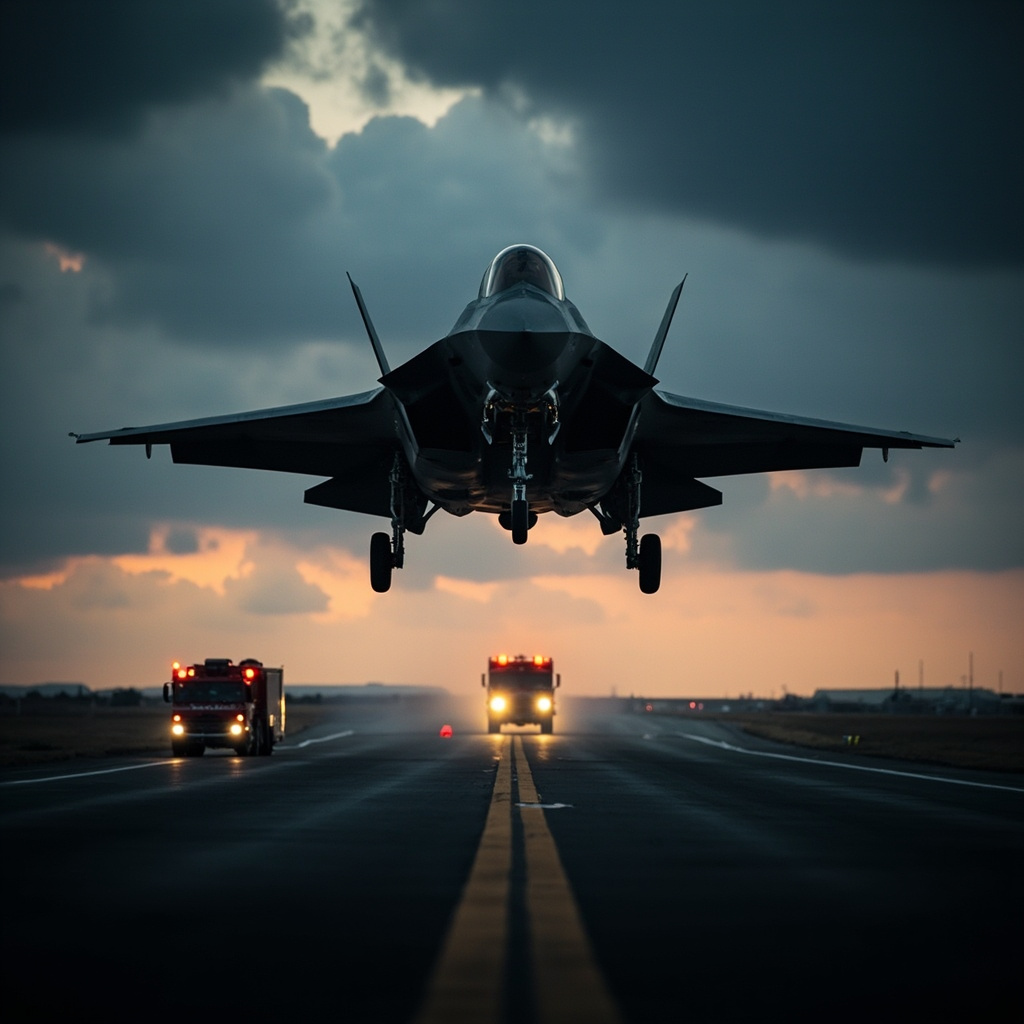
A U.S. F-35 made an emergency landing after a combat mission over Iran. The pilot is stable. The incident is under investigation. Military Times confirmed that much from CENTCOM. [1] Al Jazeera's report, also citing CENTCOM, adds that Iran claims it targeted a U.S. aircraft, while Washington has not yet confirmed the cause of the emergency landing. [2]
Everything after that is argument.
The Myth Problem
Modern military systems accumulate mythology almost as quickly as capability. The F-35 in particular carries several at once: stealth, survivability, cost, software, primacy, overpromising, underestimating, depending on who's talking.
That is why an emergency landing after combat matters even before the investigation is finished. It does not need to prove every maximal claim made by critics in order to revise the emotional weather around the aircraft. A platform can remain formidable and still become more legible to its enemies the moment it begins absorbing real wartime stress under public observation.
Yesterday's article on the F-35 strike over Iran focused on the first shock value: the hit itself. The March 20 feature is a different question. What does a war learn from an incident like this, even if the jet lands and the pilot walks away?
Survival Is Not the Same as Invulnerability
One obvious answer is that survival still matters. If the pilot gets home and the aircraft is not lost, defenders of the system can reasonably say the design did what expensive military systems are supposed to do in a dangerous environment: preserve crew, preserve enough integrity to return, absorb damage without becoming immediate catastrophe.
That is not trivial. It is part of the point.
But the opposite lesson also travels. A stealth aircraft forced into an emergency landing after a combat mission reminds both sides that air superiority is not a mood. It is an advantage contested and measured over time, sortie by sortie, response by response, adaptation by adaptation.
The mythology says either the F-35 is untouchable or it is overhyped junk. Combat is less melodramatic. Combat says systems reveal themselves slowly, in fragments, under pressure.
A War of Practical Lessons
This is why the incident belongs in the feature well rather than as a single-day marvel. Wars are instructional, however brutally. Iran learns what it can still threaten. The United States learns what still leaks through. Observers learn which claims were marketing, which were doctrine, and which were simply too confident for the conditions.
No sane military planner would draw a full conclusion from one damaged or possibly struck aircraft. But no serious planner would ignore it either.
The F-35 made it home. That is good news for the pilot and meaningful news for the program. It is not an eraser. If anything, it turns the war's technical lessons from theory into evidence.
And once combat begins producing evidence, the argument gets harder to hide inside branding.
-- SAMUEL CRANE, Washington