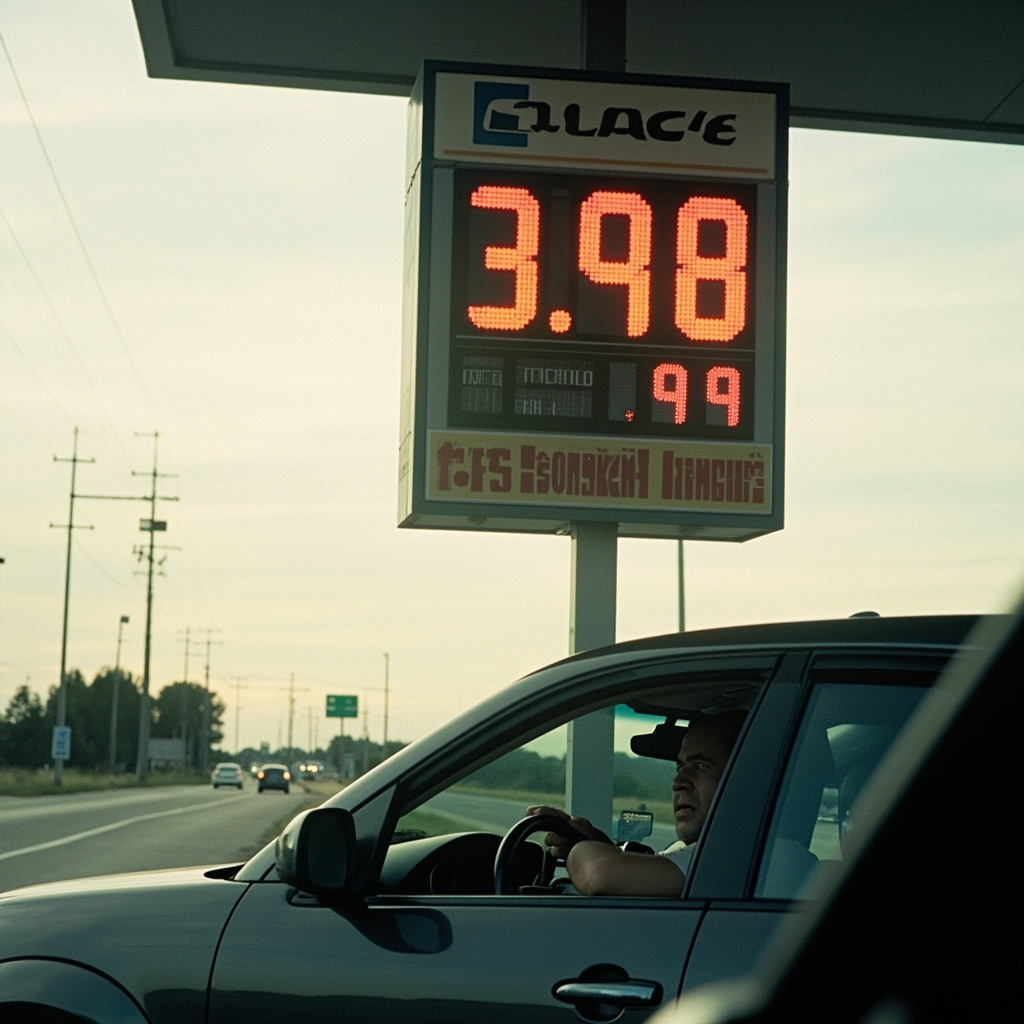
The national average price for a gallon of regular unleaded gasoline reached $3.98 on Wednesday, March 26, according to AAA, and held there through Saturday. The number is exactly one dollar higher than the $2.98 average on February 28, the day before American strikes on Iranian power plants began. In twenty-nine days, the war added a dollar to every gallon pumped in the United States. [1] [2]
This paper's March 27 coverage argued that the market sold off on good news because the deadline mechanism had lost credibility. The gas price tells the same story from the kitchen table instead of the trading floor. The market's loss of confidence in the resolution path translates, at the consumer level, into a price that will not come down until the Strait of Hormuz reopens -- and nothing in the current diplomatic trajectory suggests that is imminent.
The arithmetic is structural, not speculative. Before the war, the United States imported approximately 500,000 barrels per day of crude oil that transited the Strait of Hormuz. The strait's closure -- first the minefield reports, then the Iranian toll system, then the 95 percent collapse in shipping traffic -- removed that supply from the global market. The Strategic Petroleum Reserve releases and the Treasury's licensing of sanctioned Iranian oil partially offset the loss, but the net effect is a permanent war premium that Goldman Sachs estimated at $25 to $32 per barrel. At the refinery, that premium translates to roughly 60 to 75 cents per gallon. The rest of the dollar increase comes from refinery margin expansion, summer blend switchover, and the general uncertainty premium that traders attach to a commodity whose supply chain runs through an active war zone. [3] [4]
The $3.98 figure approaches the $4.00 threshold that consumer behavior research identifies as a psychological inflection point. The New York Times published a feature on Tuesday titled "Life at $4 a Gallon," documenting the behavioral changes: fewer discretionary trips, increased carpooling, postponed road trips, shifts to public transit in cities where it exists. AAA's own data shows that gasoline demand fell 2.1 percent in the most recent weekly survey -- the first demand decline since the pandemic recovery. People are driving less because they cannot afford to drive the same amount. [5]
The distributional impact is regressive. Gasoline spending as a share of household income is highest for the bottom two income quintiles. A family earning $35,000 a year that drives 15,000 miles and gets 25 miles per gallon spends approximately $2,400 annually on gasoline at $3.98 -- roughly $600 more than at the pre-war price. That $600 does not come from savings. It comes from groceries, medications, and the margins that low-income households do not have. [1] [6]
The political dimension is the one the administration cannot avoid. Gas prices are the most visible economic indicator in American life. They are displayed on signs at every intersection. They are experienced daily by every driver. The president's approval rating has tracked inversely with the pump price since the war began -- every ten-cent increase in the national average has corresponded to roughly a one-point decline in approval. At $3.98, the price is a campaign poster for the opposition and a daily reminder to every voter that the war has a cost that arrives not in casualty reports but in credit card statements.
The Houthi entry into the war on Saturday threatens to push prices higher. The Red Sea shipping disruption that followed the 2024-2025 Houthi campaign added between $1 and $3 per barrel to crude prices through higher insurance premiums and longer routing. If the Houthis resume attacks on commercial shipping -- which the European maritime mission ASPIDES warned Saturday was possible -- the supply chain disruption compounds the Hormuz closure. Two chokepoints, not one. The $4.00 barrier may not hold through April.
The administration has deployed every tool available to suppress gasoline prices short of ending the war. The Strategic Petroleum Reserve has released 140 million barrels since March 5. Treasury licensed the sale of sanctioned Iranian crude to non-allied buyers. The EPA waived summer blend requirements for twelve states. None of these measures address the fundamental problem: the Strait of Hormuz is functionally closed, the war is expanding, and the market has priced in the absence of resolution. The dollar at the pump is not a spike. It is a new floor.
-- HENDRIK VAN DER BERG, Brussels