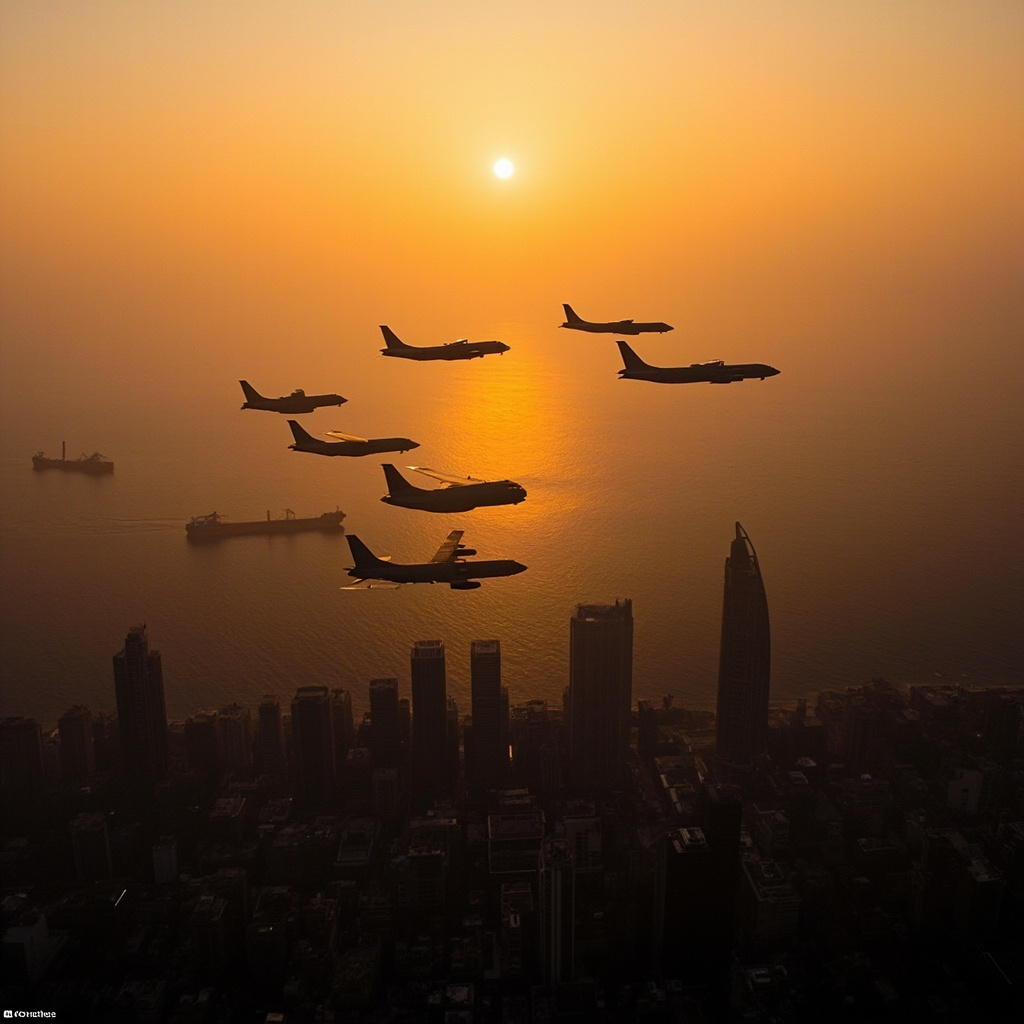
Saudi Arabia has allowed U.S. forces to use a key air base that could support operations linked to the war with Iran. The United Arab Emirates has begun targeting Iranian-linked financial and commercial networks inside the country. Twelve Arab and Islamic foreign ministers, meeting in Riyadh on March 19, issued a collective condemnation of "deliberate Iranian attacks" using ballistic missiles and drones against civilian infrastructure [1]. The Wall Street Journal, reporting Monday, described the Gulf's trajectory in two words that would have been unthinkable a month ago: "edging toward" [2].
This paper reported last week that Iran had directly threatened civilian water supply infrastructure across the Gulf, a line that transformed the conflict from a bilateral U.S.-Iran war into something the Gulf monarchies could no longer watch from the sidelines. That threat has now been followed by action — and the action has produced consequences that the region's most careful diplomatic operators cannot finesse away.
The Damage Ledger
The toll of Iranian strikes on Gulf states is no longer a matter of intercepted projectiles and close calls. It is a matter of infrastructure damage, economic disruption, and civilian fear.

Kuwait has been hit repeatedly. Power transmission lines were knocked out by intercepted drone debris, causing partial electricity outages that lasted several hours before five of six lines were restored [3]. The U.S. Embassy in Kuwait shut down after retaliatory Iranian strikes, becoming the second American embassy in the region forced to close [4]. Amazon Web Services' Bahrain region was disrupted by drone activity on Tuesday, forcing the company to help customers migrate workloads to alternate regions [5].
Saudi Arabia has intercepted multiple Iranian missiles — a feat that demonstrates the kingdom's defense capabilities while simultaneously proving that those capabilities are now required on a daily basis. Bahrain, which hosts the U.S. Navy's Fifth Fleet, has been struck repeatedly. The Carnegie Endowment, in an analysis published March 3, described the Iranian attacks as "the most serious and sustained threats to the physical security of the GCC states since the Iraqi occupation of Kuwait in 1990" [6].
NBC News reported that the UAE "in particular is bearing the brunt of Iranian attacks," with 1,714 drones launched at the country as of mid-March [7]. The strikes sparked fires near luxury hotels in Dubai, caused panic at Kuwait's international airport, and put Saudi Arabia's largest oil processing facility on alert.
The Strategic Shift
For decades, the Gulf monarchies pursued a strategy of hedging — maintaining security partnerships with Washington while cultivating economic and diplomatic ties with Tehran. The UAE opened direct flights to Iran. Saudi Arabia, under Crown Prince Mohammed bin Salman, pursued a rapprochement with Tehran brokered by China in 2023. Qatar hosted Iranian diplomatic facilities. The logic was straightforward: the Gulf states are rich, small, and vulnerable, and the last thing they needed was a war with a neighbor of 88 million people.
Iran's decision to strike Gulf states in retaliation for the American-Israeli campaign destroyed that logic in less than a week.
The Riyadh meeting of 12 foreign ministers — representing Saudi Arabia, the UAE, Kuwait, Bahrain, Qatar, Oman, Jordan, Egypt, Turkey, Pakistan, Iraq, and the Palestinian Authority — produced a joint statement that condemned Iran's attacks and demanded an immediate halt [1]. The statement called on Iran to comply with UN Security Council Resolution 2817, passed since the conflict began. The Anadolu Agency reported that the ministers described the attacks as unjustifiable "under any pretext" [8].
The UAE's national security adviser, Tahnoun bin Zayed, told the WSJ that Iran's conditions for ending the conflict — including compensation, guarantees against future attacks, and the removal of American military bases from the Gulf — were "too high" for mediation [2]. The implication was clear: if Iran will not negotiate on reasonable terms, the Gulf may have to fight.
The Basing Question
The most consequential development is Saudi Arabia's decision to allow expanded American use of its air facilities. The kingdom has long hosted U.S. military assets — Prince Sultan Air Base south of Riyadh has been an American operations hub since the 1990s — but the level of cooperation has fluctuated with the political temperature. MBS's public posture since the conflict began has emphasized Saudi Arabia's defensive orientation: protecting its own territory, not enabling offensive operations against Iran.
That posture appears to be shifting. The WSJ reported that Saudi Arabia and the UAE have made "tougher basing and financial commitments" in recent days [2]. Bloomberg's Monday newsletter described the two countries as "weighing joining the Iran war" [9]. The CNBC analysis from March 19 noted that Gulf states had explicitly warned that Iran's attacks "won't go unanswered" — but had not yet acted on the warning [10].
The distinction between hosting American forces and actively participating in combat operations is significant in international law and regional politics. But the distinction is eroding. Every intercepted missile that drops debris on Kuwaiti power lines, every drone that disrupts Bahraini cloud infrastructure, every strike that forces Saudi air defenses into action — each incident makes the case for active participation harder to resist.
The Water Calculus
The Gulf states' vulnerability is existential in a way that most military conflicts are not. Kuwait and Oman rely on desalination for approximately 90 percent of their drinking water. Saudi Arabia depends on it for roughly 70 percent. The UAE, Bahrain, and Qatar have similarly high dependence for potable supply [11]. Iran's explicit threat to target desalination infrastructure — made by Brigadier General Zolfaghari on March 22 as part of the counter-threat to Trump's power plant ultimatum — transformed the conflict calculus.
A military attack on Gulf desalination plants would not merely inconvenience populations. It would create a humanitarian catastrophe within days. Millions of people in the hottest region on earth would lose access to clean water. The response capability of even the wealthiest Gulf states would be overwhelmed. This is the threat that changed the political arithmetic in Riyadh and Abu Dhabi — not the abstract question of regional order, but the concrete question of whether Iranian missiles can turn off the taps.
The Coalition That Nobody Wants
Twenty-two countries have now signed a joint statement signaling readiness to help secure the Strait of Hormuz, according to the WSJ, with Australia and the UAE adding their names over the weekend [12]. The coalition is forming not because anyone in the Gulf wanted a confrontation with Iran, but because Iran's strategy of striking neighboring states has left them with no neutral ground to stand on.
The Al Jazeera analysis put it most directly: "While Gulf states need support in face of Iranian attacks, it is less clear what their allies can provide" [13]. The Arab Center in Washington described the situation as the GCC "rethinking responses to unwanted consequences" [14]. The Atlantic Council noted that "the Gulf that emerges from the Iran war will be very different" from the one that entered it.
All of which is true, and all of which misses the essential irony: the Gulf states spent years building the most sophisticated hedging strategy in modern diplomacy, and Iran, by striking their infrastructure, forced them to choose a side. They are choosing. They did not want to.
-- HENDRIK VAN DER BERG, Brussels