The missiles missed. That is the least important fact about what happened on Saturday morning.
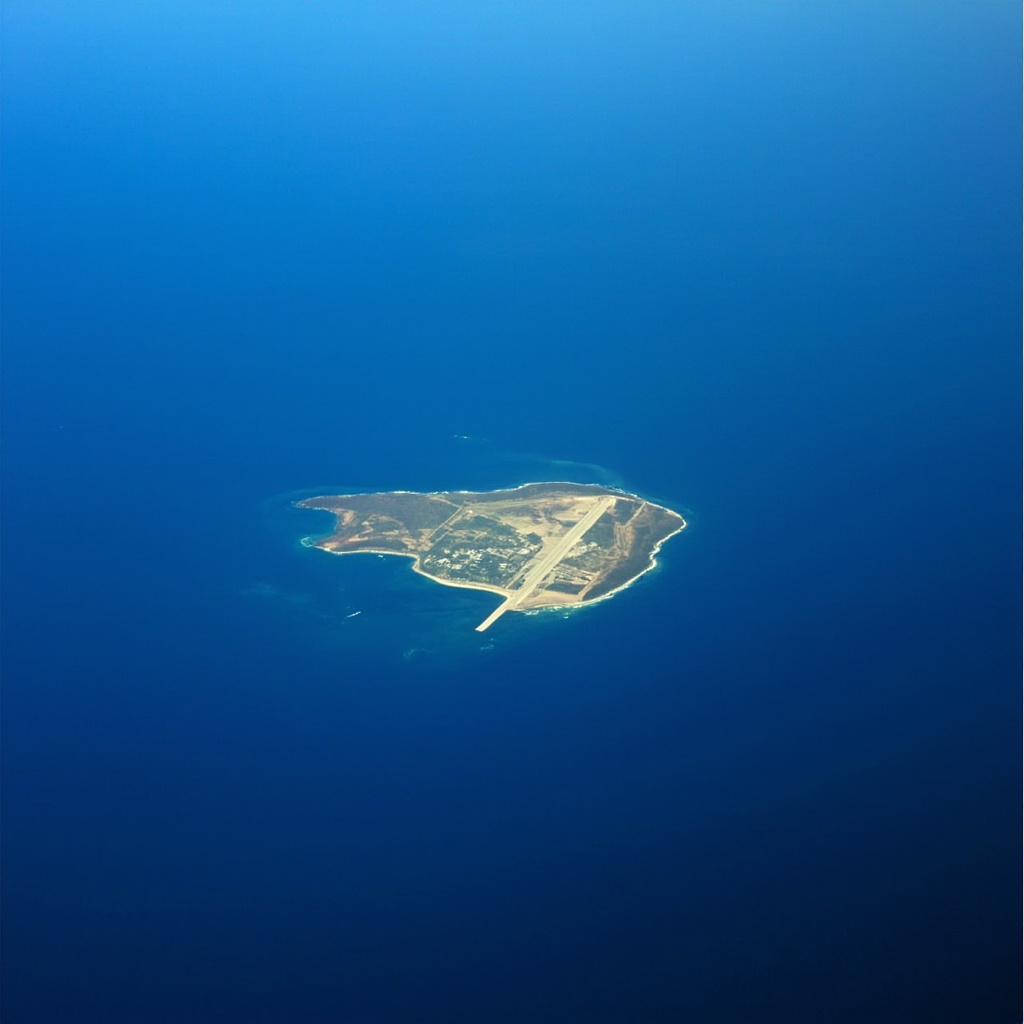
Iran fired two intermediate-range ballistic missiles at the joint U.S.-UK military base on Diego Garcia, a coral atoll in the Chagos Archipelago roughly 3,800 kilometers south of Tehran [1]. One failed in flight. The other was intercepted by an SM-3 fired from a U.S. warship, according to the Wall Street Journal, citing multiple officials [2]. Neither struck the base. No casualties have been reported.
What matters is the targeting. Diego Garcia is not in the Middle East. It is not in the Persian Gulf, not in the Arabian Sea, not even in the waters that CENTCOM typically patrols. It sits in the central Indian Ocean, closer to the Maldives than to the Strait of Hormuz. Until Saturday, every Iranian strike in this war -- missiles at Israel, drones at Saudi Arabia, attacks on shipping in the Gulf -- had remained within the broadly understood theater of operations.
This one did not. And in breaking that perimeter, Iran accomplished three things at once: it demonstrated a missile range its foreign minister had publicly capped at 2,000 kilometers, it turned the United Kingdom from a logistics provider into a direct target, and it signaled that the geographic boundaries of this conflict are no longer fixed.
The Range Revelation
Iranian Foreign Minister Abbas Araghchi had, in prior public statements, indicated that Iran's ballistic missile range was limited to approximately 2,000 kilometers [2]. This was the number cited in arms control discussions, the number embedded in Western intelligence assessments shared with allied governments, the number that shaped defensive deployments across the Gulf.
Diego Garcia is approximately 4,000 kilometers from Iran. The missile that reached its vicinity -- whether it was the Khorramshahr-4, as open-source analysts on X rapidly assessed [3], or something newer -- doubled the publicly acknowledged range in a single launch.
This has implications beyond the immediate theater. A 4,000-kilometer range from Iranian launch sites covers all of the Arabian Peninsula, all of the Indian subcontinent, much of East Africa, Southern Europe as far as Rome, and the entirety of Central Asia. The strategic calculus for every nation within that radius changed on Saturday morning.
The Khorramshahr-4, if that is indeed what was fired, is a liquid-fueled medium-range ballistic missile that Iran has paraded but never publicly tested at extreme range. Its theoretical capacity has been debated in non-proliferation circles for years. Saturday's launch was not a test. It was an operational strike, fired in anger, at a real military target. That is a different kind of confirmation.
Britain Gets Dragged In
Diego Garcia is, legally and operationally, a British territory. The United Kingdom has sovereignty over the Chagos Islands under a contested arrangement with Mauritius -- one that has generated years of diplomatic friction, a pending lease-back deal that Prime Minister Keir Starmer delayed earlier this year, and pointed criticism from Trump, who called the arrangement a "blight" on the UK [2].
The base itself has been a cornerstone of Anglo-American military projection since the 1970s, when British authorities forcibly removed the island's native Chagossian population to make way for a military facility capable of accommodating long-range American bombers. It has been used in every major U.S. military campaign in the Middle East since.
On Friday, Starmer's government expanded the permission granted to the United States to use British bases. Previously, UK facilities had been authorised only for "defensive" operations. Friday's decision extended that to offensive strikes against Iranian missile sites targeting the Strait of Hormuz [1]. The timing was not coincidental. Iran fired at Diego Garcia hours later.
"Vast majority of the British People do not want any part in the Israel-US war of choice on Iran," Iran's foreign minister wrote on X before the strikes. "Ignoring his own People, Mr Starmer is putting British lives in danger by allowing UK bases to be used for aggression against Iran. Iran will exercise its right to self-defence" [1].
The Ministry of Defence condemned the strikes as "reckless" and described U.S. use of British bases as "limited and defensive" in nature [1] -- language that will be increasingly difficult to maintain as the operational scope expands.
Conservative leader Kemi Badenoch called Starmer's decision the "mother of all U-turns" and told Times Radio that the UK was "being dragged into" the conflict [1]. The Liberal Democrats and Green Party demanded a parliamentary vote before any further authorisation of base usage for offensive operations.
Trump, for his part, was not sympathetic. "They didn't want us to use the island -- the so-called island -- which for some reason they gave up rights to it," he told reporters at the White House on Friday, referring to Diego Garcia [2].
The Geography of Escalation
There is a structural logic to what Iran did, and it is worth examining without the filter of outcome. The missiles missed. The base was not damaged. From a purely military standpoint, the strike was a failure. But wars are not won or lost on single salvos.
By striking outside the Middle East, Iran demonstrated that it retains offensive capability despite three weeks of sustained American bombardment. CENTCOM had announced, on the same day, that it had struck over 8,000 military targets and destroyed 130 Iranian naval vessels [4]. The campaign's own metrics suggested overwhelming superiority. Yet the enemy reached out and touched a target on the other side of the Indian Ocean.
This is the paradox of the damage assessment. The United States can accurately claim that it has degraded Iran's navy, cratered its airfields, and dismantled its coastal missile batteries. Iran can accurately reply that it just fired a ballistic missile 4,000 kilometers and forced an SM-3 intercept -- a missile that costs approximately $12 million per round -- to defend a base the U.S. describes as peripheral.
The war's geography is now continental, not regional. That changes the force posture requirements. It changes the alliance obligations. And it changes the political dynamics in London, where a Labour government is navigating a conflict it did not choose, does not control, and cannot easily exit now that British territory has been targeted.
What Diego Garcia Means for the Alliance
The 22-nation joint statement released on Friday -- signed by the UK, UAE, Bahrain, Germany, France, Japan, South Korea, Australia, and others -- condemned Iran's attacks on commercial vessels and energy infrastructure [1]. It was a significant diplomatic product. But it was drafted before Diego Garcia.
The question now is whether the strike on a British territory triggers different obligations. NATO's Article 5 has been discussed in the context of this war -- Trump's "cowards" broadside against allies who refuse to help with the Strait of Hormuz was directed partly at the alliance [5]. But Diego Garcia is outside NATO's geographic scope. It is a British Overseas Territory, not part of the North Atlantic Treaty area.
That technicality may not hold. If Iran is willing to strike British sovereign territory, the UK's political class will face pressure to treat this as an attack on the nation, not merely an incident at a faraway base. The parliamentary dynamics that Starmer has managed to suppress -- demands for a vote, demands for a debate, demands for a defined British role -- will be harder to contain.
Starmer has scheduled a Cobra meeting for next week to discuss plans to help households with the cost-of-living impact caused by the war [1]. That is a domestic agenda item bolted onto a security crisis. The two are about to become inseparable.
The Indian Ocean Theatre
Diego Garcia's significance extends beyond the bilateral. India, which has carefully maintained neutrality in the Iran conflict, now faces the fact that Iranian ballistic missiles flew through or near its extended strategic neighbourhood. The Maldives, Sri Lanka, and the broader Indian Ocean littoral are within the demonstrated range envelope.
None of these nations signed the 22-country statement. None have endorsed the U.S.-led military campaign. But all now live under a missile umbrella they did not anticipate three weeks ago.
The Indian Ocean has been militarised for decades -- the U.S. Fifth Fleet, Chinese naval deployments to Djibouti, French forces in Reunion -- but it has not been a missile combat theatre since the Cold War scenarios that never materialised. Iran just made it one.
Whether this was a strategic signal or a desperate lash remains unclear. The answer depends on what comes next: whether Iran can sustain operations at this range, whether it has additional assets positioned for Indian Ocean targeting, and whether the demonstrated capability represents a mature weapon system or a one-off.
What is not unclear is the consequence. The war that began as a strike on Iran's nuclear programme, expanded to naval combat in the Persian Gulf, and escalated through energy infrastructure targeting has now projected force into the central Indian Ocean. Three weeks ago, this was a Middle East war. It is no longer.