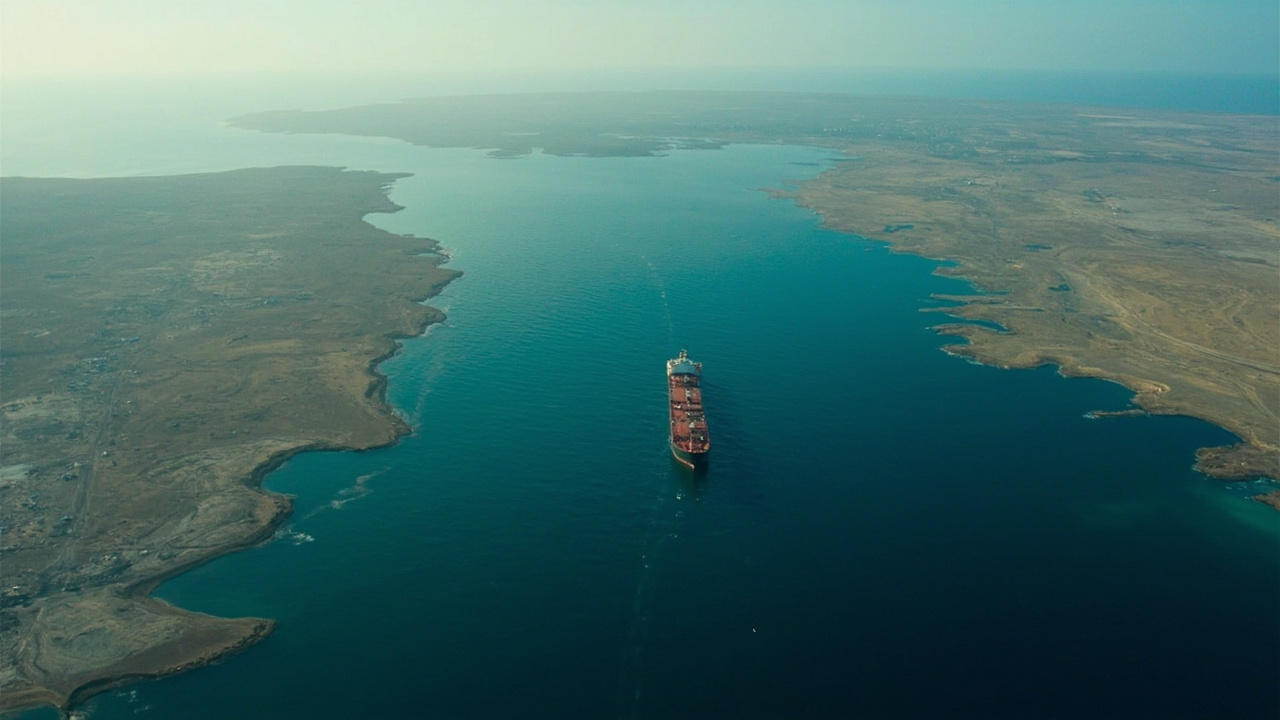
Iran announced on Friday that it would authorize the passage of vessels carrying "essential goods" through the Strait of Hormuz. The announcement came with a condition that renders it nearly meaningless: the goods must be destined for Iranian ports only. [1]
The selective opening was confirmed by Anadolu Agency, which reported that certain vessels have been granted one-month transit permits under a permission-based system that Iran now controls unilaterally. [2] The permits are not for commercial shipping broadly. They are for specific vessels, carrying specific cargo, bound for specific destinations -- all determined by Tehran. The word "essential" is not defined by any international standard. It is defined by the IRGC Navy.
Al Jazeera's reporting provides the number that matters: approximately 95% of Strait traffic remains blocked. [3] Before the war, roughly 21 million barrels of oil per day transited Hormuz, along with a quarter of the world's liquefied natural gas. The "essential goods" exception restores a trickle. Windward's maritime intelligence daily for April 2 reported nine inbound transits that day, seven of which were sanctioned, Iran-linked tankers. [4] The traffic that the global economy depends on -- the Saudi, Emirati, Kuwaiti, Qatari, and Iraqi oil exports that flow through the strait to Asia, Europe, and the Americas -- remains severed.
The structure of the concession reveals the strategy. Iran is not reopening Hormuz. It is replacing the international maritime order with a bilateral licensing regime. OSINT analysts have described it as a "toll system" in which passage requires Iranian approval rather than the right of innocent passage guaranteed under the United Nations Convention on the Law of the Sea. [5] Chinese-owned containerships received transit permission on March 30. [6] Everyone else queues for a permit that may or may not arrive.
The Homeland Security Today analysis from April 1 described the system in operational terms: Iran is consolidating control of a "permission-based route" between two Iranian islands, funneling all traffic through a corridor it can monitor, tax, and close at will. [7] The 40-nation crisis meeting reported by Gulf Business on Thursday discussed joint action to reopen the strait, but produced no mechanism to do so. [8] Britain convened the session. No enforcement plan emerged.
The practical effect of the "essential goods" announcement is that Iran can claim it has not fully blockaded the strait -- a legal distinction with diplomatic utility. The practical effect on the global energy market is nil. Physical Brent crude was trading above $140 per barrel on Thursday because the market understands what the announcement means: Iran controls the strait and is choosing, vessel by vessel, who may pass.
The Daily Sabah reported that Iran was easing passage for "friendly" vessels, a formulation that underscores the political nature of the system. [9] Friendship, in this context, is not a diplomatic category. It is a price. The currency may be geopolitical alignment, or it may be the yuan-denominated tolls that have been reported since late March. Either way, the Strait of Hormuz -- the most important maritime chokepoint on Earth -- is now operating on terms set by the country that closed it.
-- PRIYA SHARMA, Delhi