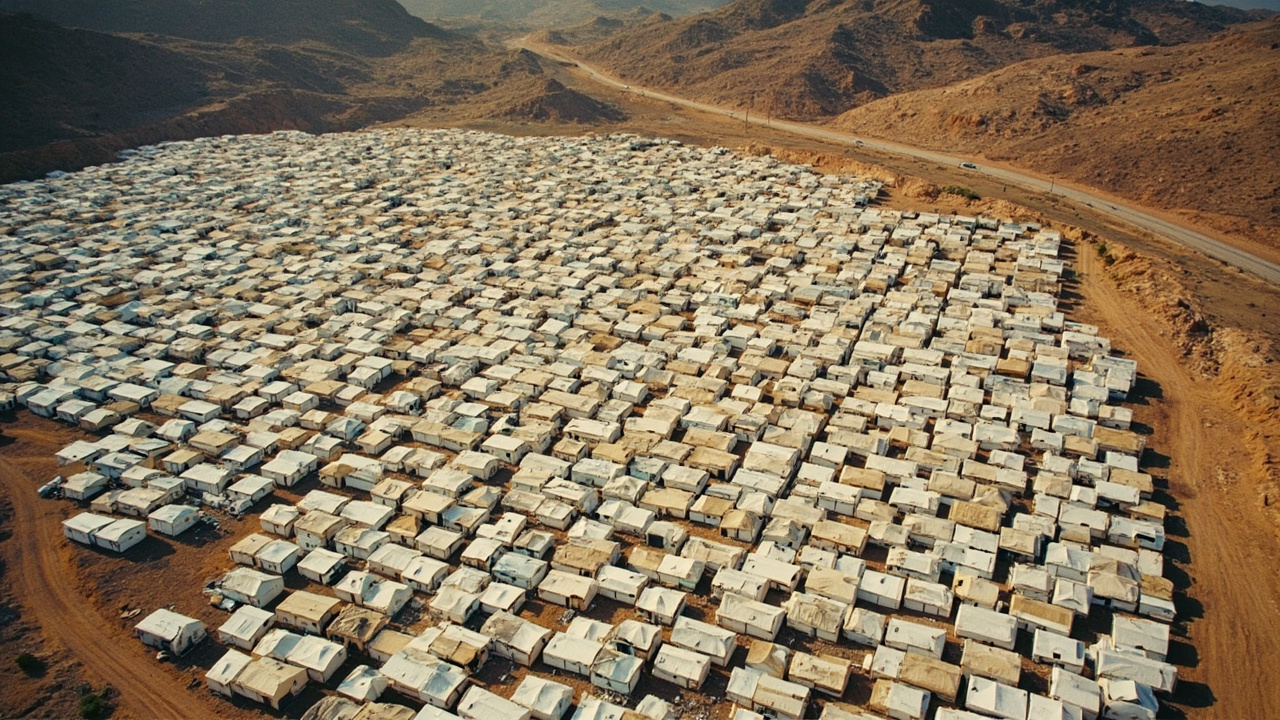
The tents are visible from space. Satellite images circulating Sunday show massive encampments forming along the Iranian-Turkish border -- rows of shelters arranged in the geometry of displacement, white against brown earth, legible from orbital altitude as the newest artifact of a war that is thirty-seven days old [1]. The images arrived without ceremony. No government released them. No aid agency published them. They surfaced on social media, shared by OSINT analysts who specialize in reading the landscape of crisis from the sky. What they show is not ambiguous. A refugee population is massing at the edge of a country being bombed, and the receiving country is running out of room.
Turkey prepared for this. Interior Minister Abdullah Ciftci announced in early March that Turkey had established initial capacity to host up to 90,000 people in the event of a sudden inflow, including tent camps and a buffer zone along the border [2]. The preparations were prudent. The 90,000 figure was based on modeling that assumed a gradual escalation of displacement. The war did not provide a gradual escalation. It provided thirty-seven days of sustained aerial bombardment across Iranian population centers, military installations, energy infrastructure, and -- as of the past week -- western border regions and Kurdistan province. The people arriving at the Kapikoy crossing are not fleeing a single strike. They are fleeing a campaign.
The Guardian reported from the Kapikoy border crossing on April 3 with the kind of ground-level detail that satellites cannot capture [3]. Families arriving with suitcases, plastic bags, children. The crossing -- located in Turkey's eastern Van province -- has become one of the few functioning exit points from Iran since Iraq closed its border and Pakistan's ceasefire mediation collapsed. The people at Kapikoy are not combatants. They are not strategic. They are not the subject of briefings at the Pentagon or talking points at the State Department. They are schoolteachers and shopkeepers and elderly couples who heard the bombardment getting closer and decided to leave.
"Every night they are bombarding," one Iranian told the Guardian at the crossing [3]. The quote is unremarkable in its content and devastating in its ordinariness. Every night. The routine of it. The bombardment has become a weather pattern -- something to endure, or something to flee from. The people who chose to flee arrived at Kapikoy carrying what they could hold.
The Wall Street Journal reported from the same crossing in late March, interviewing two dozen Iranians who expressed fear and anxiety about the future of their country [4]. PBS documented the crossing in early March as "one of the few ways out of Iran during the war" [5]. Channel NewsAsia reported Iranians arriving in Van -- weary, some fleeing bombardment, others hoping to wait out the conflict in safety [6]. The reporting converges on a single image: a narrow border gate in mountainous terrain, a line of people, and a country behind them that is burning.
The scale is what the satellite images force into view. Individual reporting from Kapikoy captures families. Satellite imagery captures populations. The tent cities forming on the Turkish side of the border represent a humanitarian infrastructure being built in real time -- not by design but by accumulation. Each family that crosses adds a tent. Each tent adds a row. The rows become visible from space. Turkey's 90,000-person capacity was a contingency plan. The images suggest it may now be an operating reality.
The war's costs have been counted in many currencies. Barrel prices. Sortie rates. Aircraft losses. Diplomatic failures. The refugee dimension has been, until this week, largely absent from the accounting. Iraq closed its border. Pakistan's ceasefire effort collapsed. Afghanistan's border with Iran has seen movement in the other direction -- Afghan families returning home to escape a conflict that is not theirs. The Turkish border remains open, and Kapikoy remains functional, and the result is a concentration of human displacement that the war's planners did not model and the war's critics have not yet fully weaponized.
The UNHCR has been mobilizing across the region since early March, reinforcing preparedness at Iran's key border points and urging all countries to keep their borders open to those fleeing [7]. Its emergency flash update from April 2 reported that Iranian government sources estimate up to 3.2 million people have been temporarily displaced internally [7]. But preparedness and capacity are different words. Preparedness means you anticipated the need. Capacity means you can meet it. The satellite images suggest the gap between the two is widening. Tent cities do not form at borders where the situation is under control. They form at borders where the flow exceeds the infrastructure, where the people keep coming and the shelters keep multiplying and the overhead view reveals a pattern that no amount of diplomatic language can soften.
These are the war's newest refugees. They did not sign up for a conflict. They did not vote for escalation. They did not appear in any intelligence briefing about military objectives or strategic targets. They appear in satellite images -- small white rectangles against brown terrain, arranged in rows, multiplying daily, visible from space because there are so many of them that the earth itself has changed color at the border. The war is thirty-seven days old. The tent cities are new. The people inside them have been there for less time than that, and already the geometry of their displacement is legible from orbit.
The tents are visible from space. The people inside them are not.
-- LUCIA VEGA, Sao Paulo