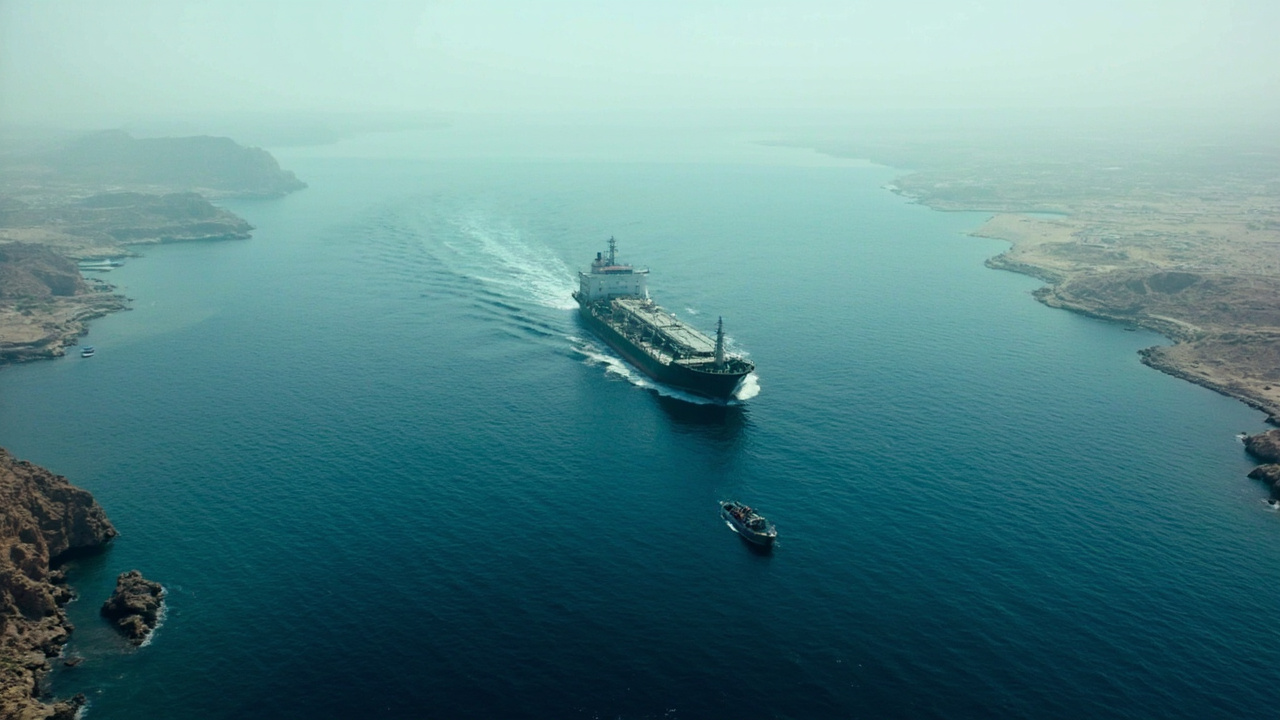
The shakedown is becoming a statute. On Tuesday, Tehran lawmaker Somayeh Rafiei announced that Iran's parliament is pursuing legislation to impose formal tolls and taxes on all vessels transiting the Strait of Hormuz, the 33-kilometer chokepoint through which roughly 20 percent of the world's oil supply once flowed without interruption [1].
"Countries will pay tolls and taxes to the Islamic Republic if the Strait of Hormuz is used as a secure route for transit, energy and food security," Rafiei told the ISNA news agency. "The security of the strait will be established with strength, authority and grandeur by the Islamic Republic of Iran, and countries must pay a tax in return" [1].
As we reported in India Ships Break Through Hormuz, Iran Charges Two Million, Iran has already been extracting payments of up to $2 million per tanker from vessels it selectively permits to pass. What the legislation proposes is something qualitatively different: moving from ad hoc extortion to codified sovereignty claims over an international waterway.
The distinction matters. A warlord who demands payment at a checkpoint is a nuisance to be cleared. A sovereign government that passes legislation asserting territorial jurisdiction over transit routes is making a legal argument — one that will outlast the current conflict and create precedent for decades of maritime law disputes.
Parliament Speaker Mohammad Bagher Ghalibaf reinforced the permanence of the shift on Tuesday, declaring that maritime traffic through the strait would "not return to its pre-war status" [1]. This was not a threat about what Iran might do if negotiations fail. It was a statement about what Iran considers the new baseline — the floor, not the ceiling.
The legislation, if passed, would create a formal fee structure that distinguishes between nations Iran considers "friendly" and those it says have joined the "aggression." Maritime intelligence firm Windward reported that at least five ships exited the strait via Iranian waters on March 15 and 16, suggesting Tehran is already operating a selective transit system [1]. The toll legislation would merely give this system a legal framework.
The economics are straightforward. At $2 million per vessel, and with an estimated 15 to 20 tankers attempting transit daily before the war, a fully operational toll system could generate $30 million to $40 million per day — or roughly $11 billion to $14 billion annually. For a country whose oil exports have been crushed by sanctions and whose economy contracted an estimated 8 percent in the first quarter of 2026, the strait is no longer just a strategic asset. It is a revenue stream [2].
Iran's claim rests on geography and force, not international law. The strait's shipping lanes pass through both Iranian and Omani territorial waters, but the United Nations Convention on the Law of the Sea guarantees the right of transit passage through international straits. Iran signed but never ratified UNCLOS, and has historically maintained that foreign military vessels must obtain prior permission to transit — a position no major maritime power accepts [3].
The proposed legislation would extend this disputed claim to commercial shipping, effectively asserting that the right to transit the strait is not a right at all but a privilege that Iran may revoke or monetize at will. If upheld by Iranian courts and enforced by the IRGC Navy, it would create a de facto toll system that no amount of diplomatic protest can reverse without either a military operation or a negotiated settlement that addresses Iran's claims.
Supreme Leader Mojtaba Khamenei's message left no ambiguity: "the lever of blocking the Strait of Hormuz must definitely be used" [1]. The question is whether the lever is held permanently or released as part of a broader deal.
Insurance markets have already priced in the new reality. War risk premiums for tankers transiting the Gulf have tripled since February, according to Lloyd's of London, and several major insurers have suspended coverage for vessels entering Iranian-controlled waters entirely. The cost of a $2 million toll begins to look rational when the alternative is an uninsured transit through a live fire zone.
India, which imports roughly 60 percent of its crude through the strait, has already paid — setting the precedent that the legislation now seeks to codify. China has reportedly negotiated separate terms. European nations, which Iran classifies among the aggressors due to their support for US strikes, have not been offered passage at any price [2].
The bill has not yet been scheduled for a full parliamentary vote, and Iranian legislative procedure can be unpredictable. But the direction of travel is clear. What began as wartime improvisation — IRGC patrol boats stopping tankers and demanding cash — is being institutionalized with committee hearings, floor speeches, and statutory language. Iran is not building a blockade. It is building a toll booth. And toll booths, once constructed, are not easily dismantled.
-- PRIYA SHARMA, Mumbai