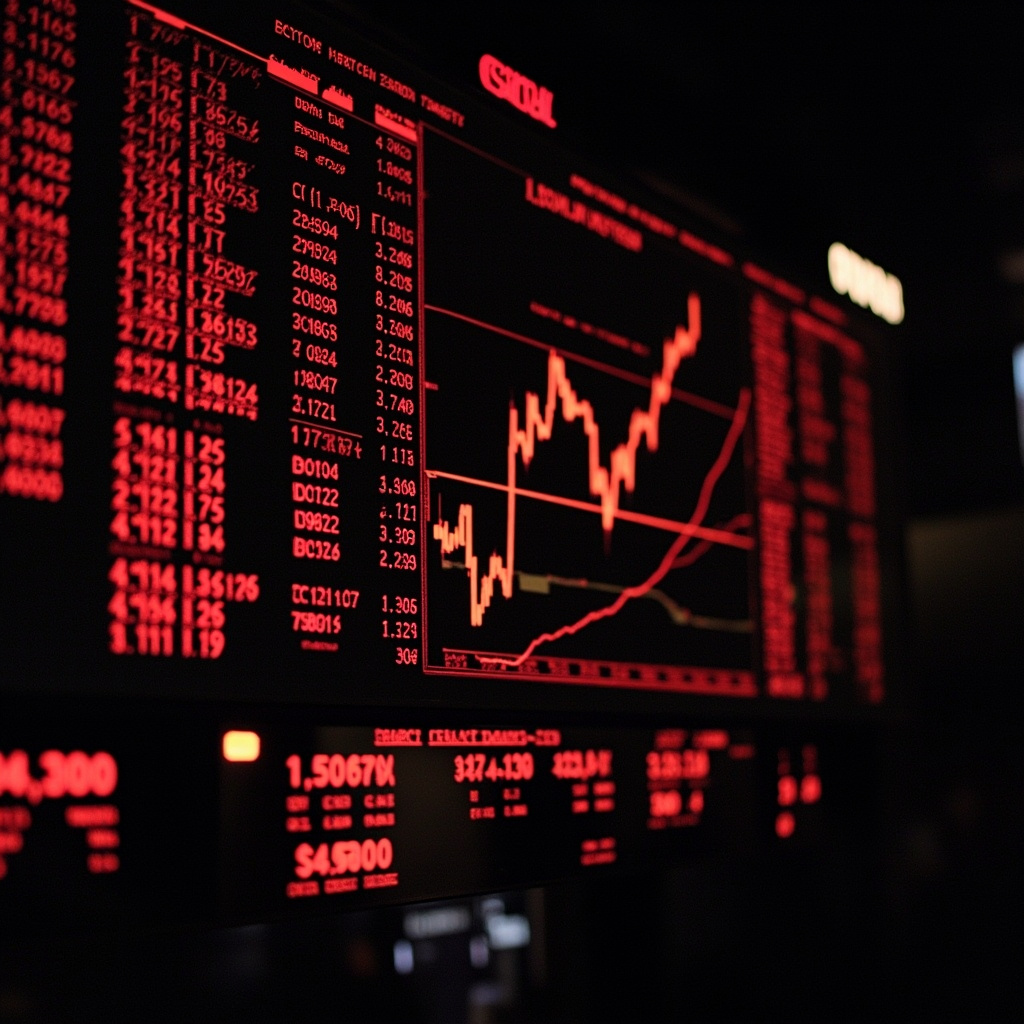
March ended the way it began: with oil rising, equities falling, and no one able to say when either would stop.
The S&P 500 closed Monday at approximately 5,580, capping its worst month since September 2022 and erasing all gains for the year [1]. The Nasdaq slipped 0.7 percent on the session. The Dow, which had briefly rallied on March 24 when ceasefire rumors circulated, gave back those gains and more. The index that tracks American corporate confidence just recorded a month that shredded it.
The proximate cause was oil. WTI crude settled at $102.88 per barrel on Monday -- its first close above $100 since June 2022, as this paper noted in its coverage of oil breaking the $100 barrier [2]. The price had briefly spiked to $107 in mid-March after Iran threatened oil facilities in Saudi Arabia, the UAE, and Qatar [3]. It retreated, then climbed back. The $100 barrier, once psychological, is now structural. The war premium is baked in.
Semiconductors led the decline. Micron, which hit an all-time high on March 18, fell nearly 10 percent on Monday alone and has now declined 30 percent from that peak in just twelve trading days [4]. The selloff accelerated after Google unveiled a new memory technology that threatens Micron's core market, but the broader semiconductor index had already been weakening on war-related supply chain fears. Memory chips require helium. Helium comes from Qatar. Qatar's exports transit the Strait of Hormuz.
The month's anatomy tells the story. The first week of March saw the S&P 500 drop to a three-month low, erasing all 2026 gains, as the war's opening days sent oil surging past $80 [5]. The second week brought tanker attacks and $100 oil. The third week produced the worst single trading day since the war began, with the S&P falling 1.5 percent on March 11 [6]. A brief rally on ceasefire hopes in week four was reversed when Iran rejected direct negotiations.
The fifth week -- the one ending Monday -- delivered the knockout. The S&P posted its fifth consecutive losing week, the worst streak since the spring 2025 tariff turmoil [7]. Energy was the only sector in the green, up 1.8 percent, as oil companies profited from the very disruption that was destroying the rest of the market [8].
The forward curves tell a different story than the spot market, and the divergence is instructive. December 2026 WTI futures traded at $77 on Monday. The market is pricing in peace by winter. Bloomberg Intelligence analyst Mike McGlone argued that WTI is "more inclined to drop toward $50 by US midterms than stay above $100" once hostilities cease. Goldman Sachs raised its 2026 average Brent forecast to $95 but assumed resolution by Q3 [2].
Those assumptions require resolution. Resolution requires one side to stop fighting. Nothing in Monday's news flow suggested either side was ready. Trump told the Financial Times he wanted to "take the oil" [9]. Iran said its retaliation would not be proportional. Spain closed its airspace to U.S. military flights. The April 6 ceasefire deadline is six days away and already looks like a formality.
For investors, March 2026 crystallized a problem that has no technical solution: you cannot hedge a war with no defined objective, no timeline, and no off-ramp that both parties will accept. The VIX, Wall Street's fear gauge, closed above 25 for the fourteenth consecutive session. The last time it stayed elevated that long was March 2020.
March is over. The damage is not.
-- HENDRIK VAN DER BERG, Brussels