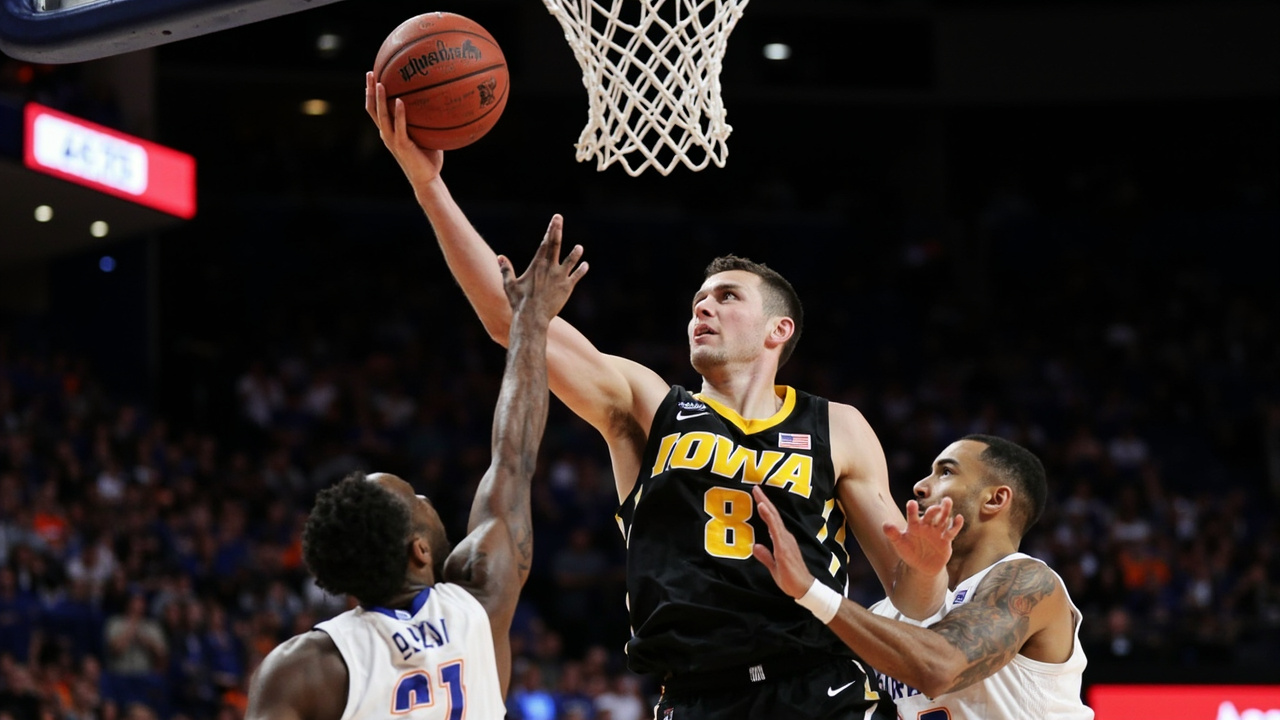
The ball left Alvaro Folgueiras's hands from the right corner with 4.5 seconds remaining, a 22-year-old from Ourense, Spain, releasing a shot that no one in Tampa's Amalie Arena expected to go in. Iowa trailed 72-70. The play was designed for Payton Sandfort on the wing. Sandfort was smothered. The ball swung to the corner, to the Spaniard who had averaged 8.3 points per game in the regular season, who had been recruited out of a basketball academy in Vitoria-Gasteiz, who had spent two years at a junior college in Kansas before Iowa coach Ben McCollum found him on film [1].
The ball went in. Iowa 73, Florida 72. The defending national champions — the number one overall seed, the team that had lost three games all season — were eliminated in the second round by a ninth seed from the Big Ten, on a shot by a player whose name most American basketball fans could not have pronounced 48 hours earlier [1].
The Three That Broke the Day
Folgueiras's shot was the headline, but it was not the only buzzer-beater on Saturday.
St. John's, the sixth seed, trailed Kansas by one point with 2.3 seconds remaining when Dylan Darling — a junior guard from Spokane, Washington who had transferred from Idaho State, where he was the 2024-25 Big Sky Player of the Year — caught an inbound pass near the free-throw line, took one dribble left, and laid the ball off the glass as the horn sounded. St. John's 67, Kansas 66. Darling was asked in the postgame press conference whether it was his first buzzer-beater. "First one that mattered," he said [2].
Across the bracket, No. 11 Texas — a team that had to win a First Four game in Dayton just to reach the main draw — completed a 14-point second-half comeback against third-seeded Gonzaga to become only the sixth First Four team in tournament history to reach the Sweet 16. The Longhorns did not win on a buzzer-beater, but the comeback, fueled by 24 second-half points from guard Tre Johnson, carried the same energy of a tournament that had abandoned its seedings entirely [1].
The Big Ten's Weekend
The conference realignment that reshaped college athletics — absorbing USC, UCLA, Oregon, and Washington, swelling to 18 teams — was supposed to dilute the Big Ten's basketball identity. Too many teams, critics said. No coherent regional culture.
The Big Ten sent six teams to the second weekend: Iowa, Michigan State, Purdue, Illinois, Oregon, and Wisconsin. Six teams in the Sweet 16 from a single conference. The SEC sent four. The Big 12 sent three [1].
Iowa's advancement was the most improbable. McCollum, in his first year after replacing Fran McCaffery, had built the roster through the transfer portal with the patience of a man assembling furniture from parts sourced across four different stores. Sandfort was a holdover. Folgueiras was a JUCO find. Point guard Dasonte Bowen transferred from Dayton. Center Riley Mulvey came from Columbia. They were not supposed to be here [2].
Folgueiras's Journey
Alvaro Folgueiras grew up in Ourense, a city of 105,000 in Galicia, the rainy northwestern corner of Spain that produces more poets than basketball players. He played youth basketball for Club Ourense Baloncesto before moving at 16 to the Saski Baskonia academy in Vitoria-Gasteiz, one of Spain's premier development programs [1].
He was good but not elite — a skilled shooter with limited athleticism, the kind of European prospect who falls between the cracks. He went to Coffeyville Community College in Kansas, a town of 9,000 people, where he averaged 17.2 points and shot 41 percent from three over two seasons.
McCollum was watching Coffeyville film for a different player when Folgueiras caught his eye. "He didn't move like anyone else on the court," McCollum told ESPN. "Not faster, not more athletic. He just moved with purpose. Every cut had a reason" [1].
The scholarship offer came in May 2025. His regular season at Iowa was unremarkable — 8.3 points, 2.1 assists, 38 percent from three. Nothing in those numbers suggested a player who would end a dynasty with a corner three in the second round of the NCAA tournament.
The Sweet 16 bracket looks nothing like the projections generated two weeks ago. No. 1 seeds Florida and Kansas are gone. No. 2 seed Alabama fell to seventh-seeded Clemson. For Iowa, the Sweet 16 is the program's first since 1999 [2].
For Folgueiras, the moment will define a career regardless of what follows. A kid from Ourense, Spain, who went to junior college in Kansas, who was watching film of someone else when his future coach found him. The improbability is the point. It is why the brackets exist — not to be correct, but to be destroyed.
-- AMARA OKONKWO, Tampa