TL;DR
NASA's Ignition event cancelled the Gateway lunar station and announced a $20 billion, seven-year plan to build a permanent moon base instead.
MSM Perspective
Major outlets focus on the $20 billion price tag and note the money is unfunded, with international partners blindsided by Gateway's cancellation.
X Perspective
Space enthusiasts see this as Isaacman finally choosing the ambitious path — a permanent base — over the compromise architecture that Gateway always was.
On Tuesday afternoon, in the auditorium at NASA Headquarters in Washington, Administrator Jared Isaacman walked up to a podium and did something that no NASA administrator has done since the cancellation of the Constellation program in 2010: he killed a flagship architecture that was already being built.
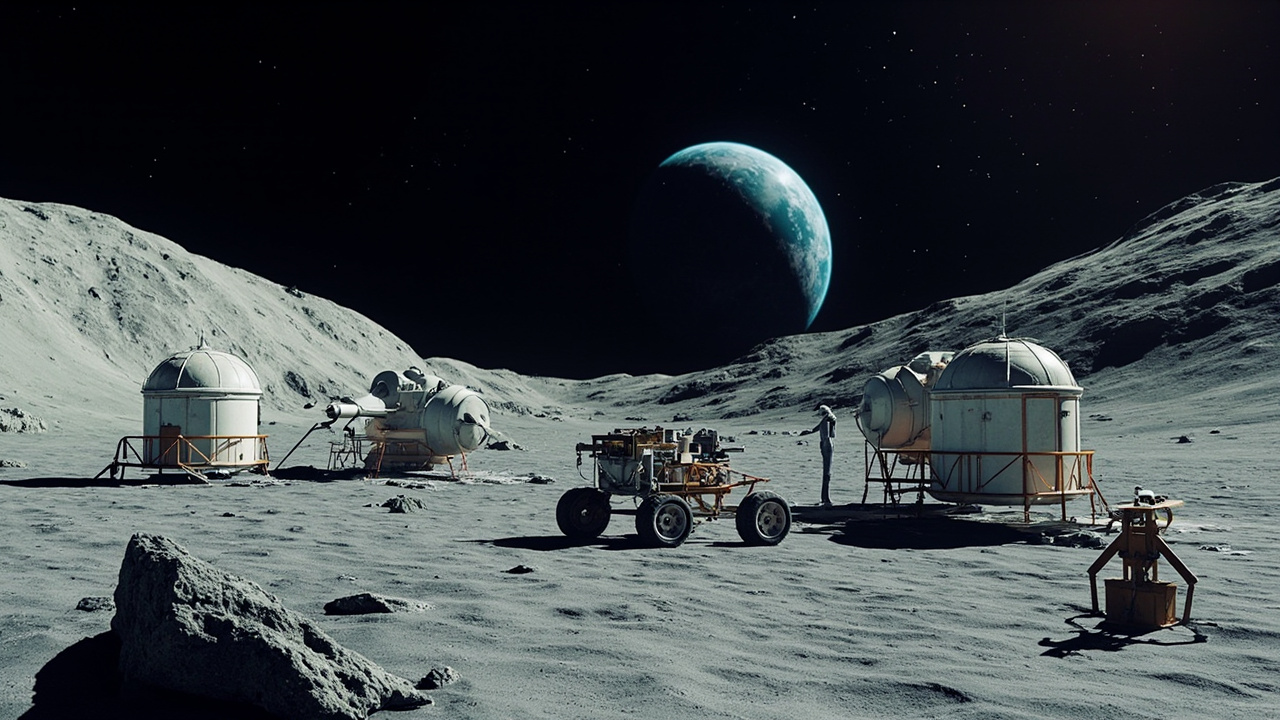
The Gateway — a small space station designed to orbit the Moon in a high elliptical path, serving as a staging point for crewed lunar landings — is, as of March 24, "paused in its current form" [1]. In its place, NASA announced a $20 billion, seven-year plan to construct a permanent base on the lunar surface near the south pole. The event was called "Ignition." The name was not subtle.
"It should not really surprise anyone that we are pausing Gateway in its current form and focusing on infrastructure that supports sustained operations on the lunar surface," Isaacman said [1]. He was right that it should not surprise anyone. Gateway has been a troubled program for years — technically complex, chronically delayed, and designed to solve an orbital mechanics problem that commercially developed landers may soon make irrelevant. But the manner of the announcement — at an internal pep rally, without prior consultation with international partners who had committed billions to the project — was a surprise of a different kind.
What Gateway Was
To understand what NASA just cancelled, you have to understand a peculiar engineering constraint. The Orion crew capsule, which sits atop the Space Launch System rocket, does not carry enough propellant to enter and leave a low lunar orbit the way Apollo did. It can, however, reach a near-rectilinear halo orbit — a vast, looping path that swings as close as 1,500 kilometers to the lunar surface and as far as 70,000 kilometers away on each orbit. Gateway was designed to sit in that orbit, acting as a transfer station where astronauts arriving in Orion could climb into a separate lander for the trip down to the surface.
The station was to be built from two initial modules: the Power and Propulsion Element, a solar-electric spacecraft built by Maxar Technologies, and the Habitation and Logistics Outpost, or HALO, built by Northrop Grumman [3]. Additional modules were planned from the European Space Agency, the Japan Aerospace Exploration Agency, and the Canadian Space Agency. The UAE had also signed on. Total international commitments ran into the billions of euros.
Congress itself appeared to endorse the plan. A budget reconciliation bill passed last July provided $2.6 billion specifically for Gateway, defined in the legislation as "an outpost in orbit around the Moon" [3].
None of that, apparently, was enough.
What Replaces It
The moon base will be built in three phases, according to Carlos Garcia-Galan, the program executive NASA assigned to lead the effort [3].
Phase 1 (2026–2028): Build, Test, Learn. NASA will dramatically increase the cadence of robotic lander missions through the Commercial Lunar Payload Services program, targeting up to 30 deliveries starting in 2027. These will carry rovers, instruments, power systems, and technology demonstrations. The goal is to get what Garcia-Galan called "ground truth" — actual data about terrain, radiation, dust, and ice conditions at potential base sites near the south pole. Cost: approximately $10 billion [3].
Phase 2 (2029–2031): Establish Early Infrastructure. NASA begins constructing habitable structures, building out communications and navigation networks, and supporting two crewed landings per year. International contributions enter here — Japan's pressurized rover, Canada's Lunar Utility Vehicle, and potentially European science payloads. Cost: approximately $10 billion [3].
Phase 3 (2032 and beyond): Long-Duration Human Presence. As cargo-capable human landing systems mature, NASA will deliver the heavy infrastructure needed for continuous habitation. Italy's Multi-purpose Habitats are pencilled in for this phase. Cost: $10 billion or more, with the phase extending to at least 2036 [3].
The total comes to roughly $30 billion over a decade, though NASA presented only the first $20 billion as its current planning figure. Where that money comes from remains an open question. Isaacman addressed it with the confidence of a man who built a payments company before he ran a space agency: "NASA does not necessarily have a top-line problem. We get a lot of resources. We may not always allocate them that efficiently" [2].
The Nuclear Piece
Alongside the moon base, NASA unveiled what may be the most consequential single mission in the entire announcement [5][6]. Space Reactor-1 Freedom, or SR-1, will be the first nuclear-powered interplanetary spacecraft. It will launch to Mars before the end of 2028 carrying a fission reactor that drives a nuclear-electric propulsion system [1].
When SR-1 reaches Mars, it will deploy a payload called "Skyfall" — a set of Ingenuity-class helicopters that will fly through the thin Martian atmosphere to scout landing zones for future crewed missions. The engineering lineage is direct. Ingenuity, the small helicopter that flew 72 times on Mars between 2021 and 2024, proved that powered flight in the Martian atmosphere was possible. Its successors will now arrive aboard a nuclear spacecraft.
Nuclear electric propulsion is not new as a concept. It has been studied since the 1960s. What is new is that NASA is committing to flight hardware on a defined timeline. The significance is not the Mars helicopters; it is the reactor. If SR-1 works, it establishes the regulatory precedent, the launch safety protocols, and the industrial supply chain for every nuclear system that follows — surface power on the Moon, propulsion for crewed Mars transits, and missions to the outer solar system where solar panels are useless.
Artemis II: Eight Days Away
All of this was announced with the Artemis II mission eight days from launch. Four astronauts — Reid Wiseman, Victor Glover, Christina Koch, and Jeremy Hansen — are scheduled to fly around the Moon on or about April 1 in the first crewed flight of the SLS and Orion [2]. The mission will not land. It will loop around the far side of the Moon and return to Earth, validating the life-support systems, navigation, and heat shield that every subsequent Artemis mission depends on.
The timing of the Ignition event was clearly designed to ride the wave of public attention that Artemis II will generate. But the juxtaposition is also slightly jarring. NASA is asking the world to celebrate a flight architecture that it is, in the same breath, substantially redesigning. The missions after Artemis II — Artemis III in 2027, then IV and V in 2028 — will now proceed without a Gateway to dock at. Orion astronauts will transfer directly to their landers in lunar orbit. How that transfer works, and in what orbit, was not specified.
The Partners Nobody Called
The most conspicuous absence from the Ignition event was any representative of the international partners whose hardware NASA just sidelined. The European Space Agency has been building the I-HAB habitation module for Gateway. JAXA has been developing life-support systems. The Canadian Space Agency committed its Canadarm3 robotic system — the successor to the International Space Station's robotic arm — specifically for Gateway operations.
Garcia-Galan said NASA would "repurpose" international partner commitments for the lunar base or other programs, but disclosed no details [3]. NASA separately announced it would convene Artemis international partners next week to discuss the new architecture [4]. That meeting will be interesting. The partners were not consulted before the Ignition announcement. They learned about it the same way the rest of the world did.
SpaceNews editor Jeff Foust noted that any shift from Gateway to a moon base will require Congressional approval, since the $2.6 billion appropriated last July was specifically for a lunar orbital outpost [3]. The space policy blog NASA Watch was blunter, calling it "like trying to take a taxi you designed and use the parts to build a snowmobile instead."
The Money Question
Twenty billion dollars over seven years is approximately $2.9 billion per year. NASA's total annual budget is roughly $25 billion. The Planetary Society estimates that the United States has already spent approximately $107 billion in inflation-adjusted dollars on return-to-the-moon plans since the Columbia disaster in 2003 — across Constellation, Artemis, and all their permutations [2].
Isaacman's claim that NASA can fund a moon base, a nuclear Mars spacecraft, ongoing science missions, Artemis crew flights, and commercial low-Earth-orbit station development within its existing budget depends on savings from cancelling Gateway, trimming what he called "bureaucratic waste and inefficiency," and repurposing hardware. It is an assertion, not a budget. Congress has not seen a request, and the appropriations committees have not weighed in.
But here is the thing about assertions from an administrator who has the White House behind him: they tend to become budgets. The National Space Policy signed by President Trump explicitly calls for a permanent lunar presence, and Isaacman has Trump's support. The question is whether $20 billion buys a base or a Phase 1 demonstration that the next administration can cancel, as has happened with every lunar program since Apollo.
"The moon base will not appear overnight," Isaacman said. "We will invest approximately $20 billion over the next seven years and build it through dozens of missions, working together with commercial and international partners towards a deliberate and achievable plan" [2].
Whether it is achievable depends on whether the money appears, whether the partners stay, and whether a reactor can fly to Mars in thirty-three months. For now, the Gateway is dead, the base is a rendering, and Artemis II is on the pad. The clock, as Isaacman said, is running.
-- KENJI NAKAMURA, Washington
Sources & X Posts
News Sources
X Posts