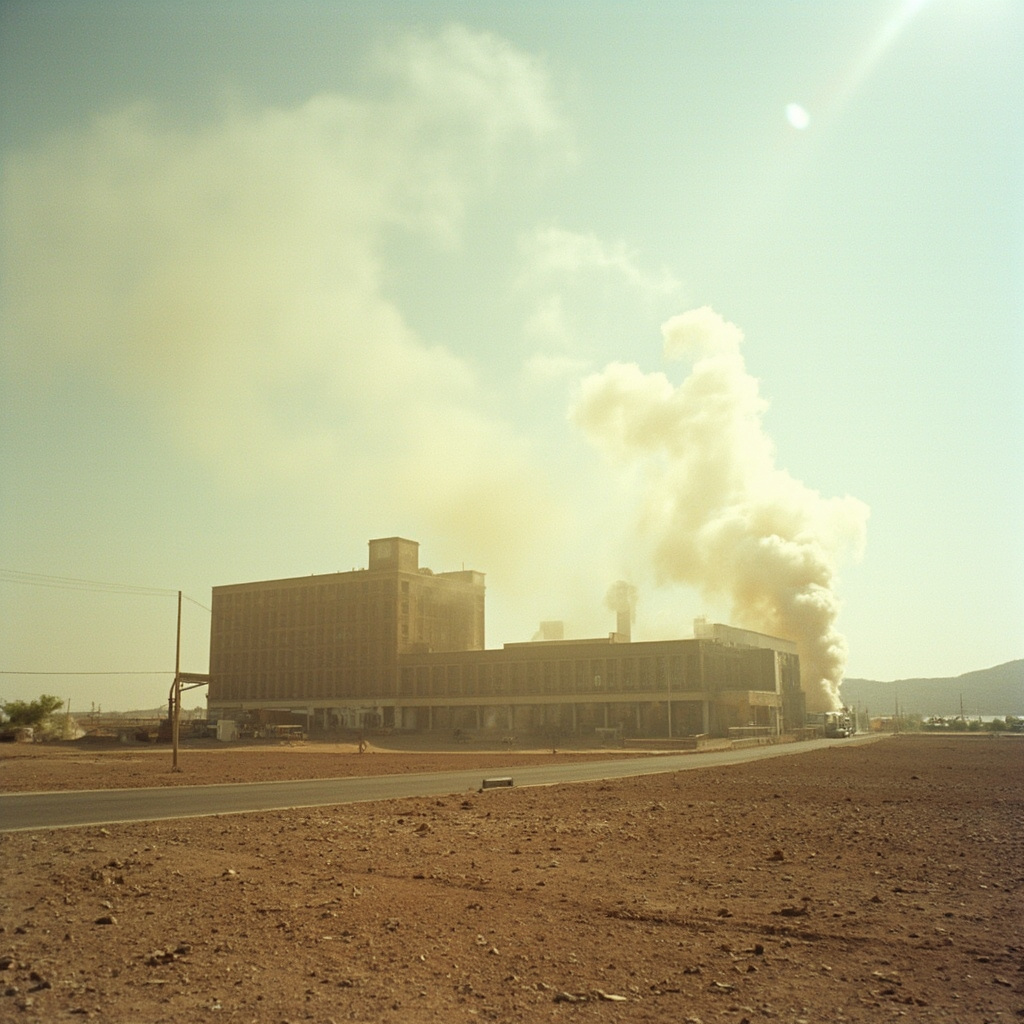
The Shahid Ahmadi Roshan uranium enrichment complex at Natanz was struck again on Saturday morning, March 21. This is the second time in three weeks that American and Israeli munitions — bunker-busters, by all credible accounts — have hit the facility. Iran's Atomic Energy Organization confirmed the strike within hours and said there was no leakage of radioactive materials. [1] [2]
That claim may be true. It is also, at this point, beside the point.
What Natanz Is
Natanz is not a missile factory or a naval base. It is an active uranium enrichment facility, housing thousands of centrifuges in underground halls designed to resist exactly the kind of ordnance that has now struck it twice. The facility processes uranium hexafluoride gas. It stores enriched material. It is monitored — or was monitored — by the International Atomic Energy Agency.
When you drop penetrating munitions on a building that contains fissile material, you are not simply destroying infrastructure. You are gambling on structural containment. The first strike, on March 2, was assessed by independent analysts to have degraded enrichment capacity significantly. The IAEA confirmed that strike but noted "no indicated damage to core nuclear installs" at the time. [3] The second strike went deeper.
The Question Nobody Is Asking
Every government involved has an interest in minimizing the environmental dimension of these strikes. The United States and Israel do not want to defend bombing a nuclear facility on radiological grounds. Iran does not want to admit vulnerability. The IAEA is investigating, but its monitoring access has been compromised by the war itself.
The question that is not being asked in any capital — Washington, Jerusalem, or Tehran — is straightforward: what happens if the next strike, or the cumulative effect of repeated strikes, breaches containment?
This is not a hypothetical drawn from science fiction. It is an engineering problem. Natanz's underground halls were built to withstand conventional attack. They were not designed to withstand repeated bombardment by GBU-57 Massive Ordnance Penetrators, the 30,000-pound bombs in the American arsenal. Each strike weakens the geology. Each strike changes the structural calculus.
What a Leak Would Mean
A radiological release from Natanz would not resemble Chernobyl. The enrichment facility does not house a reactor. But it does contain significant quantities of uranium hexafluoride and enriched uranium product. A breach could disperse radioactive particulate across the surrounding plateau.
The town of Natanz has a population of roughly 15,000. Isfahan, a city of two million, is 150 kilometers to the south. Prevailing winds in March blow southeast.
The World Health Organization published a trending advisory this week on nuclear incident preparedness in the context of the Iran strikes — a document that received more engagement on social media than many of the strike reports themselves. [4] That tells you something about where public anxiety is sitting.
The Precedent Problem
No country has repeatedly bombed an active nuclear enrichment facility in wartime. The Israeli strike on Iraq's Osirak reactor in 1981 hit a facility that had not yet been loaded with fuel. The Stuxnet cyberattack on Natanz in 2010 degraded centrifuges without physical destruction. The strikes of 2026 are in a different category entirely.
Assessments compiled from the IAEA and independent analysts place degradation of key Iranian nuclear facilities — Natanz, Fordow, Isfahan — between 86 and 95 percent. [5] That is a military achievement. But degradation of a nuclear facility is not the same as safe destruction of one. The rubble is not inert.
What the IAEA Can and Cannot Do
The IAEA has confirmed both strikes. Its inspectors have, at various points during this war, had intermittent access. The agency's director general, Rafael Grossi, has called for restraint. He has not publicly assessed the radiological risk of the second strike.
This is not surprising. The IAEA is a monitoring body, not a military assessor. Its mandate does not extend to telling the United States or Israel what they can bomb. But it is the only credible international institution with the technical capacity to evaluate what happened underground at Natanz on March 21. Its silence on the containment question is conspicuous.
The Conversation That Isn't Happening
In Washington, the Natanz strikes are discussed as counterproliferation successes. In Tehran, they are discussed as acts of war. In neither capital are they discussed as potential environmental disasters.
This is a failure of public discourse, not intelligence. The people who plan these strikes understand the radiological risks. The people who authorize them have been briefed. The people who will live with the consequences — the residents of Natanz, Isfahan, and the broader Iranian plateau — have not been consulted and have nowhere to go.
Iran says there was no leak. The IAEA is investigating. The bombs keep falling. And the conversation about what happens when you keep hitting a building full of uranium remains, for now, one that nobody in power wants to have.