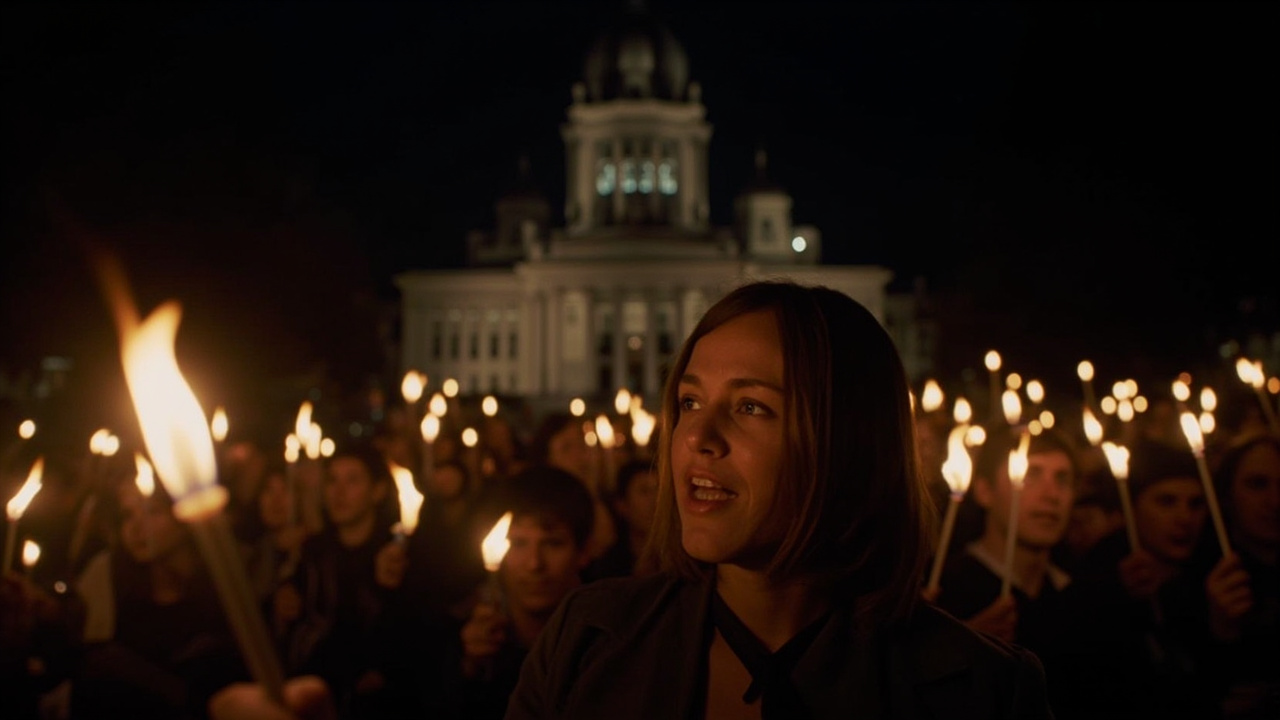
On March 28, more than nine million Americans participated in what Britannica has already cataloged as the largest single day of coordinated protest in the country's history. [1] Over 3,200 demonstrations took place across all fifty states. The images were extraordinary: candlelit processions through downtown corridors, hand-lettered signs held above seas of bodies, the kind of visual evidence that in previous decades might have forced a congressional hearing or a presidential retreat. None of that happened. The government did not respond. No legislation was introduced. No official acknowledged the number. The No Kings movement achieved scale. It did not achieve leverage.
The pivot to vigils came the following week. Organizers announced a shift in tone, from daytime marches to evening candlelight gatherings outside government buildings, courthouses, and federal offices. [2] Reuters described the transition as a "tactical evolution," citing organizers who said the movement needed to sustain presence without burning out its participants. CNN covered the first wave of vigils on April 1 as evidence that the movement was "entering a new phase." [3] The framing was generous. The facts were less so.
The problem the No Kings movement faces is not one of messaging, turnout, or media coverage. It is structural. The marches produced no economic disruption. No work stoppages accompanied the demonstrations. No consumer boycotts were organized in parallel. No corporations were targeted. The movement generated attention without generating cost, and in the arithmetic of political power, attention without cost is a parade.
This is the paradox that X has been dissecting with considerably less patience than the mainstream coverage. The most shared critique, repeated verbatim across dozens of accounts, was blunt: "The last 'No Kings' protest ended in inconsequence because there was no material leverage. No economic disruption. No cost for ignoring the workers; just another march that produced another headline that produced another day of nothing." [4] The framing is harsh. It is also accurate. Nine million people took to the streets and the institutional response was silence.
The comparison to movements that did produce institutional change is instructive. The Montgomery Bus Boycott lasted 381 days and imposed a direct financial cost on the transit system. The Solidarity movement in Poland combined mass demonstration with organized labor strikes. The Indian independence movement paired civil disobedience with economic non-cooperation. Each understood that scale is necessary but insufficient. What converts scale into power is the imposition of cost on the institutions that the movement seeks to change.
The No Kings movement has not yet found its cost mechanism. The vigils are beautiful. The turnout is historic. The signs are eloquent. But candles do not vote, and marches do not legislate. The question the movement must answer is not whether it can put nine million people in the streets -- it has already proven that it can -- but whether it can translate that presence into a form of pressure that institutions cannot ignore.
The NYT reported that organizers are discussing more disruptive tactics for future actions, including workplace walkouts and targeted consumer campaigns. [5] Those discussions remain discussions. Britannica noted that the March 28 turnout exceeded the 2017 Women's March by a factor of roughly two. [1] That earlier march, which drew an estimated four million participants, also produced no legislation and no policy reversal. It did, however, contribute to a wave of electoral organizing that produced the 2018 midterm results. Whether the No Kings movement can achieve something similar -- converting street energy into ballot energy -- is the only question that matters.
For now, the vigils continue. Every evening, in hundreds of cities, Americans gather with candles and stand in silence outside buildings where their representatives work. The representatives leave through the back door. The candles burn down. The vigils end. The government opens in the morning as if nothing happened. Because, institutionally, nothing did.
-- Maya Calloway, New York