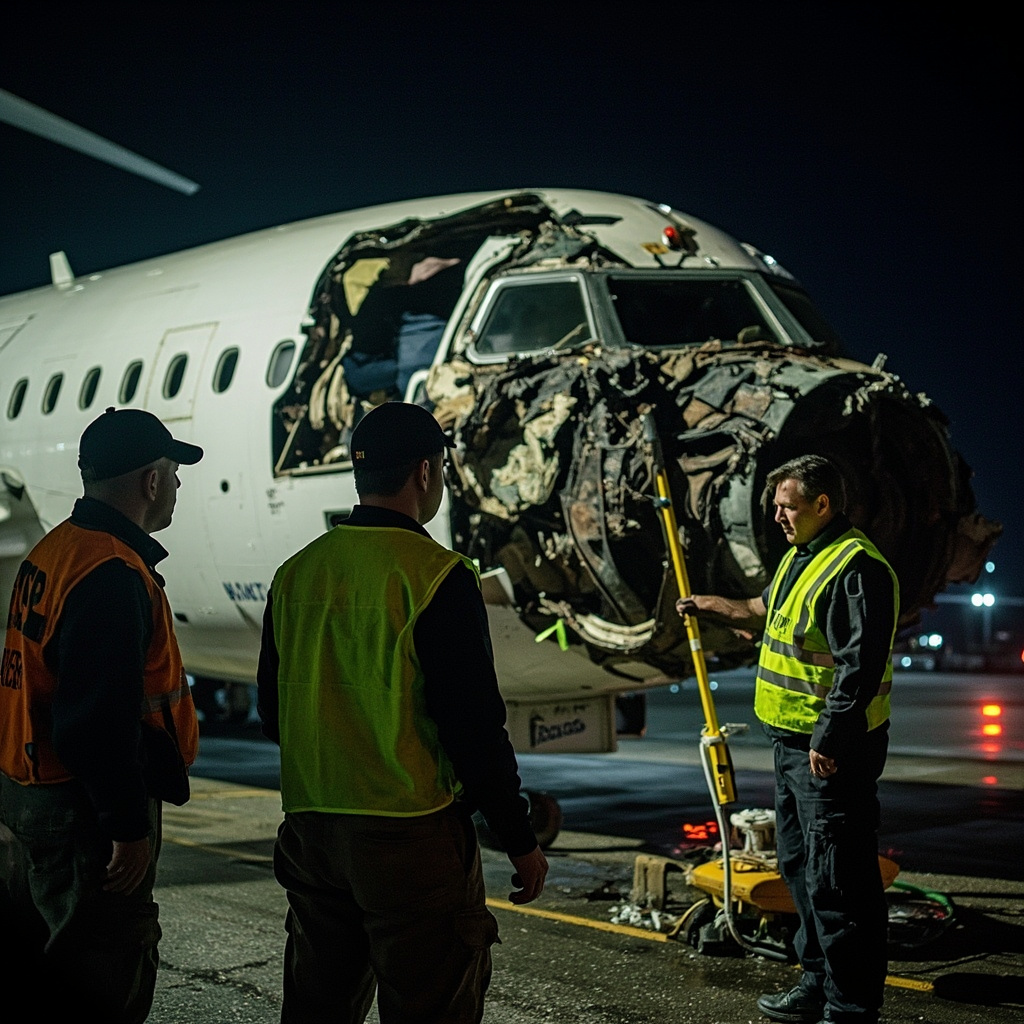
National Transportation Safety Board investigators cut through the roof of the Air Canada aircraft at LaGuardia Airport on Monday to extract the cockpit voice recorder and flight data recorder — the two devices that will determine whether a controller's error, a pilot's decision, or a cascading equipment failure killed two people on a New York runway. [1]
NTSB Chair Jennifer Homendy confirmed at a Monday press conference that both recorders have been sent to the agency's laboratory in Washington for analysis. The CVR captures the final 30 minutes of cockpit audio. The FDR records flight parameters — speed, altitude, control inputs. Together, they will reconstruct the last seconds of Air Canada Flight 8622's landing roll on Runway 4 on Sunday evening. [2]
The air traffic control audio, released by multiple outlets Monday, already tells part of the story. A controller cleared a fire truck — designated Truck 1 — to cross Runway 4 at taxiway Delta while the Air Canada jet was on its landing roll. Seconds later, the same controller transmitted: "Stop, Truck 1." [3] The plane had already hit the fire truck. Both pilots died. More than 70 passengers were injured, several critically.
The controller's actions are now the central focus. The NTSB confirmed it is examining the controller's decisions as part of the investigation, including the sequence and timing of clearances issued. The agency has not named the controller and emphasized that the probe is examining systemic factors, not assigning blame at this stage. [4]
The fire truck had been responding to an unrelated emergency — a reported engine indication on a taxiing aircraft — when it was cleared to cross the active runway. The question investigators must answer is why the controller issued a crossing clearance while an aircraft was on final approach or rolling out. Standard procedure requires visual confirmation that the runway is clear before any vehicle or aircraft is permitted to enter.
Runway 4, the crash site, remains closed. The NTSB said it would stay shut until at least Friday. LaGuardia's operations are running on a single runway, and the Federal Aviation Administration issued a ground delay program Monday morning that cascaded delays across the Northeast. Port Authority officials estimated the backlog would take two to three days to clear. [5]
The pilots have been identified as Captain Marc-Olivier Beauchemin and First Officer Jean-Philippe Delisle, both based in Montreal. Air Canada CEO Michael Rousseau said in a statement that the airline was "devastated" and cooperating fully with the investigation.
LaGuardia's runway configuration makes it uniquely vulnerable to this kind of accident. The airport's two intersecting runways and constrained taxiway system mean ground vehicles must routinely cross active runways — a geometry that air safety advocates have flagged for decades. The last fatal runway incursion at a major U.S. airport was the 2025 near-miss at Austin-Bergstrom, which ended without casualties only because a FedEx pilot executed a go-around at the last moment.
This time the margins did not hold.
-- MAYA CALLOWAY, New York