
TL;DR
A rare daytime fireball over Lake Erie dropped achondrite fragments — possibly from Mars — across Medina County, triggering a meteorite gold rush NASA never saw coming.
MSM Perspective
Cleveland.com reports NASA mapped a strewn field stretching from Hinckley to Rittman, with fragments possibly of Martian or lunar origin.
X Perspective
Meteorite hunters are descending on Medina County, Ohio, where rare achondrite fragments worth thousands per gram may have fallen.
The asteroid arrived on St. Patrick's Day at 8:57 in the morning, which is not when asteroids are supposed to arrive. Meteors are creatures of darkness — we see them as shooting stars against black sky, wish on them, photograph them with long exposures. This one came in broad daylight, a six-foot-wide rock weighing seven tons, traveling at roughly 40,000 miles per hour, and it announced itself not with a streak of light but with a sound: a deep, concussive boom that rattled windows across ten states and convinced a meaningful number of Ohioans that the Iran war had come to Cleveland [1][2].
It had not. What had come to Cleveland, or more precisely to the airspace above Lake Erie near Lorain, was a piece of the solar system — a fragment of the early cosmos that had been orbiting the sun for approximately 4.5 billion years before Earth's atmosphere intercepted it on a Tuesday morning in March. The rock entered the atmosphere at a high angle that had evaded NASA's skywatch network, became visible roughly 50 miles above the lake, and streaked southward for 34 miles before breaking apart 30 miles above Valley City in Medina County [1][2].
The breakup released energy equivalent to 250 tons of TNT. That is not a metaphor. It is a measurement. Two hundred and fifty tons of explosive force, unleashed in the atmosphere above a county of 180,000 people, at breakfast time, on a holiday. The pressure wave — the sonic boom — was detected by weather radar in Cleveland and Pittsburgh, by a lightning-mapping instrument aboard a NOAA satellite that was not looking for meteors, and by approximately 200 human beings who reported the event to the American Meteor Society from states as distant as North Carolina, Wisconsin, and the District of Columbia [2].
What happened next is where the story becomes extraordinary.
When a meteorite hits the ground — and most do not; most burn up entirely in the atmosphere — the fragments are classified by composition. The vast majority of meteorites are chondrites, stony objects that have not been significantly altered since the formation of the solar system. They are scientifically valuable but relatively common, as space rocks go. They sell for $1 to $5 per gram on the collector's market [3].
Early analysis of the Ohio fireball's trajectory, entry angle, and spectral signature suggests that its fragments are not chondrites. They are achondrites — igneous rocks that were once melted and differentiated, meaning they come from a body large enough to have had a molten interior. Only about 8 percent of all meteorites that reach Earth's surface are achondrites. And among achondrites, a subset comes from only two known sources: the Moon and Mars [3].
NASA has not confirmed a Martian or lunar origin. The confirmation requires physical analysis of recovered fragments — a process that involves cutting the rock, examining its mineral composition, and comparing the trapped gases to known samples from the Apollo missions and from the small number of confirmed Martian meteorites in museum collections worldwide. But the preliminary data has been enough to trigger what Ralph Harvey, a professor of earth, environmental, and planetary science at Case Western Reserve University, called "exactly what you'd expect" — a gold rush [1].
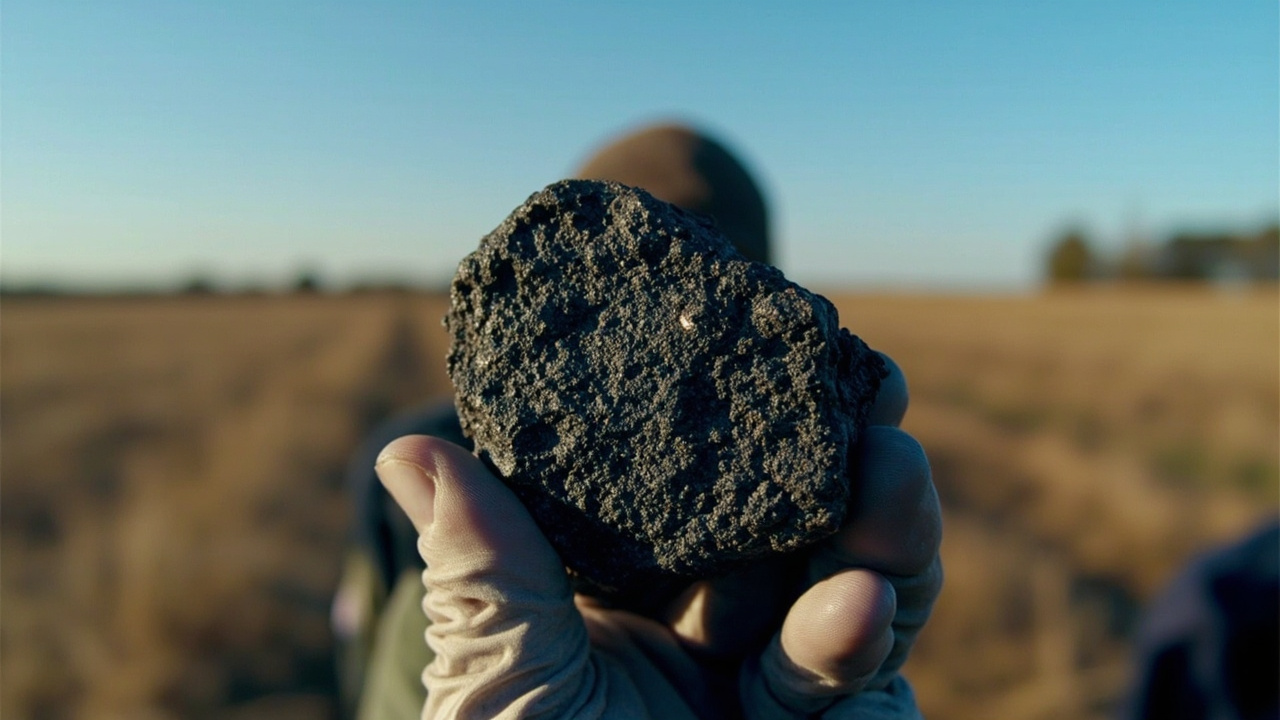
Meteorite hunters began arriving in Medina County within 24 hours. They came from Texas, from Arizona, carrying metal detectors, GPS units, and the specific body language of people searching for something very small and very valuable in a very large field [1].
NASA's Astromaterials Research and Exploration Science division mapped a projected strewn field stretching from northern Medina County between Hinckley and Richfield south-southwest toward Rittman. The map is color-coded by fragment size: pea-sized pieces scattered widely to the northeast by 150 mph winds at altitude; larger fragments, up to about one kilogram, concentrated near Rittman [1].
"If there are meteorites, they will likely be small and hard to find," Harvey told Cleveland.com. "Think more pea-sized than baseball-sized or bowling ball-sized" [1].
The financial incentive is real. Confirmed Martian meteorites sell for $500 to $1,000 per gram — more than gold, more than platinum, more per unit weight than almost any substance on Earth. A fragment the size of a marble could be worth $10,000. The most expensive meteorite ever sold at auction, a piece of the Moon recovered in the Sahara, fetched $612,500 at Christie's in 2018. The Ohio fragments, if they prove to be Martian, would enter that rarefied market [3].
But the more interesting question is not what the rocks are worth. It is what they tell us about the universe's capacity for surprise.
NASA could not see this asteroid coming. Its skywatch programs — the Catalina Sky Survey, the ATLAS system, the Pan-STARRS telescopes in Hawaii — are designed to detect objects approaching from predictable trajectories. This asteroid entered at a steep angle, from a direction that the detection network does not cover well, and at a speed that left almost no warning time. It was, in the language of planetary defense, a "gap object" — a rock that exploited a known limitation in humanity's ability to monitor incoming threats from space [2].
In Medina County, the search continues. Farmers are walking their fields with magnets taped to walking sticks. Children are bringing rocks to school and asking teachers if they are from Mars. A local antique dealer has posted a sign in his window: "WE BUY METEORITES." The sign includes a phone number.
Somewhere in that narrow band of Ohio farmland, between Hinckley and Rittman, there may be a pebble that was blasted off the surface of Mars by an ancient impact, spent millions of years orbiting the sun, entered Earth's atmosphere at forty thousand miles per hour on a Tuesday morning in March, and landed in a soybean field next to Route 57. It has been waiting 4.5 billion years to be found. The hunters are in a hurry.
-- KENJI NAKAMURA, Tokyo
Sources & X Posts
News Sources
X Posts