TL;DR
Analysts halved Tesla's 2026 delivery growth forecast to 3.8%, with US sales down 17% in January and a third straight year of declining deliveries now feared.
MSM Perspective
Reuters reported the analyst downgrades as a consensus shift — the framing has moved from 'temporary setback' to structural demand erosion.
X Perspective
Tesla bears on X are pointing to collapsed delivery times and 7-year financing as demand signals, while bulls insist China growth will offset domestic losses.
Wall Street analysts have halved their 2026 delivery growth estimate for Tesla, cutting the projection from 8.2 percent to 3.8 percent. The revision is not a minor adjustment. It reflects a consensus shift from the belief that Tesla's demand problems are temporary to the recognition that they may be structural. [1]
The numbers tell a clear story. US sales fell 17 percent year-over-year in January. February continued the decline. March is on pace for the same. If the trend holds through the full year, 2026 will be Tesla's third consecutive year of delivery slides — a trajectory that no analyst was forecasting twelve months ago. The company that defined the electric vehicle category is now struggling to sell the vehicles it makes.
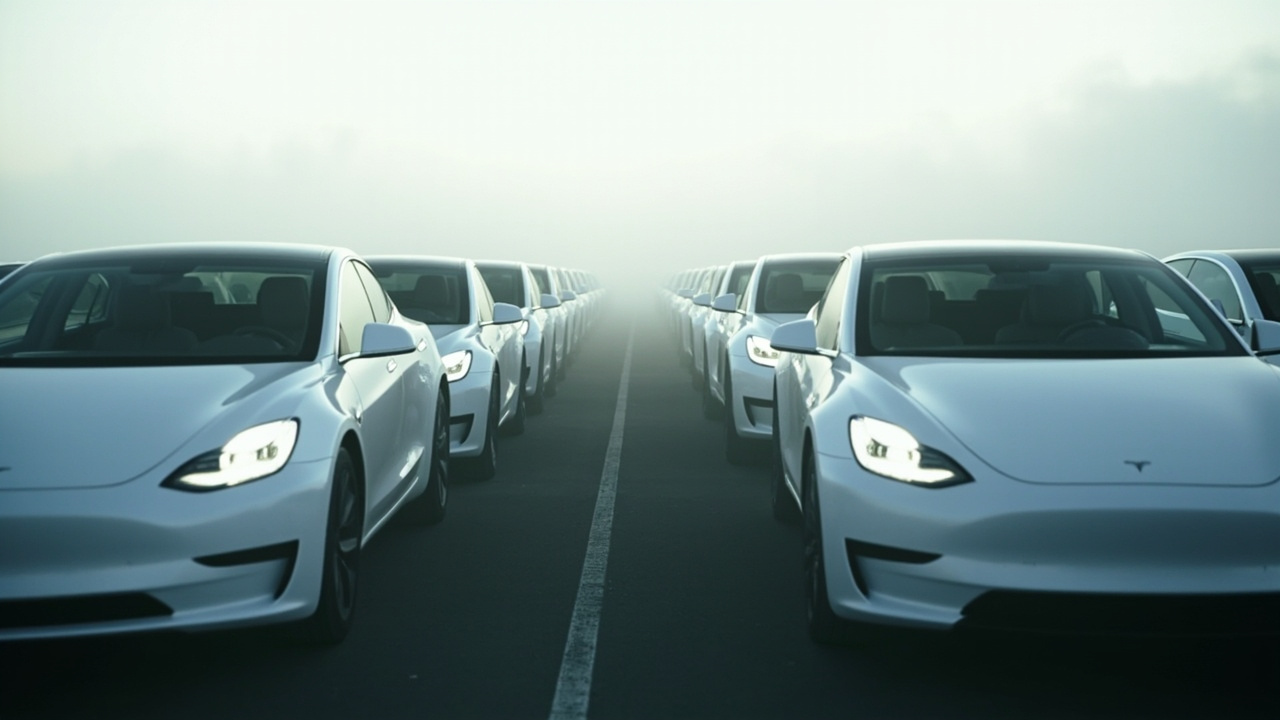
The demand signals visible to consumers are as telling as the sales data. Delivery times for most Tesla models have collapsed to one to three weeks, down from the three-to-six-month waits that characterized the company's peak demand period. When a car manufacturer can deliver in a week, it means the cars are sitting on lots. Tesla has also introduced seven-year financing options on certain models, a move that lowers monthly payments but extends the ownership commitment — a tool manufacturers deploy when the problem is not the car's price but the buyer's willingness to pay it.
China provides the only bright spot in the global picture. Tesla sold 127,728 vehicles in China during January and February, a 35 percent increase over the same period last year. The Chinese market has its own dynamics — aggressive pricing, government EV subsidies, and competition from BYD that forces Tesla to fight for every sale — but the growth is real. The question is whether it is large enough to offset the losses elsewhere.
Troy Teslike, a closely followed independent Tesla analyst, framed the problem in its starkest terms: "After a 1.1% drop in 2024, Tesla deliveries fell 8.6% in 2025. I expect an even bigger drop in 2026." The trajectory is not a correction. It is a curve bending in the wrong direction.
The causes are multiple and mutually reinforcing. Competition has intensified as legacy automakers and Chinese manufacturers have released compelling EVs at competitive prices. Brand damage from Elon Musk's political activities has pushed some buyers to alternatives. The novelty premium that Tesla once commanded — the willingness to pay more for a Tesla than for a comparable vehicle — has eroded as the market matures.
None of these factors is individually decisive. Together, they describe a company that is losing the demand advantage it spent fifteen years building. Tesla still moves more electric vehicles than any single competitor. But the gap is closing, the growth has reversed, and the analysts who once competed to set the highest price target are now competing to describe the decline with the appropriate degree of concern.
-- David Chen, Beijing
Sources & X Posts
X Posts