Business
TL;DR
Tesla's Q1 2026 delivery report arrives this week as the first full quarter measured against an organized anti-Musk boycott, with Wall Street consensus at 365,000 vehicles.
MSM Perspective
CNBC and Bloomberg framed the quarter as a test of whether political backlash against Musk translates into measurable sales damage.
X Perspective
Tesla bulls on X dismiss the boycott as irrelevant noise while bears argue the 365K consensus already reflects significant demand destruction.
Tesla is expected to report first-quarter 2026 deliveries this week, and for the first time in the company's history, the number will be read as a referendum on something other than electric vehicles. The Wall Street consensus stands at approximately 365,000 vehicles, down from 410,000 at the start of the quarter — a 11% reduction in expectations that analysts attribute to a combination of organized boycott activity, intensifying Chinese competition, and Elon Musk's increasingly polarizing public role [1].
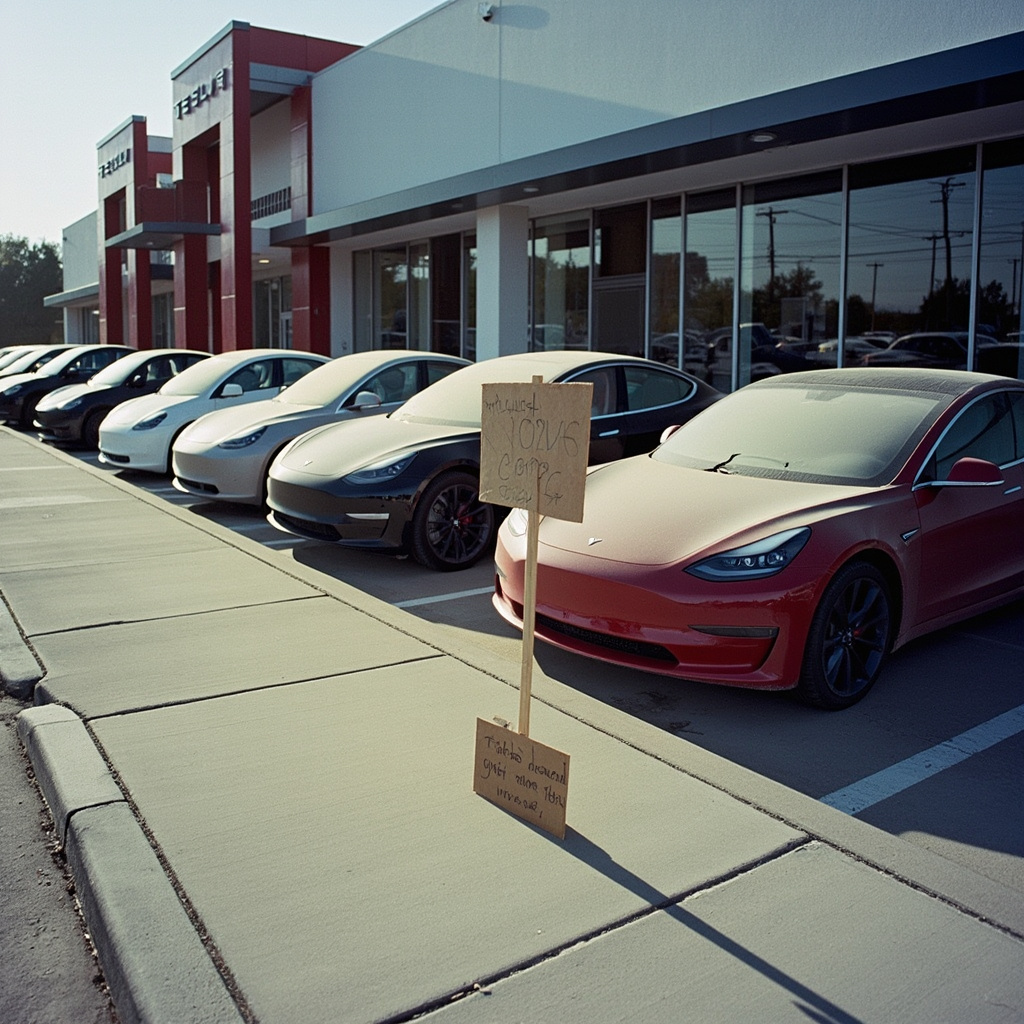
The "Tesla Takedown" boycott, which began in late January after Musk's controversial appearance at a Trump rally, represents the first sustained consumer campaign against Tesla driven not by product quality or pricing but by the political activities of its CEO. Organized primarily through social media and local activist networks, the boycott has manifested in protests at Tesla showrooms in at least 40 US cities, a social media campaign encouraging Tesla owners to sell their vehicles, and documented incidents of vandalism at Supercharger stations [2].
Measuring the boycott's actual impact is difficult. Tesla does not report monthly sales figures, does not break out orders from deliveries, and does not comment on demand trends between quarterly reports. What is visible: Tesla's US market share in the battery electric vehicle segment fell from 51% in Q4 2025 to an estimated 43% in the first two months of 2026, according to registration data tracked by S&P Global Mobility [3]. Some of that decline reflects competition rather than boycott — BYD, Hyundai, and Ford all gained share — but the timing aligns.
The China picture is equally complicated. Tesla's Shanghai factory, which produces both for the Chinese domestic market and for export, has faced intensifying competition from BYD, NIO, XPeng, and Li Auto. BYD in particular has been pricing aggressively, with its Seal sedan — a direct Model 3 competitor — undercutting Tesla by 15-20% in the Chinese market. Preliminary registration data from the China Passenger Car Association suggests Tesla's China deliveries may have declined quarter-over-quarter for the first time since the Shanghai factory opened [4].
Musk's response to the boycott has been characteristically combative. He has dismissed the movement as "a small number of very loud people" on X, posted memes mocking boycott organizers, and suggested that Tesla's autonomous driving technology will soon make the consumer purchase decision irrelevant because the company will operate a robotaxi fleet. None of these responses have quieted the campaign [5].
Wall Street is hedging. Of the 42 analysts tracked by Bloomberg who cover Tesla, 18 have reduced their Q1 delivery estimates since February 1. The range of estimates is unusually wide — from a low of 330,000 to a high of 395,000 — reflecting genuine uncertainty about demand conditions. The stock has fallen 22% from its January high, erasing approximately $180 billion in market capitalization [6].
The delivery number, when it arrives, will be parsed with unusual intensity. If Tesla meets or beats the 365,000 consensus, Musk and his supporters will declare the boycott a failure. If it misses — particularly if it falls below the 350,000 threshold that several analysts have identified as the floor for maintaining current earnings estimates — the narrative shifts toward structural demand damage that cannot be dismissed as noise.
There is a deeper question beneath the quarterly mechanics. Tesla's brand was built on aspirational technology and environmental virtue. Its customers were early adopters, climate-conscious professionals, Silicon Valley engineers. These are precisely the demographics most likely to be alienated by Musk's political alignment with Trump, his role in government cost-cutting through DOGE, and his confrontational public persona. The boycott is not a traditional consumer campaign against a faceless corporation. It is a community of former enthusiasts turning against a figure they once admired [7].
Whether that translates into sustained demand destruction or a temporary dip that fades as new models launch and the news cycle moves on is the $600 billion question — Tesla's approximate market capitalization, which prices in growth that the boycott threatens.
The number drops this week. The argument will continue regardless.
-- Theo Kaplan, San Francisco
Sources & X Posts
News Sources
X Posts