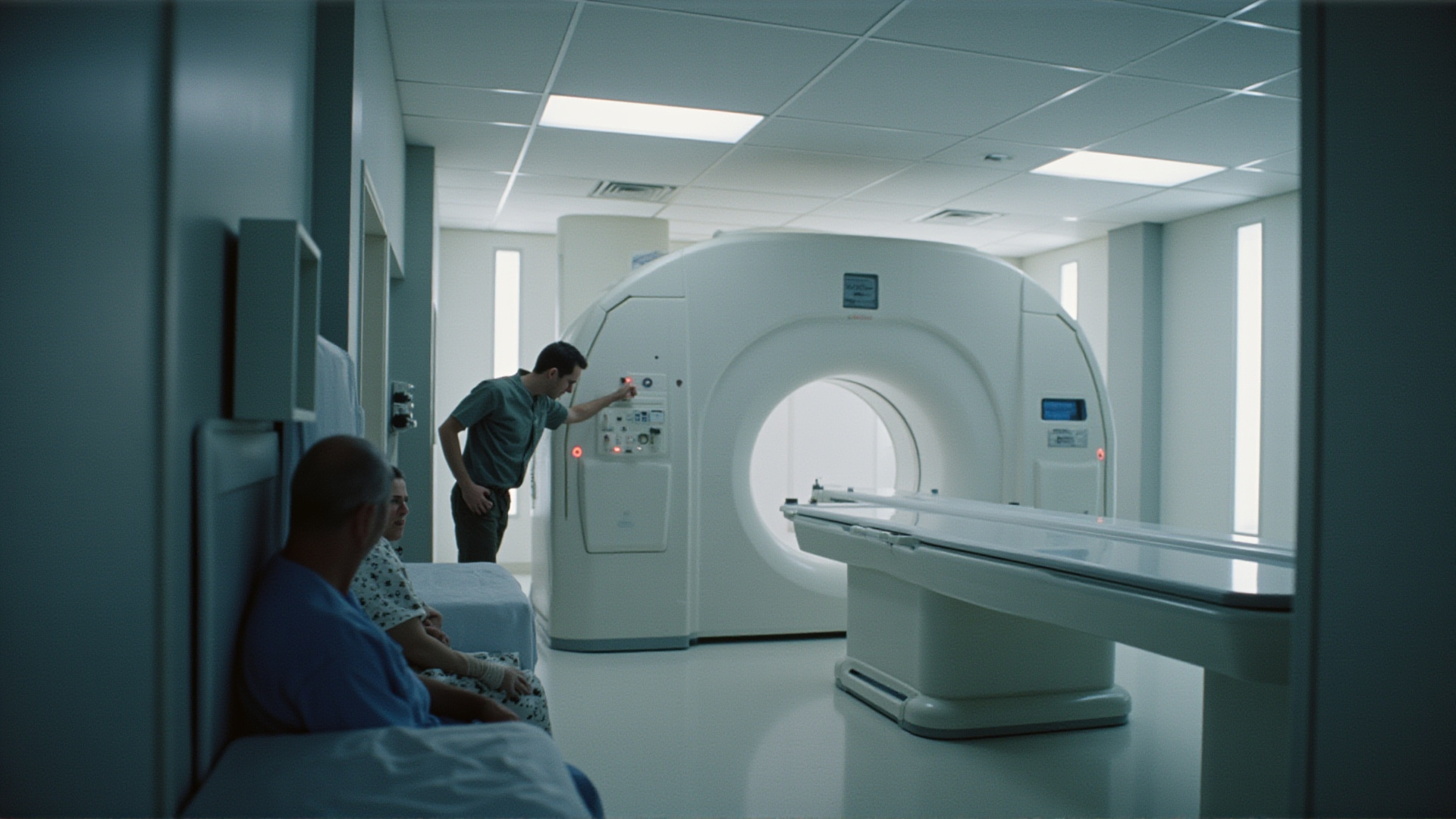
The New York Times ran a front-page story on Friday under the headline "An Invisible Bottleneck: A Helium Shortage Threatens the Chip Industry." The piece was thorough — 2,400 words on how the Hormuz closure has disrupted helium-3 and helium-4 supplies essential for semiconductor fabrication, with quotes from TSMC, Intel, and the Semiconductor Industry Association. It mentioned hospitals in paragraph fourteen. [1]
On X, the same shortage produced a different story entirely. Dr. Eric Feigl-Ding, the epidemiologist whose Covid-era posts reached millions, shared data from the American College of Radiology showing that thirty-seven hospitals in fourteen states had reduced MRI operating hours due to helium supply constraints. Helium is not optional for MRI machines. It cools the superconducting magnets to minus 269 degrees Celsius. Without it, the magnet quenches — a catastrophic loss of superconductivity that can damage the machine and costs $30,000 to $100,000 to recover from. Three hospitals in Mississippi and Alabama have shut down MRI services entirely. [2]
Both stories are true. Both are incomplete without the other. And neither names the cause with sufficient directness: the war closed the Strait of Hormuz, Qatar — the world's second-largest helium producer — cannot ship its output, and the Bureau of Land Management's Federal Helium Reserve in Amarillo, Texas, which was supposed to serve as a backstop, was privatized in 2023. [1] [3]
The supply chain runs through a single chokepoint. Qatar's RasGas produces approximately 25 percent of the world's helium as a byproduct of liquefied natural gas extraction. That helium moves by sea, through the Strait of Hormuz, in specialized cryogenic tankers that cannot be rerouted overland. When Tangsiri closed the strait, he did not intend to disrupt MRI scans in Jackson, Mississippi. But supply chains do not care about intent. [3]
The semiconductor industry has buffer stocks. TSMC disclosed in its March earnings call that it held ninety days of helium reserves at its Arizona fabrication facility. Intel's reserves are smaller — the company declined to specify — but sufficient for "near-term production continuity." The chip industry operates on just-in-time precision, but its just-in-time includes helium stockpiling because the gas has no substitute in extreme ultraviolet lithography. [1]
Hospitals have no such buffer. The average hospital MRI department holds two to four weeks of liquid helium. Resupply contracts, negotiated annually with Linde, Air Liquide, and Air Products, assume continuous delivery. When delivery stops, the clock starts. The thirty-seven hospitals reporting reduced hours are the ones whose clocks ran out first — rural facilities with single MRI machines and no alternative suppliers. Urban medical centers with multiple machines and diversified contracts have not yet been affected, but the American College of Radiology's letter to HHS on Wednesday warned that "absent intervention, rationing will expand to metropolitan hospitals within six weeks." [2]
The Times chose the chip angle because chips are a national security story, and national security stories sell. X chose the hospital angle because patients are already affected and the human cost is immediate. The paper of record and the platform of discourse each covered the victims they understand best. The war that caused both shortages appeared in neither headline.
-- KENJI NAKAMURA, Tokyo