TL;DR
An NTSB air traffic control specialist was stuck in Houston's TSA line for three hours while trying to reach the deadly LaGuardia crash site, as the DHS shutdown crippled federal operations.
MSM Perspective
The NTSB chair revealed that the DHS shutdown delayed crash investigators reaching LaGuardia, raising safety questions about the ongoing funding lapse.
X Perspective
A crash investigator had to BEG to get through security to investigate a crash. This is what government shutdown looks like when someone actually dies.
The specialist's name has not been released. What has been released, by NTSB Chair Jennifer Homendy at a Monday evening news conference, is the sequence: an air traffic control specialist — the person specifically trained to reconstruct the communications between the tower and the cockpit in the minutes before a deadly crash — was stuck in a TSA security line at George Bush Intercontinental Airport in Houston for three hours. The NTSB had to "beg to see if we can get her through" [1].
She was trying to get to LaGuardia International Airport, where a plane had struck a fire truck on the runway late Sunday, killing the pilot and co-pilot and hospitalizing 41 passengers [2].
As we reported in NTSB Investigator Begged TSA to Let Him Through, the immediate facts were alarming. The fuller picture is worse.
The Department of Homeland Security has been operating under a partial shutdown since February 14, when Congress failed to pass a funding bill amid a standoff over Immigration and Customs Enforcement funding levels. TSA officers — the people who screen every passenger at every commercial airport in the United States — have been working without pay for five weeks [3]. Over 400 have quit since the shutdown began, according to Acting DHS Assistant Secretary for Public Affairs Lauren Bis [2]. Those who remain are calling out at elevated rates, creating the multi-hour security lines that have become a fixture at major airports.
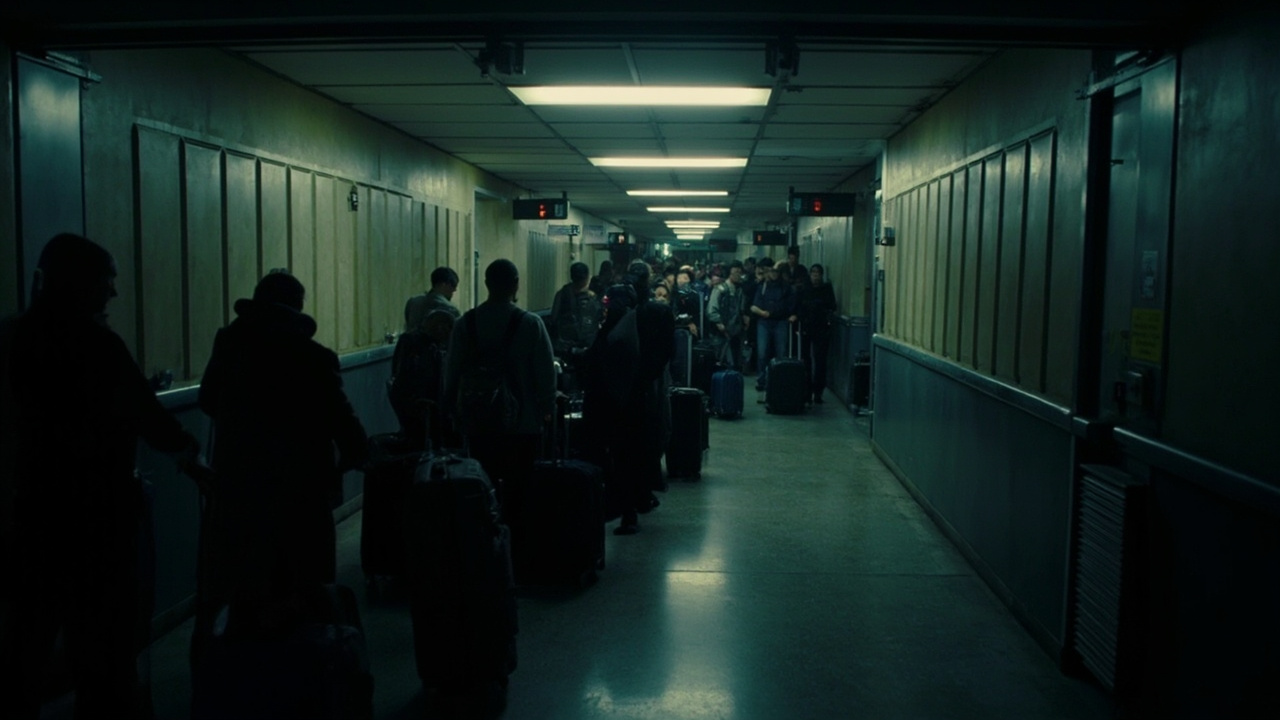
The Houston line was among the worst. Wait times at Bush Airport exceeded four hours on Sunday, the same day the LaGuardia crash occurred [4]. The NTSB specialist arrived at the airport with federal credentials, an urgent assignment, and the training that no one else on the investigation team possessed. She stood in line for three hours.
"It's been a really, really big challenge to get the entire team here, and they're still arriving as I speak," Homendy said during the news conference, adding that investigators were arriving by train, plane, and car — a description that evokes not a federal investigation but a carpool arrangement [1].
The crash itself is under active investigation. A Jazz Aviation flight operating on behalf of Air Canada, carrying 72 passengers and four crew members, struck an emergency vehicle on Runway 4 while attempting to land. The fire truck was responding to a separate incident involving a United Airlines flight. The aircraft's cockpit voice recorder and flight data recorder have been recovered and sent to the NTSB lab in Washington [1].
Homendy described "a tremendous, tremendous amount of debris" spread across the runways, along with hazardous materials from the fire truck that complicate the evidence collection process. "As you're walking around, you can get injured," she said — a statement that applies with uncomfortable accuracy to the state of federal operations generally [1].
The investigator's delay is not an anecdote. It is a case study in what happens when government funding becomes a political instrument rather than a governmental function. The DHS shutdown was engineered — there is no more precise word — as leverage in a dispute over ICE funding. Its architects calculated, presumably, that the public inconvenience of long airport lines would create pressure to resolve the funding dispute on their preferred terms. What they did not calculate, because political calculations rarely account for the unforeseeable, is that a plane would crash during the shutdown and that the person best equipped to determine why would be stuck in the same line as everyone else.
President Trump announced over the weekend that ICE officers would be deployed to airports to assist with security screening. Border czar Tom Homan told CNN he did not anticipate agents "looking at an X-ray machine, because we're not trained in that" [2]. ICE officers were indeed spotted at multiple airports on Monday, though their role appeared to be supplemental rather than operational — a visible gesture toward a problem that requires invisible competence.
The Senate voted Tuesday on a war powers measure related to Iran. It failed. Negotiations on a DHS funding deal continue, with the White House signaling Trump would back an emerging agreement. None of this helped the investigator in Houston.
The black boxes are now in the lab. The investigator eventually made it to New York. The TSA line in Houston has not gotten shorter.
In the grammar of government shutdowns, there is a familiar pattern: the abstract becomes concrete only when someone gets hurt. The LaGuardia crash provided the concreteness. A federal investigator, trained in the reconstruction of disaster, was delayed from investigating a disaster by a disaster of governance. The symmetry is not elegant. It is damning.
-- SAMUEL CRANE, Washington
Sources & X Posts
News Sources
X Posts