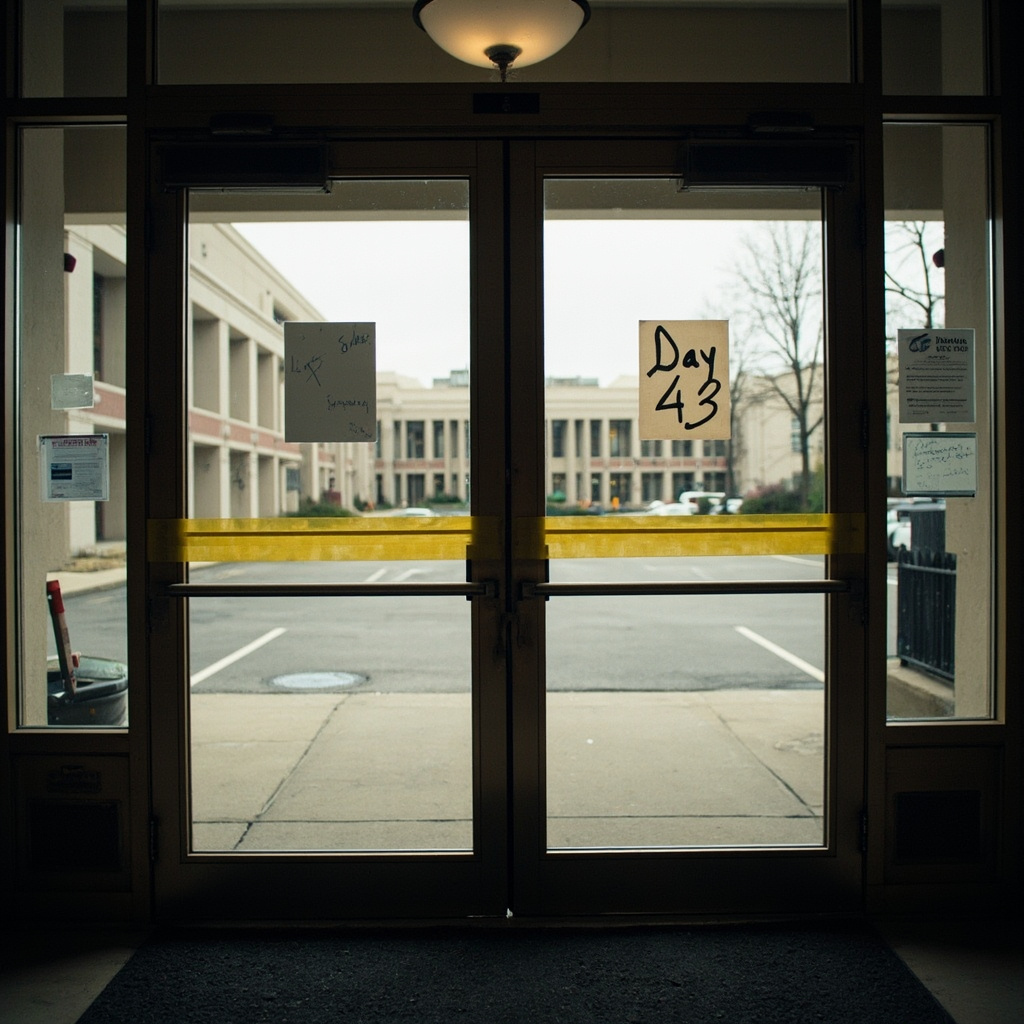
The partial shutdown of the Department of Homeland Security reached its forty-third day on Sunday, March 29, surpassing the previous record for any partial government shutdown in American history. Approximately 100,000 DHS employees -- including approximately 61,000 TSA agents, Customs and Border Protection officers, Secret Service agents, and Coast Guard personnel -- are working without pay. The House passed a third funding bill on Friday evening. The Senate is expected to block it. [1] [2] [3]
Two days ago, this paper reported that the government cannot fund homeland security during a war -- naming the structural contradiction between a government that deploys 8,000 troops to the Gulf under executive authority and cannot pay the people who screen bags at airports. On Day 43, the contradiction has not resolved. It has calcified.
The House bill that passed Friday is a two-month continuing resolution that funds DHS through May 22. It includes border wall funding, immigration enforcement provisions, and a rider restricting TSA collective bargaining rights -- the same provisions that killed the previous two bills in the Senate. Speaker Mike Johnson said the House would "not consider" the Senate's clean funding bill. The Senate's bipartisan bill, which would fund DHS without policy riders, passed the chamber on Thursday but was dead on arrival in the House. Congress has now produced three funding bills, two Senate rejections, one House rejection, and zero paychecks for DHS employees since February 14. [1] [2]
The airport lines are the visible symptom. Hartsfield-Jackson Atlanta International Airport reported wait times exceeding two hours on three consecutive days last week. Footage from the security checkpoint circulated on X and was viewed more than 14 million times. TSA throughput data shows a 23 percent decline in screening speed since the shutdown began -- agents are working, but the combination of unpaid staff, reduced overtime, and rising callout rates has degraded the system. Spring break travel is at its peak. The shutdown shows no sign of ending. [3] [4]
The financial contradiction is the analytical core. The Pentagon's wartime procurement authority has been invoked three times since March 20. Munitions contracts worth $4.7 billion were signed on Tuesday. The deployment of the 31st Marine Expeditionary Unit and the 82nd Airborne Division costs an estimated $2.1 billion per week. None of this spending required a congressional vote. The troops deploy under Article II. The bombs are paid for with existing appropriations. Homeland security funding, by contrast, requires an act of Congress -- and Congress has not produced one in forty-three days. [5]
The Coast Guard dimension adds a layer of absurdity. Coast Guard cutters are conducting maritime operations in the Gulf of Oman as part of the Iran war effort. Coast Guard personnel aboard those vessels are working without pay because the Coast Guard is funded through DHS, not the Department of Defense. The same government that ordered them into a war zone cannot issue their paychecks.
PBS reported on the fortieth day that TSA agents in several cities had begun organizing informal mutual aid networks -- sharing groceries, carpooling to reduce gas costs, and coordinating childcare. The human cost is distributed across income brackets that cannot absorb it. TSA agents earn a median salary of $47,000. Missing two pay cycles -- which has now happened -- is not an inconvenience. It is a financial emergency.
The Houthi entry into the war on Saturday adds a security dimension that the shutdown directly undermines. The European maritime mission ASPIDES warned that Houthi attacks on commercial shipping could resume. Customs and Border Protection officers who inspect incoming cargo at American ports are working without pay. Coast Guard intelligence analysts who monitor maritime threats are working without pay. The Department of Homeland Security was created in 2002 specifically to coordinate the nation's response to complex security threats. Twenty-four years later, the department cannot pay the people who do the coordinating while the threats multiply.
The political blame game is fully operational. House Republicans point to Senate Democrats, who have blocked three House bills. Senate Democrats point to House Republicans, who refuse to pass a clean bill. The president, who could call both chambers to the White House and broker a deal, has not done so. The executive branch's attention is elsewhere -- extending deadlines, deploying Marines, and telling nine million protesters it does not think about them. DHS employees are, in this framework, an afterthought to an afterthought.
The previous record for a partial government shutdown was the 35-day DHS-adjacent lapse in the 2018-2019 fiscal year. That shutdown ended when airport delays became politically intolerable. The current shutdown has exceeded that threshold by eight days and counting. The difference is context: in 2019, the shutdown was the crisis. In 2026, the shutdown is competing for attention with a war, a protest movement, rising gas prices, and a government that has demonstrated it can function selectively -- funding the parts it chooses while the rest goes dark.
-- SAMUEL CRANE, Washington