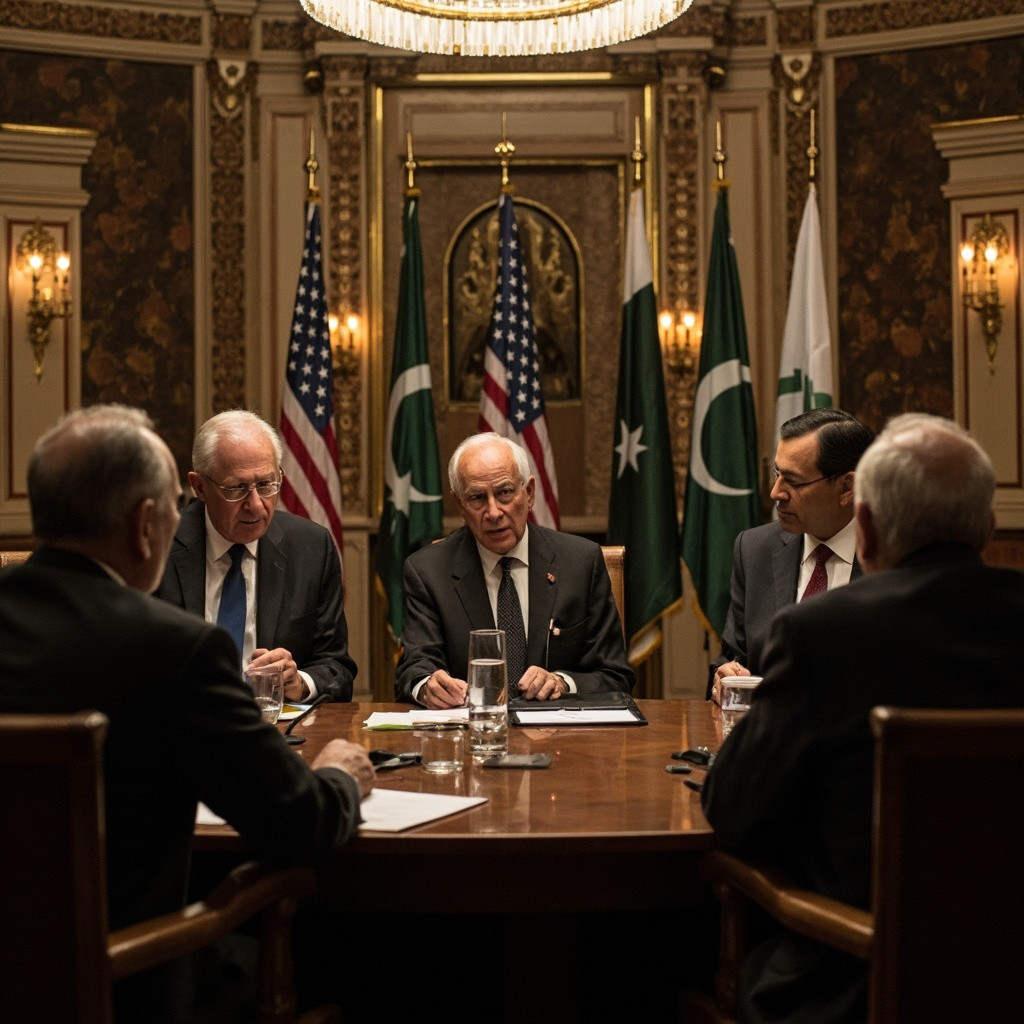
Pakistan will host the foreign ministers of Saudi Arabia, Turkey, and Egypt in Islamabad beginning Sunday, March 29, for two days of talks on the Iran war. Deputy Prime Minister and Foreign Minister Ishaq Dar will chair the quadrilateral session. The meeting is the first multilateral diplomatic effort since the war began that does not include the United States or Israel at the table. [1] [2]
The structure of the talks is the story. Four Muslim-majority nations convening to discuss a war between the United States, Israel, and Iran -- without the belligerents present -- is either the beginning of an independent diplomatic track or an exercise in collective frustration. Reuters reported that Pakistan is "positioning itself as a potential venue for US-Iran mediation," a framing that assumes the four nations are building a bridge to American participation. The composition of the room suggests something different: a calculation that American participation is the problem, not the solution. [1] [3]
Pakistan's diplomatic rationale is geographic and sectarian. Islamabad shares a 959-kilometer border with Iran. Pakistan's population of 230 million is roughly 15 percent Shia Muslim. The war has already produced protests in Karachi and Lahore, and the government faces domestic pressure from both Shia communities who oppose the war and Sunni hardliners who view the conflict through a different lens. Prime Minister Shehbaz Sharif called Iranian President Masoud Pezeshkian before the meeting was announced. Government sources told Reuters the call was "detailed." [1] [4]
Saudi Arabia's presence carries the most weight. Riyadh has spent the past decade building a normalization track with Iran -- the 2023 China-brokered detente, the exchange of ambassadors in 2024, the careful distance maintained from American military operations since March 1. The Saudis have allowed American forces to operate from Prince Sultan Air Base, which was struck by Iranian missiles on Thursday, injuring American servicemembers. The Saudi position is untenable: hosting American forces that are fighting a war Riyadh did not authorize, while absorbing Iranian retaliation for that hosting. The Islamabad meeting is Riyadh's attempt to find a diplomatic exit from a military trap. [5]
Turkey brings NATO membership and Erdogan's long-standing claim to be a mediator between the West and the Islamic world. Egypt brings the Suez Canal, through which the economic consequences of the war flow in both directions. Neither country has taken a military position in the conflict. Both have economic exposure -- Turkey through energy imports that traverse the Gulf, Egypt through canal revenues that decline when shipping reroutes around the Cape of Good Hope.
The American absence is conspicuous. The State Department has not commented on the Islamabad meeting. Secretary Rubio, who declared last week that American military action in Iran would be "completed in weeks," has not acknowledged the parallel diplomatic track. The administration's posture toward the talks appears to be the same posture it adopted toward the No Kings protests: deliberate non-engagement. The quadrilateral meeting exists. Washington does not think about it at all.
The diplomatic substance of the talks is unclear. Al Jazeera reported that the foreign ministers will discuss "a framework for de-escalation and humanitarian corridors." Asharq Al-Awsat cited Pakistani sources describing "in-depth discussions on a range of issues, including the ongoing conflict." The vagueness may be diplomatic caution or may reflect the fundamental limitation of the format: four nations without military leverage discussing a war they cannot stop. [2] [6]
The timing is not accidental. Israel struck the Arak heavy-water plant and the Yazd yellowcake facility on Friday. The Houthis launched missiles at Israel on Saturday. Iran declared that future retaliation "will no longer be proportional." The four foreign ministers are arriving in Islamabad on the most dangerous weekend of the war to date. The urgency of the meeting reflects the pace of escalation that the American-led bilateral track has failed to contain. [6]
The meeting's significance may be less in what it produces than in what it represents. For one month, the diplomatic track has been bilateral -- Washington and Tehran, with no mediator and no framework. That track has produced one Iranian counter-proposal (unanswered), two deadline extensions (unenforced), and zero direct talks. The Islamabad quadrilateral introduces a new variable: a diplomatic process that the United States does not control. Whether it produces results or merely communiques, the fact that it exists at all is a judgment on the American-led approach. Four nations concluded that waiting for Washington was no longer a viable strategy.
The precedent is the 2023 China-brokered Saudi-Iranian detente, which produced a diplomatic normalization that the United States had been unable to achieve for decades. That deal was built on the premise that regional powers, not external ones, are better positioned to manage Middle Eastern conflicts. The Islamabad meeting operates on the same premise. The difference is scale: Saudi-Iran normalization was a bilateral confidence-building exercise. The current war involves active combat operations, missile strikes on nuclear facilities, and a humanitarian crisis that stretches from the Gulf to East Africa. Confidence-building requires a baseline of confidence. The baseline does not exist.
-- PRIYA SHARMA, Delhi