TL;DR
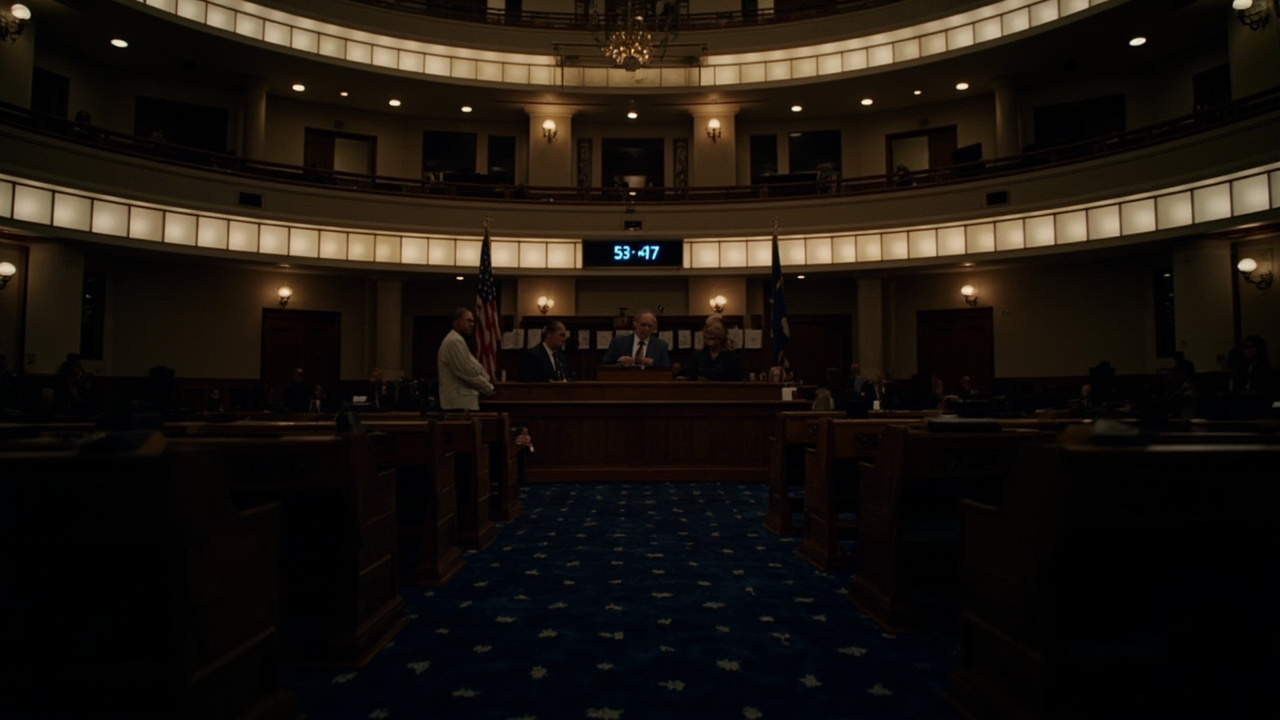
The Senate voted 53-47 to reject war powers constraints for a third time as 6,000-8,000 troops deploy without congressional authorization.
MSM Perspective
Stars and Stripes reports the third failed war powers vote while Time profiles Rand Paul as the lone Republican willing to defy his party on the war.
X Perspective
Constitutional conservatives on X split between backing Trump's commander-in-chief authority and agreeing with Rand Paul that Article I means what it says.
The Senate voted 53-47 on Tuesday to kill a resolution that would have directed the removal of U.S. armed forces from hostilities against Iran not authorized by Congress [1]. It was the third time since the war began that the chamber has rejected war powers constraints. Sen. Chris Murphy of Connecticut, who forced the vote, promised it would not be the last. "If our Republican colleagues will not do their duty," Murphy said, "then we will force a debate and a vote on this floor" [1].
One Republican voted yes: Rand Paul of Kentucky. One Democrat voted no: John Fetterman of Pennsylvania. The remaining lines held. This is now the pattern — a near-party-line wall protecting the executive's authority to wage a war that is entering its fifth week with no congressional authorization, no defined endgame, and no supplemental funding.
The resolution would have required withdrawal from hostilities "within or against the Islamic Republic of Iran that have not been authorized by Congress" [2]. It did not question whether the war should be fought. It asked whether the Constitution required someone other than the president to say so. Fifty-three senators answered that it did not. The arithmetic has not moved since Tim Kaine forced the first resolution and Cory Booker the second [1]. Same margin. Same lone defector.
The One Republican
Paul's case is the simplest one being made in Washington, which may be why almost nobody in his party wants to hear it. "Only Congress can declare war," he said on the Senate floor. "That's not my opinion. That's Article I of the Constitution" [2]. Then the line that landed harder than any legal citation: "Congressional leadership, resigned to their own irrelevance, will gladly hand the president the power to initiate war in exchange for plausible deniability" [2].
Trump made his displeasure clear before the vote, posting a message aimed at Paul and Rep. Thomas Massie: "Vote for us, and don't call me great. I'd rather have the vote, than the statement." Then the threat: "We have people that don't stick together, and those people, hopefully, will someday be gone" [2].
Paul voted against his president anyway. No other Republican did.
Fetterman's no was the mirror image. "I think it is very effective and I do think it's moving towards the kind of appropriate outcome," he told reporters [2]. Ideological rather than procedural — Fetterman believes the war is working. The other 46 Democrats who voted yes believe, or at least say, that whether it is working is beside the constitutional point.
The House Track
The House produced something slightly different. Rep. Josh Gottheimer introduced a resolution requiring authorization within 30 days and explicitly barring ground troops [1]. It has not been scheduled for a vote. Between 6,000 and 8,000 troops are already assembling in the Persian Gulf — 82nd Airborne paratroopers, Marine Expeditionary Units, support elements — all deployed under Article II authority without a floor vote in either chamber. The Gottheimer resolution would draw a line the deployment has already crossed.
The Money
Paul raised a second argument that may age better than his constitutional one. The war has cost at least $12 billion. Hegseth confirmed the Pentagon has asked the White House to approve a $200 billion funding request. The national debt passed $39 trillion last week [2].
"I'm not for adding more debt. I think adding more makes us less safe" [2]. The $200 billion has not been formally submitted. When it is, the same Senate that refuses to authorize the war will be asked to appropriate the money to pay for it. The chamber will not vote to say the war is legal, but it will vote to write the check.
The Oversight Void
Murphy and several Democratic colleagues are demanding that Hegseth and Secretary of State Marco Rubio appear before the Senate for public oversight hearings [1]. Neither has testified in open session since the conflict began. Sen. Jim Risch of Idaho, the Republican chair of the Senate Foreign Relations Committee, responded by ignoring the demand: "Every American should stand behind our fighting men and women... stop this" [1].
Sen. Tammy Duckworth, the Illinois Democrat and Iraq War veteran who lost both legs in combat, was less interested in rallying cries: "They need to explain their case, respecting the American people enough to tell them why they're being forced to take on the cost of this conflict" [1].
The same day, the Senate unanimously honored six service members killed in a refueling plane crash in Iraq [1]. The vote was 100-0. The chamber that cannot agree on whether the war is constitutional had no difficulty agreeing that the dead deserve recognition.
The Constitutional Machinery
Three votes. Three defeats. Same margin. Same lone Republican. Same lone Democrat. Murphy says he will force a fourth. Paul says Article I means what it says. Fetterman says the war is working. Risch says support the troops. Duckworth says explain the war. Trump says fall in line or be gone.
Between the Persian Gulf and the floor of the Senate, 6,000 to 8,000 American troops are taking positions in a war zone that their elected representatives have neither authorized nor debated in public session. The machinery of democratic accountability is not broken. It is functioning exactly as a majority designed it to function — which is to say, not at all.
-- SAMUEL CRANE, Washington
Sources & X Posts
News Sources