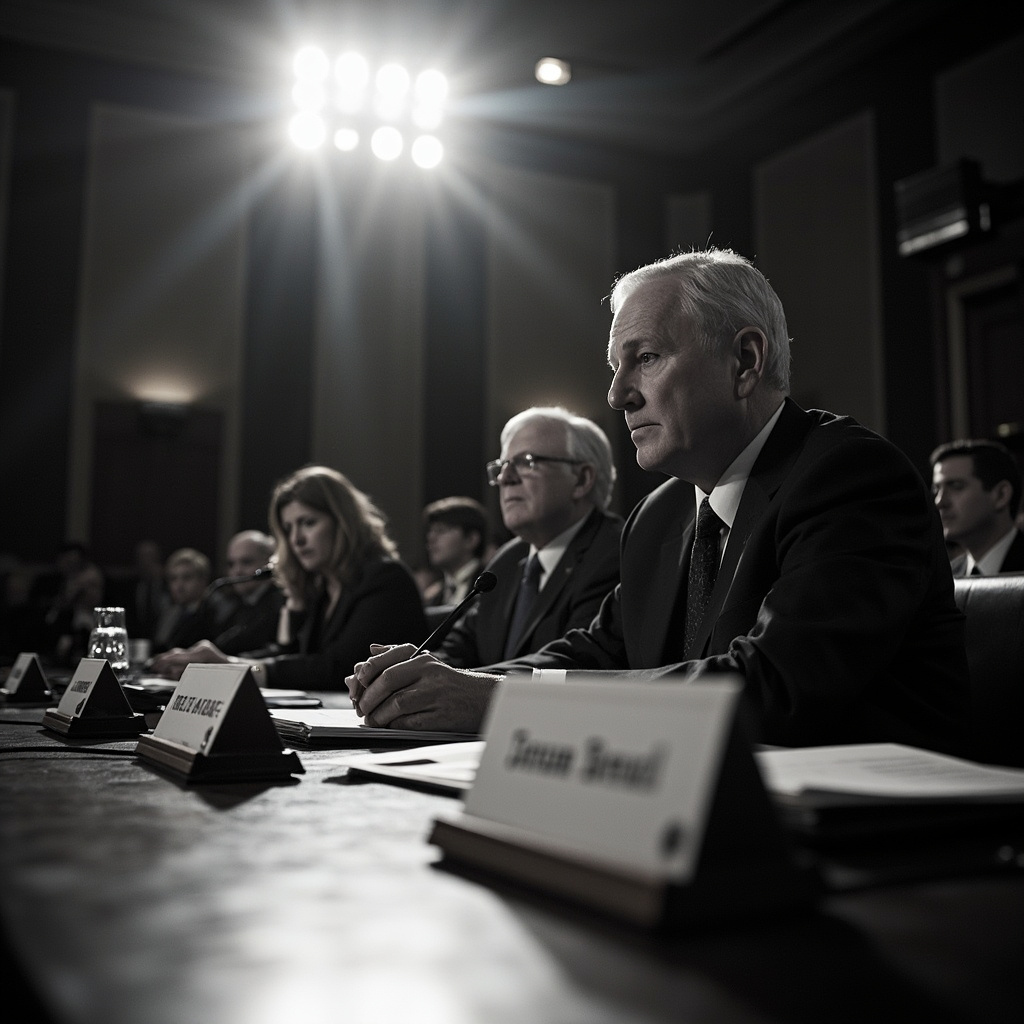
Three weeks into the war, the administration is still telling the country one story. Its own witnesses are now telling several.
Tulsi Gabbard told senators this week that only the president can determine what counts as an imminent threat. [1] CNN, meanwhile, reported that sources familiar with Israel's strike on South Pars contradicted Trump's claim that the United States knew nothing about it in advance. [2]
That is not one clean wartime narrative. That is a pile of overlapping claims, each narrowing the room around the last one.
Yesterday, this paper wrote about Joe Kent's resignation and the way it turned insider dissent into a public force. Today the important change is larger. The credibility problem no longer belongs only to a departed official or to hostile commentators on X. It now belongs to the administration's own public testimony.
The Question Gabbard Would Not Answer
The most damaging exchange from the Senate hearing was not dramatic. It was flat.
Asked whether the intelligence community assessed that Iran posed an imminent nuclear threat, Gabbard would not say yes. She answered that the president is the one who determines what is and is not imminent. [1] That formulation may protect the chain of command. It does not help the public understand whether the intelligence case matched the rhetoric that sold the war.
ABC's account of the hearing also underscored another problem: Gabbard said Iran had made "no efforts" to rebuild its enrichment program after prior strikes. [1] The regime, she said, appears intact though degraded. That is a long way from the public language of urgent, closing windows.
The gap matters because the administration did not sell this war as a gamble, or as an act of strategic punishment, or as a choice made under uncertainty. It sold it as a response to a threat that could not wait.
What Imminent Means When Nobody Defines It
The word doing all the work here has a legal history, which is why its evasion matters. The accepted standard for preemptive force descends from an 1837 incident on the Niagara frontier, when Secretary of State Daniel Webster justified British action against a rebel vessel by insisting that self-defense requires a necessity "instant, overwhelming, leaving no choice of means, and no moment for deliberation." The UN Charter's Article 51 narrows it further: an armed attack, or something very close to one. By that inheritance, imminence is a claim about clocks — about how little time remained. Gabbard declined to say what the intelligence showed about time. [1] Her formulation may protect the chain of command. It cannot protect the argument, because an imminent-threat war whose own intelligence chief will not date the threat is a war being justified after the fact by the word itself.
The 2002 Bush doctrine tried to solve this problem by declaring that America would not wait for threats to fully form. That standard was controversial then and abandoned in practice afterward. This administration has revived neither the old standard nor the new one. It has simply used the adjective.
One War, Two Sets of Aims
The unanswered question may prove even more consequential over time. If U.S. and Israeli war aims are not the same, then every escalation now has two questions attached to it: who wanted it, and who is now owning it? [2]
That distinction was easy to avoid when the story was air sorties, casualty counts, and military maps. It becomes much harder to avoid once energy infrastructure, Gulf allies, and global shipping lanes are in play. South Pars is the standing example. The field Israel struck is the largest natural gas accumulation on earth, and its western half sits under Qatari waters as the North Field — the reservoir that feeds Ras Laffan and, through it, roughly a fifth of the world's tradable LNG. A miscalculated strike there does not stay an Iranian problem. It becomes a Gulf problem, a European heating bill, and a crisis inside every alliance structure Washington claims to be defending. [2]
Trump has tried to keep political distance from at least one key escalation by saying Washington did not know in advance about the South Pars strike. CNN reported that sources familiar with the attack dispute that claim and say the United States was aware of it or coordinated around it. [2]
Ignorance was always a fragile defense. The Gulf is one of the most heavily surveilled airspaces on the planet; American radar coverage, satellite passes, and liaison channels with every Gulf air defense mean that large strike packages do not move through the region invisibly. Claiming not to have known asks the public to believe the surveillance state slept. If that account holds, the problem is not merely that the war is expanding. The problem is that the public explanation keeps changing shape after the fact.
The Witnesses Keep Multiplying
Kent still matters here, even after his resignation stopped being the newest fact in the story. He matters because his complaint now looks less like a lonely ideological revolt and more like the first visible crack in a structure that keeps taking on water.
Note, too, what has and has not happened to the substance of his charge. The lobby question he named was supposed to end careers; instead it sits inside the week's public record next to an intelligence chief who would not certify imminence. Suppression of the argument failed, so the argument migrated into testimony. That migration — from fired-official grievance to sworn-question mark — is the actual escalation of this story, and it cannot be undone by a stronger news cycle.
This newspaper's March 19 lead story was about a war entering its third week with no exit plan. The March 20 story is sharper. A war can drift without an exit plan for a while. It cannot keep adding contradictions forever without changing the public argument around it.
The pattern of witnesses undoing a sold war is old enough to have a literature. In August 1964, the Gulf of Tonkin resolution moved through Congress in days on an account of attacks that internal reviews later showed was garbled at best; the truth surfaced years after the commitment had compound interest. The Iraq case ran faster: aluminum tubes and mobile bioweapons laboratories collapsed under inspection within eighteen months of the invasion, long before the occupation's costs were tallied. The lesson of both episodes is not that every wartime claim fails. It is that witness cracks matter most in the weeks when commitments are still being made, because each week adds forces, contracts, casualties, and prestige to one side of the ledger. Three weeks into this war, the cracks are already public testimony rather than leaked memos. That is either healthier or more alarming. It is certainly earlier.
The administration still has military power, rhetorical force, and a coalition of hawks willing to defend the campaign. What it increasingly lacks is narrative discipline. The more witnesses speak, the harder that gets to hide.
The war's defenders are left with a thin fallback position: maybe the facts are messy, maybe the testimony is partial, maybe the public cannot see the whole picture, but the president had to act. That is not nothing. It is also not the same thing as the clear imminent-threat case Americans were told they were getting. A war sold on urgency can survive many things; it cannot indefinitely survive its own witnesses declining to date the emergency.
And once a wartime story starts fighting its own witnesses, the next round of facts rarely arrives in a friendlier mood.
-- SAMUEL CRANE, Washington