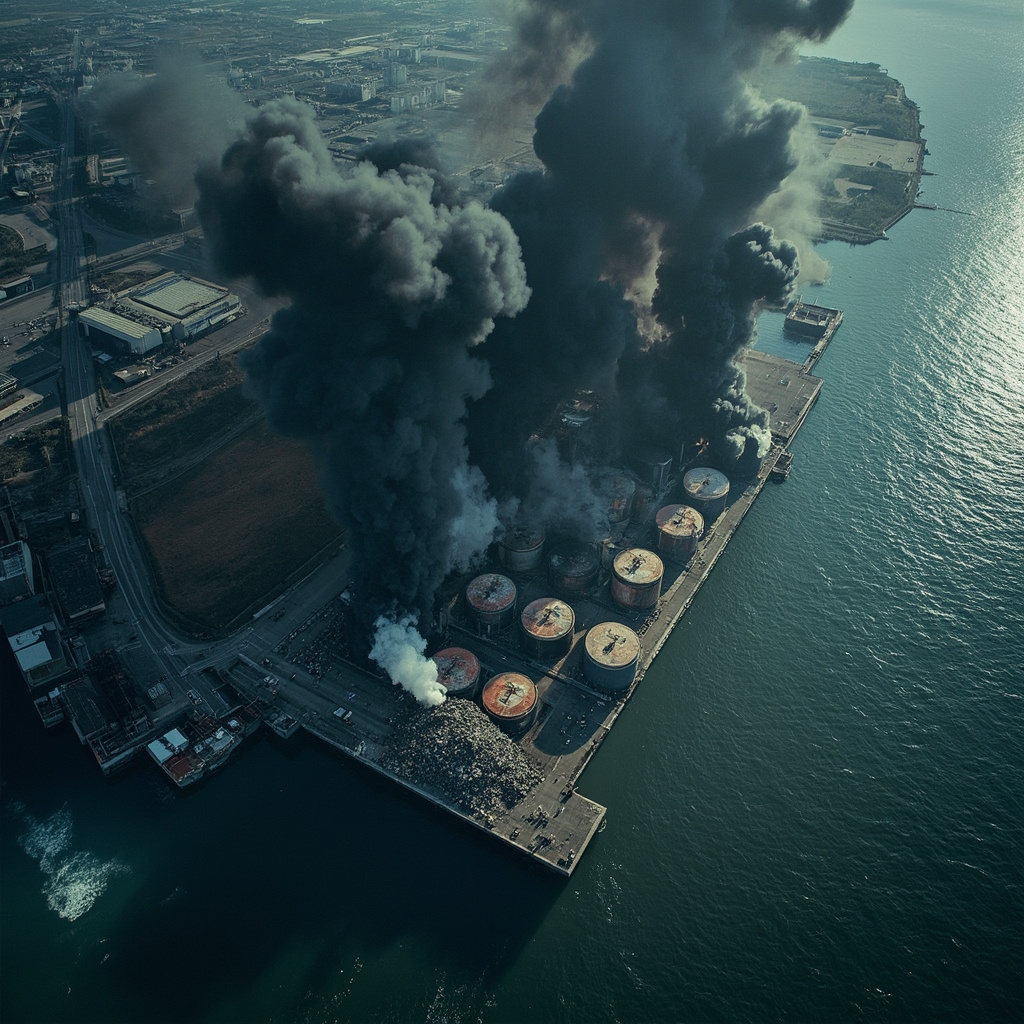
Dozens of Ukrainian long-range drones struck Primorsk overnight on March 22-23, setting fuel storage tanks ablaze at Russia's largest oil export terminal on the Baltic Sea and forcing the port to suspend crude oil loading operations [1][2]. Satellite imagery published by Planet Labs showed dense black smoke rising from multiple tank farm locations at the Transneft-operated facility, which in peacetime handles roughly 1.2 million barrels per day — approximately a quarter of Russia's total crude exports [3].
The Leningrad Oblast governor, Alexander Drozdenko, acknowledged the attack but claimed only one fuel tank was hit. Ukrainian officials contradicted this. Major General Serhii Bratchuk of Ukraine's Security Service briefed reporters that the strike was part of a broader overnight campaign involving 249 drones targeting Russian energy and military infrastructure across multiple oblasts [4][5].
Primorsk is not an obscure target. It is the terminus of the Baltic Pipeline System, the conduit through which Russian crude reaches European and Asian buyers who have not — despite sanctions — stopped purchasing it. The port's closure, even temporarily, disrupts the logistical chain that funds Russia's war. Ukraine has spent months methodically attacking Russian oil refineries and fuel depots, but Primorsk represents a qualitative escalation: this is the first confirmed strike on a major export terminal, as opposed to domestic processing facilities [2][6].
The attack came as part of a broader wave. In the same overnight campaign, Ukrainian drones hit the Bashneft-Ufaneftekhim refinery in Ufa, located approximately 1,400 kilometers from the Ukrainian border — a distance that demonstrates the increasing range of Ukraine's indigenous drone fleet [4]. The Kyiv Independent reported that Ukrainian forces also struck military targets in Bryansk, Kursk, and Belgorod oblasts, in what appears to be a coordinated attempt to overwhelm Russian air defenses across a wide geographic arc [5].
Russia's Baltic energy infrastructure had already been under pressure. The nearby port of Ust-Luga, which handles liquefied natural gas and fuel oil exports, had itself been hit by Ukrainian drones earlier this month. Reuters reported Monday that Ust-Luga has restarted exports, but Primorsk remains shut [1]. The combined disruption to Russia's two largest Baltic terminals, even if brief, sends a clear signal about Ukraine's ability to threaten the revenue stream that sustains the war.
The energy strikes come at a moment when Russia's military is simultaneously attempting to accelerate on the ground. The Institute for the Study of War (ISW) assessed on March 20 that Russian forces are conducting mechanized assaults that "may be part of preparation for a Spring-Summer 2026 offensive" [7]. On March 19, Ukraine's 3rd Army Corps reported stopping what it called Russia's "biggest mechanized push" on the Lyman-Borova axis in Donetsk Oblast — an assault involving over 500 Russian troops, armored vehicles, and more than 100 motorcycles and buggies along seven simultaneous attack prongs [8].
The 3rd Army Corps spokesperson, Oleksandr Borodin, said Ukrainian forces destroyed multiple armored vehicles and inflicted significant casualties, but noted that Russian forces are adapting — dispersing vehicles across wider frontages and switching from concentrated columns to simultaneous probes designed to find gaps in defensive lines [7][8].
The parallel campaigns — energy infrastructure in Russia's rear and mechanized assaults along the front — define the war's current phase. Ukraine cannot match Russia's manpower on the ground. Russia cannot stop Ukraine's drones from reaching targets 1,400 kilometers behind the lines. Both sides are fighting wars of attrition tailored to their respective strengths.
The Iran-US war has, from Ukraine's perspective, been a perverse gift. Western attention has fractured. The diplomatic bandwidth that might otherwise be devoted to ceasefire negotiations — already negligible — has evaporated entirely. Polymarket's ceasefire probability for Ukraine sits at roughly one percent [9]. Russia, meanwhile, has benefited from rising oil prices driven by the Hormuz crisis, even as Ukraine burns the infrastructure through which that oil reaches market.
Primorsk will be repaired. Fuel tanks can be rebuilt. But the strategic reality the strike reveals is not temporary: Ukraine has demonstrated the capability to shut down Russia's most important export hub, and it did so with weapons that cost a fraction of what the infrastructure they destroyed is worth. The economics of drone warfare continue to favor the attacker in a way that no Russian air defense procurement can fully offset.
The fires at Primorsk were still burning on Monday afternoon. The oil was not loading. The war was not ending.
-- KATYA VOLKOV, Moscow