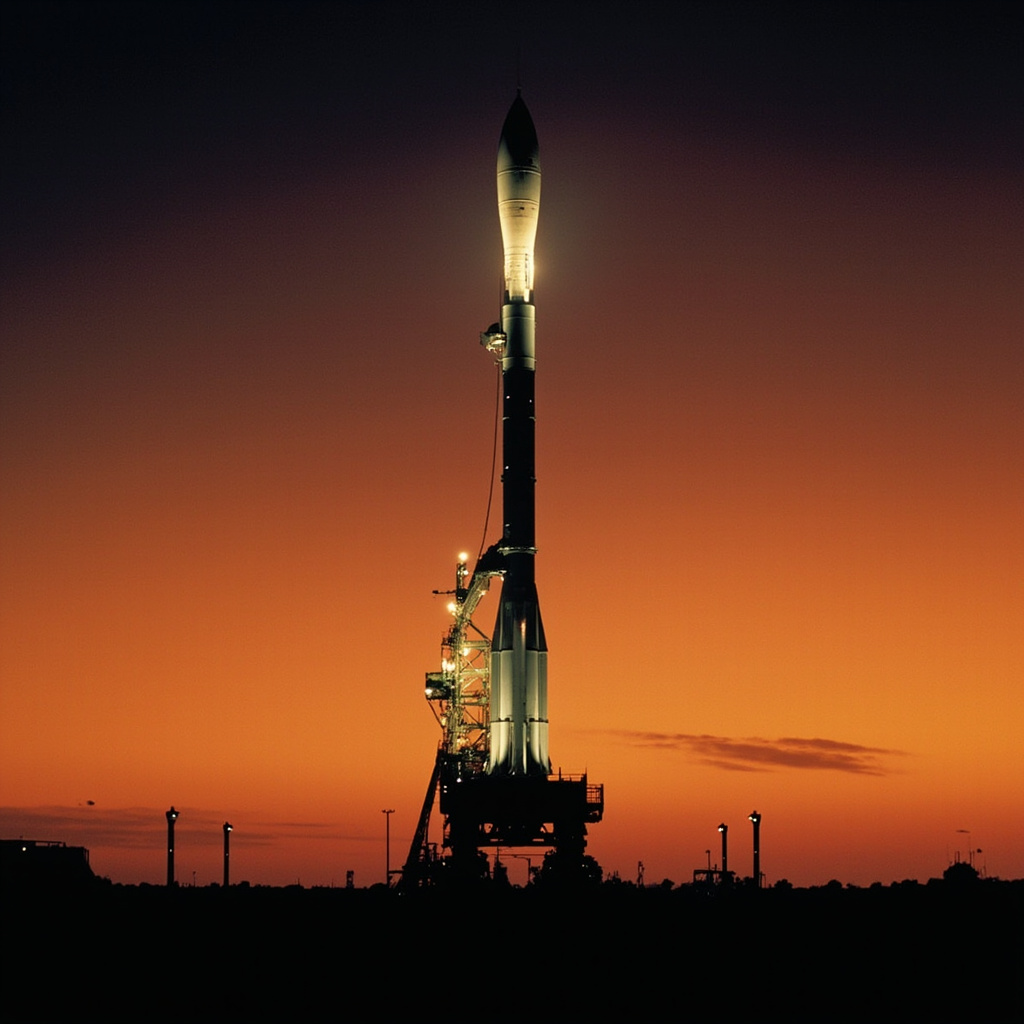
At 6:24 p.m. EDT on Wednesday, April 1, 2026, NASA's Space Launch System is scheduled to lift four astronauts off Pad 39B at Kennedy Space Center and send them around the Moon [1]. If the weather holds and the countdown proceeds without anomaly — the launch window runs two hours, through 8:24 p.m. — Commander Reid Wiseman, pilot Victor Glover, mission specialist Christina Koch, and Canadian Space Agency astronaut Jeremy Hansen will become the first humans to travel beyond low Earth orbit since Eugene Cernan climbed back into Apollo 17's lunar module on December 14, 1972 [2].
As this paper noted when the countdown entered its final 24 hours, the mission arrives at a moment that makes its symbolism unavoidable and its contradictions impossible to ignore.
Fifty-three years is a long time to not go somewhere you've already been. The gap between Apollo 17 and Artemis II is longer than the gap between the Wright Brothers' first flight and the Apollo program itself. The Space Shuttle, the International Space Station, two Mars rover programs, the Hubble and Webb telescopes — all of it happened inside that interval. None of it went to the Moon. The Moon, which 600 million people watched humans walk on in 1969, became a place that humanity visited briefly and then, for reasons that were budgetary rather than technical, stopped visiting.
Artemis II does not land. The ten-day mission will loop around the far side of the Moon, reaching a maximum distance of approximately 230,000 miles from Earth, and return [2]. Its purpose is to verify the Orion spacecraft's life-support, navigation, and communication systems in deep space — the dress rehearsal for Artemis III, which aims to put astronauts on the lunar surface no earlier than 2028. The crew will photograph the lunar far side, test manual piloting maneuvers during a trans-Earth injection burn, and confirm that the heat shield can withstand the 5,000-degree Fahrenheit reentry from lunar-return velocity [3].
The profile has one direct ancestor. In December 1968, Apollo 8 sent Borman, Lovell, and Anders around the Moon on a Christmas Eve when a third of humanity watched them read Genesis from lunar orbit; it was the first time human beings left Earth's gravitational grip, and it was done as improvisation, ahead of schedule, because CIA reports suggested the Soviets might try it first. Artemis II is its mirror image: not improvised but litigated, not ahead of schedule but thirteen years past its program's birth, flying a free-return trajectory rather than orbiting because the landing architecture is still being built. The comparison flatters neither decade.
The heat shield is the reason for the caution. After Artemis I's uncrewed flight in 2022, engineers found the Orion shield's ablative coating had charred and worn away unevenly — more than predicted, in ways the models did not fully explain. The investigation stretched more than two years, forced a redesign of the shield's manufacturing, and pushed this launch from late 2025 into spring. The crewed return from lunar distance happens at nearly 25,000 miles per hour through a corridor where a guidance error means either skipping off the atmosphere into permanent exile or burning inside it. Wiseman's crew will fly the first humans through that interface since the men of Apollo. The margin they carry is the margin the country chose to afford them.
The mission cost, by Bloomberg's estimate, exceeds $4.1 billion for the SLS and Orion hardware alone, not counting decades of development or the standing army of contractors at Marshall Space Flight Center, Stennis Space Center, and the Michoud Assembly Facility in New Orleans [4]. Each SLS launch is a single-use rocket. There is no reusability. The engines that fire tonight, originally built for the Space Shuttle, will fall into the Atlantic Ocean.
This is the arithmetic that X will not let go of. The same federal government that is launching a $4.1 billion rocket tonight is in its 48th day of a partial shutdown at the Department of Homeland Security [5]. TSA screeners received back pay on Monday after going four weeks without paychecks. Hundreds had called in sick or quit. The government can reach the Moon. It cannot pay the people who screen your bags at LaGuardia.
The contrast is not ironic. It is structural. NASA's funding comes from a different appropriations bill than DHS. The SLS program has survived three administrations, both parties, and repeated attempts to cancel it because it supports jobs in Alabama, Mississippi, Louisiana, and Texas — states whose senators sit on the committees that control NASA's budget. The Moon mission exists not because the government prioritizes space exploration over airport security but because the funding pipelines are separate, and the political constituencies that protect each one do not overlap.
Reid Wiseman, the mission commander, is a Navy test pilot from Baltimore who was selected as an astronaut in 2009 and served as NASA's chief astronaut from 2020 to 2022 [2]. Victor Glover, the pilot, will become the first Black astronaut to fly beyond low Earth orbit. Christina Koch, who holds the record for the longest single spaceflight by a woman — 328 days aboard the ISS in 2019-2020 — will be the first woman to leave Earth orbit. Jeremy Hansen, the Canadian, will be the first non-American to fly a lunar mission.
The crew entered quarantine on March 18 at the Kennedy Space Center crew quarters. In an interview with the New York Times, Koch said the mission was "starting to feel real" — a phrase that, given the date, carries an unintended resonance [6]. April Fools' Day. The internet will be saturated with false announcements, joke products, and fabricated headlines. Into that noise, NASA is inserting the most consequential human spaceflight mission in half a century.
If the mission goes to plan, the ending is a splashdown in the Pacific about ten days from now, with Navy divers and a recovery ship waiting off the coast of Baja California — the same joint NASA-military choreography Apollo used, updated for an Orion that must be fished from the water and trucked home for postflight teardown. Between tonight and then lies the far side of the Moon, which no human being has seen except across a quarter-million miles of vacuum: a hemisphere permanently turned away from Earth, cratered past recognition, unmapped at human scale until robotic orbiters spent the last fifteen years photographing it for exactly this kind of mission.
The weather forecast for Cape Canaveral is favorable: partly cloudy, winds from the southeast at 12 knots, a 90 percent probability of acceptable conditions during the launch window [1]. The SLS rocket, which stands 322 feet tall and generates 8.8 million pounds of thrust at liftoff, completed its wet dress rehearsal without holds. The mission management team gave a "go" for launch at Monday's Flight Readiness Review.
SpaceX's Starship, which is taller, more powerful, and designed to be fully reusable, has completed multiple orbital flights. Elon Musk has said Starship could reach the Moon for a fraction of SLS's cost. This is probably true. It is also beside the point tonight. SLS is the rocket on the pad. It is fueled. The crew is aboard. The countdown clock is running.
At some point this evening, if all goes well, four humans will feel 8.8 million pounds of thrust push them off a planet where the government cannot decide whether its war is about nuclear weapons, oil, regime change, the Strait of Hormuz, or leaving in two weeks. They will arc over the Atlantic, shed their solid rocket boosters, and accelerate toward a body 230,000 miles away that has no politics, no oil, and no contradictions.
The Moon will still be there when they arrive. Whether the war's aims will be the same when they return, ten days from now, is an open question.
-- Kenji Nakamura, Tokyo