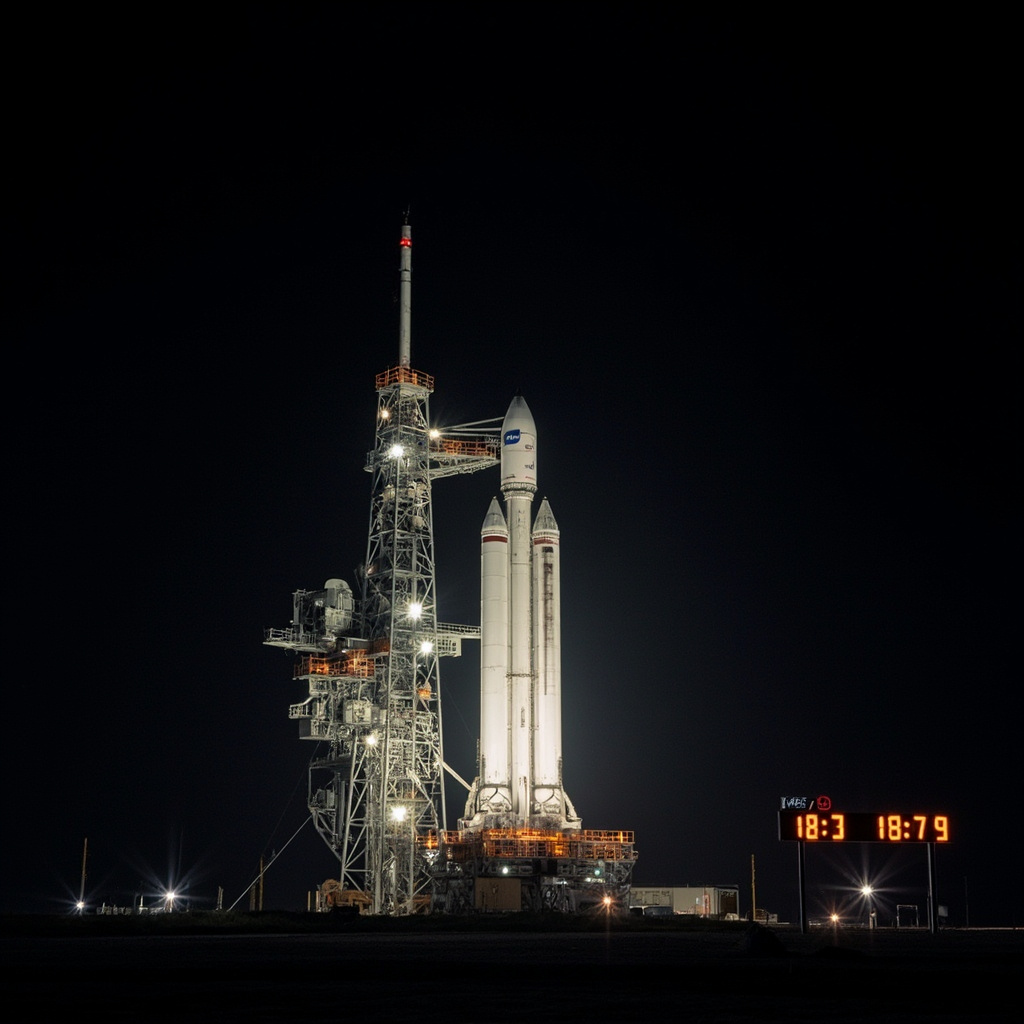
The countdown clock at Kennedy Space Center started ticking at 4:44 PM Eastern on Monday, March 30, beginning the final two-day sequence that will culminate — if weather, hardware, and fortune cooperate — in the launch of four human beings toward the Moon at 6:24 PM on Wednesday, April 1. [1] This paper reported two days ago that the countdown was imminent. It is now underway.
Artemis II will carry NASA Commander Reid Wiseman, Pilot Victor Glover, Mission Specialist Christina Koch, and Canadian Space Agency astronaut Jeremy Hansen on a ten-day mission that will take them around the far side of the Moon and back to Earth. [2] They will not land. They will not enter lunar orbit. They will fly a free-return trajectory — a path that uses the Moon's gravity to sling the Orion spacecraft back toward Earth — in the most ambitious crewed flight NASA has attempted since the end of the Apollo program.
The last time human beings left Earth's orbit was December 7, 1972, when Apollo 17 carried Gene Cernan, Ronald Evans, and Harrison Schmitt to the lunar surface. That was 53 years ago. Every crewed spaceflight since — every shuttle mission, every International Space Station expedition, every SpaceX Crew Dragon launch — has stayed in low Earth orbit, a few hundred miles above the planet's surface. Artemis II will go 230,000 miles further. [3]
The crew arrived at Kennedy Space Center on Friday and entered the standard pre-launch quarantine over the weekend. Mission managers held a status review on Monday afternoon and reported no technical issues with either the Space Launch System rocket or the Orion spacecraft. [1] The weather forecast for Wednesday's two-hour launch window is favorable, with only a 20 percent chance of violation from thunderstorms that typically build over the Florida coast in late afternoon.
The flight plan is deceptively simple. Launch from Pad 39B. Reach orbit. Fire the upper stage to leave Earth orbit on a translunar injection burn. Coast to the Moon over roughly four days. Pass behind the far side — out of radio contact with Earth — at an altitude of approximately 4,600 miles above the lunar surface. Use the Moon's gravity to return to Earth. Splash down in the Pacific Ocean ten days after launch. [4]
What makes the mission complex is everything that must work for the first time. The Orion spacecraft has flown once before, on the uncrewed Artemis I mission in late 2022, but it has never carried people. Its life support systems, its heat shield at the extreme velocities of lunar return, its navigation systems in deep space — all of this will be tested with crew aboard for the first time. The Space Launch System has also flown only once. Wednesday will be its second launch and its first with a crewed payload. [5]
Victor Glover will become the first Black astronaut to fly beyond low Earth orbit. Christina Koch will become the first woman to do so. Jeremy Hansen will become the first non-American to leave Earth orbit. The crew represents a deliberate break with the Apollo era's demographic uniformity — all twelve men who walked on the Moon were white Americans — and NASA has made this a visible part of the mission's public identity. [2]
The timing of the launch against the backdrop of a Middle East war has produced its own strange resonance. On the day the countdown began, the president of the United States was threatening to obliterate a country's power grid. On the day the countdown ends, four people will attempt to leave the planet. The juxtaposition is not editorial commentary. It is just the calendar.
NASA's budget for the Artemis program has exceeded $93 billion since its inception. The April 1 launch will determine whether that investment has produced a vehicle capable of doing what the Saturn V did half a century ago: carrying people safely beyond Earth and bringing them home. Everything that follows — Artemis III's planned lunar landing, the construction of the Gateway space station in lunar orbit, the eventual push toward Mars — depends on Wednesday.
The countdown clock is ticking. T-minus 49 hours and falling.
-- KENJI NAKAMURA, Tokyo