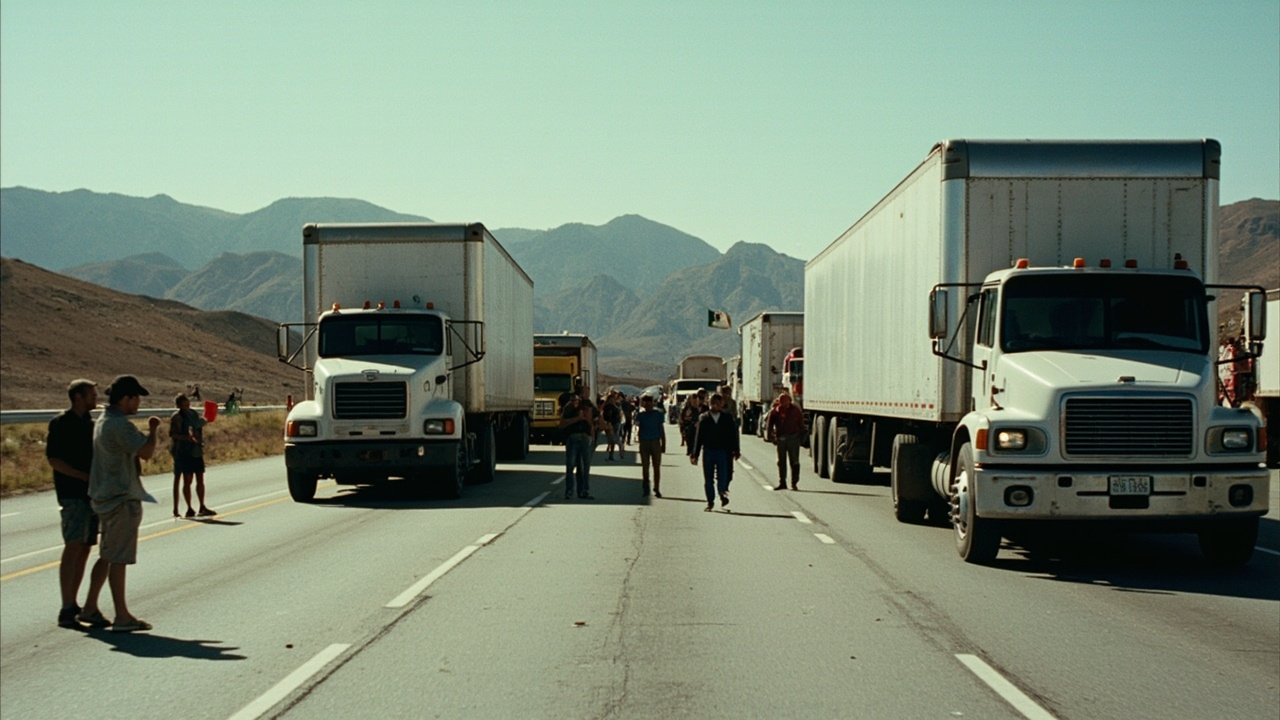
At seven in the morning, the engines stopped. Across twenty Mexican states, members of the National Association of Transporters — ANTAC — and allied farmer groups from the National Front for the Rescue of the Mexican Farmland parked their vehicles across federal highways and waited. They had said they would do it. The government had said it had made concessions sufficient to prevent it. Both things happened anyway.
The demands were three. They have been three since November, when truckers first blocked seven major roadways and the government promised responses that did not arrive in the form promised. Lower diesel prices, calibrated to the global shock being produced by a war in the Persian Gulf that Mexico did not start and cannot end. Permanent National Guard presence on the highway corridors where organized crime extracts payment from drivers in cash, in cargo, occasionally in something worse. And clarity on cross-border trucking terms with the United States — a demand that had been building since the renegotiation of NAFTA's successor and that the Hormuz crisis has sharpened into urgency.
This paper has been tracking the fuel cost cascade since the strait closed. The connection between an Iranian naval commander's decision in the Persian Gulf and the price of diesel at a Pemex station in Guanajuato is not complicated, but it requires someone to say it aloud, and Mexican official communications have been careful not to. The government capped regular gasoline at 24 pesos per litre in a deal with fuel retailers announced last week. The truckers operate on diesel. Diesel was not capped at a level they consider livable.
The government's position before today was that it had offered enough. Claudia Sheinbaum's administration negotiated a reduction in diesel prices through a levy adjustment and pointed to the capped regular petrol as evidence of good faith. ANTAC's leadership looked at what arrived versus what was promised in November and announced that the strike would proceed. "We're going to paralyze everything," one organizer said last week, in a phrase that required no translation.
The blocked highways in this strike are not the same ten corridors from November. The count had grown to twenty states by Monday morning. The routes affected include the Mexico City accesses — the arteries through which perishable goods and manufactured parts flow to and from the capital — and the cross-border corridors north to Tijuana and Laredo that link Mexican industry to the U.S. supply chain.
Sheinbaum's government faces a problem with no domestic solution. The price of diesel is set by the price of oil, which is set by whether the Strait of Hormuz is open, which is set by a war between the United States and Iran. Mexico is a significant oil producer. It is not, at the volumes and grades it currently extracts, insulated from the global price. The Pemex refineries that could theoretically buffer the country from import prices are operating at reduced capacity after years of deferred maintenance. The buffer does not exist.
What the truckers want, in substance, is for the Mexican government to absorb a cost it cannot absorb without fiscal measures the IMF would view skeptically and the ANTAC would not accept as a substitute for lower pump prices. This is the geometry of the crisis: a global shock landing on a national budget with no slack, demanding relief from an industry that cannot function at current costs, in a country whose president campaigned on energy sovereignty and is discovering that sovereignty requires supply.
The highways were blocked at seven. The country is watching to see if they are still blocked by Thursday.