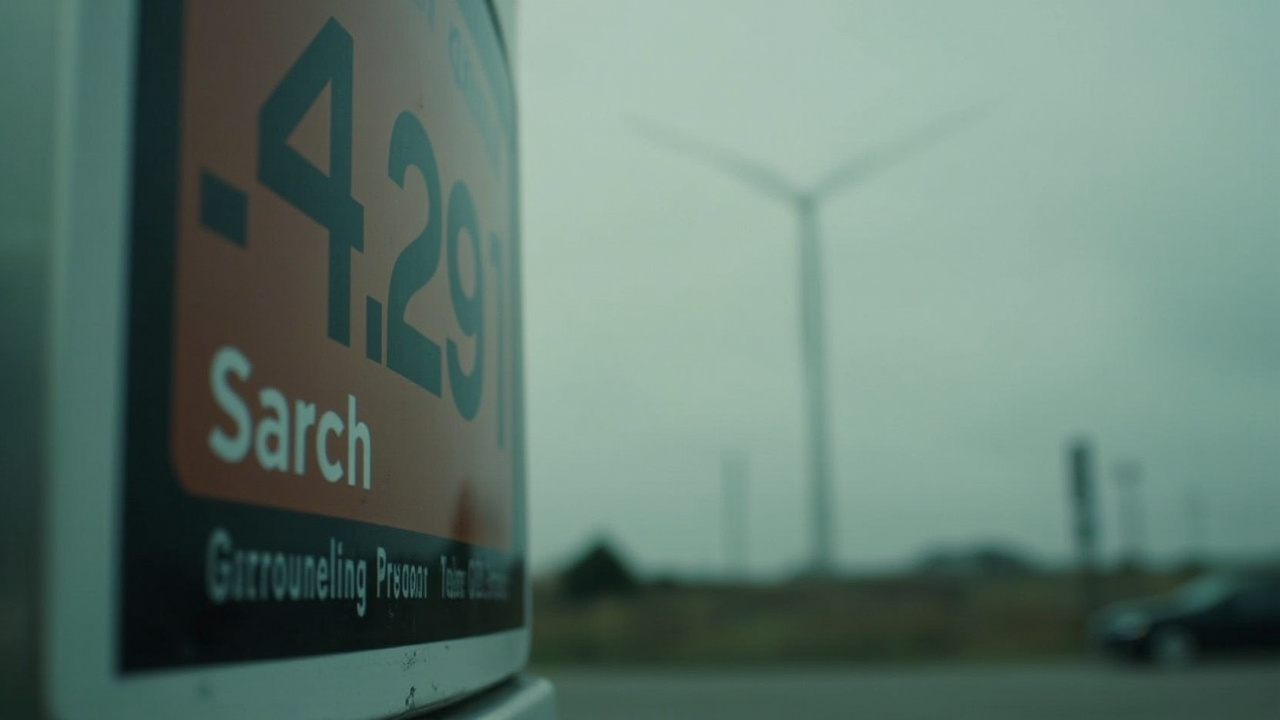
LONDON -- The Pew Research Center surveys on energy tend to arrive at convenient moments. This one arrived at a remarkable one. The American Trends Panel wave that produced Pew's April 3 report on energy attitudes was conducted March 16 through March 22, 2026 — exactly the window during which the Strait of Hormuz had been closed for three weeks, gas prices had crossed four dollars nationally, and Congress was debating emergency energy authorization. [1]
This is not an opinion poll about energy in the abstract. It is a measurement of how war, experienced at the pump, changes what Americans say they believe.
The headline finding is that Americans still favor renewables. Sixty-five percent of U.S. adults say the country should prioritize developing alternative energy sources like wind and solar over expanding fossil fuel production — a number that sounds like stability until you track its trajectory. [2] In 2020, that figure was 79 percent. The 14-point decline over six years maps almost exactly onto the period of gas price volatility, supply chain disruption, and now open warfare in one of the world's most critical oil passages.
Where the Movement Is
The partisan pattern is what researchers will study. Democrats remain overwhelmingly supportive of renewables: 85 percent say the federal government should encourage wind and solar production. [2] But in 2020, that number was 91 percent. A six-point drop among the party of climate action, measured during the first national energy crisis in decades, suggests that even deep ideological commitments are not immune to the price signal.
Republicans have moved more sharply and in the opposite direction. A growing majority within the party favors expanding fossil fuel production, and the survey data reveals the reasoning: 44 percent of Republicans say wind energy costs consumers more than other energy sources, and 43 percent say the same about solar. [2] These perceptions are contested by energy economists, who consistently find that new wind and solar installations now undercut new gas plants on levelized cost. But perceptions, particularly during a crisis, do not wait for peer review.
The cost-perception gap is the live wire in this survey. Republicans who believe renewables are expensive are not simply reading different energy papers. They are living through $4 gas and watching the administration argue that domestic fossil fuel production is the fastest path to lower prices. The war has given that argument its most sympathetic environment in a generation.
What the Timing Reveals
Pew's timing is methodologically valuable precisely because it captures opinion under stress rather than in the relative calm of a normal news cycle. Energy surveys conducted in peacetime, when gas hovers around $3 and the Strait is open, measure abstract preferences. Surveys conducted during Hormuz closures and wartime pricing measure something closer to revealed preference under constraint — the opinions people hold when the cost of those opinions is real and present.
The survey does not show Americans abandoning renewables. It shows the consensus weakening at its edges in both parties. Eighty-three percent of Democrats and Democratic leaners say wind and solar should be a priority — still a commanding majority, down from highs. [1] The question is whether that erosion continues as the war extends and prices remain elevated.
What the survey cannot capture is causation. Do Americans support fossil fuels more because gas is expensive, or because the war has reframed energy as a national security question where speed and reliability matter more than carbon calculus? The distinction matters for policy: if it is price, lower gas costs could restore the pro-renewable consensus. If it is the security frame, the shift may outlast the crisis.
The survey's publication on April 3 — as ceasefire proposals were being drafted and Trump was promising "Power Plant Day" on Tuesday — places its findings in a specific moment that will not repeat. The next Pew wave will be conducted with different prices, a different military situation, and different front pages. Whatever it finds will answer, at least partially, whether March 16-22 was a permanent inflection point or just the view from inside the storm.
-- DARA OSEI, London